
Your cart is currently empty!

My e-Canada Word On The Street Investigative News Exposé: The Right Honourable Mark Carney
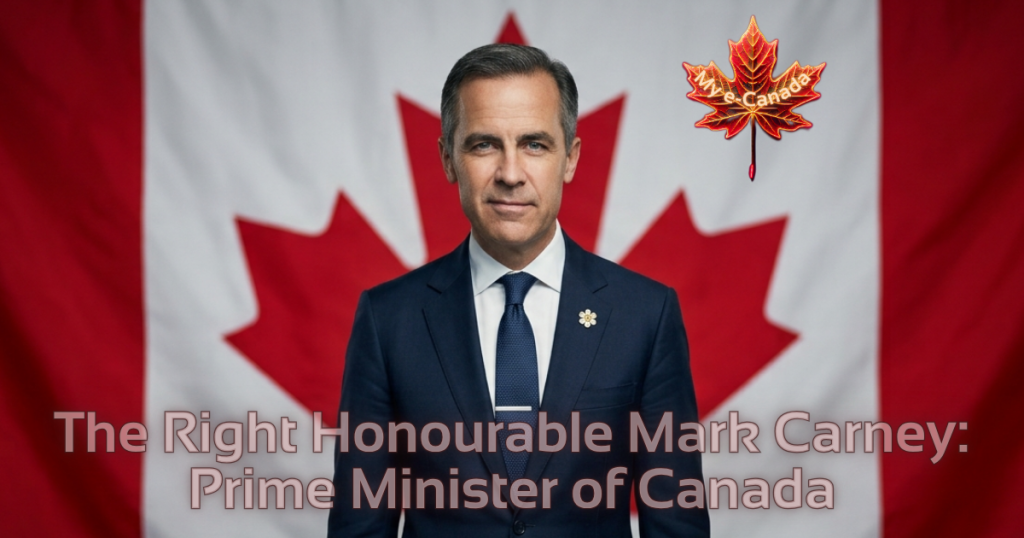
Thursday, July 16, 2026, My e-Canada Word On The Street Edition No. 25 Investigative News Exposé explores The Right Honourable Mark Carney: Prime Minister of Canada.
My e-Canada Word On The Street:
Digitally Yours To Explore
The Right Honourable Mark Carney: From Global Finance to Parliament Hill
The Unprecedented Political Transition of a Financial Technocrat
The rapid political ascension of The Right Honourable Mark Carney has completely reshaped the landscape of Canadian federal politics. Observers of Canadian public affairs have watched his historic transition with intense interest. He successfully moved from the quiet boardrooms of international central banks to the loudest political arena in the country. This journey reached its initial peak when he entered active federal politics in early 2025. He quickly won the leadership of the Liberal Party of Canada.
He was sworn in as the twenty-fourth Prime Minister of Canada on March 14, 2025. Shortly after taking office, he needed to secure a democratic mandate from the Canadian electorate. He chose to run in the federal election held in April 2025. He secured his seat in the House of Commons by winning the Ontario riding of Nepean. This victory officially transformed him from an appointed technocrat into an elected Member of Parliament.
His journey represents a unique experiment in modern Canadian political history. For decades, the nation chose career politicians to lead major political parties. The selection of The Right Honourable Mark Carney broke this long-standing tradition. He brings a reputation of cold, analytical competence to the Office of the Prime Minister. Supporters view his financial background as an asset during times of economic uncertainty. Critics argue that his decades spent in global banking detach him from the daily struggles of average Canadians.
This investigative exposé looks closely at the man now leading the nation. We examine his policies, his personal history, and his grand vision for the future of Canada. The country is watching how this financial expert handles the complex realities of democratic leadership. His administration represents a major shift in how the federal government operates in Ottawa.
Early Days in the Great Northwest
Parentage and Family Roots Formed in the Canadian Wilderness
To understand the character of The Right Honourable Mark Carney, one must look at his deep family origins. His story begins in Fort Smith, Northwest Territories, where he was born on March 16, 1965. His mother, Verlie Margaret Carney, was originally from Britannia Beach, British Columbia. His father, Robert J. Carney, was a dedicated educator. Robert worked as a high school principal in the north. He later became a Professor of Educational Foundations at the University of Alberta.
His parents built their lives around the noble profession of teaching. This academic environment shaped his early focus on education and analytical thinking. The family eventually relocated from the subarctic north to the growing city of Edmonton, Alberta. There, both parents continued their work in the educational sector. They instilled a quiet work ethic in their household.
The family history of The Right Honourable Mark Carney also stretches across the Atlantic Ocean to Ireland. Three of his four grandparents immigrated to Canada from Counties Mayo and Cavan. On his paternal side, his grandparents Robert Carney and Nora Moran grew up in Aghagower. They emigrated to Canada together in 1925 aboard a Canadian Pacific Line ship. They eventually married in Vancouver, British Columbia. On his maternal side, his grandmother Margaret Gaffney was the daughter of a Cavan miner. Her father worked in Scotland before moving to the Canadian west coast.
These immigrant roots are a source of great personal pride for the Prime Minister. His upbringing in a household of educators influenced his intellectual development. The mix of northern grit and academic focus defined his early years. This unique background set him on a path toward academic and professional excellence.
The Right Honourable Mark Carney: The Structure of a Northern Family
Siblings and the Formative Years of a Future Leader
Growing up in Edmonton, The Right Honourable Mark Carney was surrounded by a close-knit and competitive family. He was raised in a household with three siblings. Within the birth order of the four children, he is the third child. This position in the family required him to find his own unique voice early in life.
The age order of the siblings begins with his older brother, Seán Carney. Next is his older sister, Brenda Carney, who paved the way for her younger brothers. The Right Honourable Mark Carney came third, followed closely by his younger brother, Brian Carney. The sibling dynamic was highly active, with education and sports dominating their daily lives.
His parents balanced their demanding careers as teachers while raising four energetic children in Edmonton. The household valued intellectual curiosity and debate. It was an environment where achievements were celebrated, and hard work was always expected. His older siblings provided both support and competition during his formative years.
During his youth in Edmonton, he also played competitive hockey. He served as a goaltender for the local Laurier Heights community team. Playing goalie requires intense focus, quick reflexes, and the ability to handle high-pressure situations alone. These traits would later define his approach to managing global financial crises.
His childhood in Alberta provided a stable foundation for his future endeavors. The lessons he learned from his siblings and parents stayed with him. He often credits his family for teaching him the value of public service. This solid upbringing prepared him to face the intense scrutiny of national public life.
Education in the Catholic Tradition
High School Years and Early Community Connections in Edmonton
The academic journey of The Right Honourable Mark Carney began in earnest in the Alberta capital. He attended St. Francis Xavier Catholic High School in Edmonton. This secondary institution is known for its strong academic programs and community values.
As a student, he showed an early aptitude for mathematics and social studies. His teachers remembered him as a quiet but highly determined young man. He balanced his demanding high school studies with his passion for competitive hockey.
Edmonton in the late 1970s and early 1980s was a booming resource city. Growing up in this environment gave him a firsthand look at economic cycles. He saw how natural resource wealth could transform communities overnight. He also observed the challenges that came when those booms inevitably slowed down.
His parents, working as teachers, ensured that education remained his top priority. They encouraged him to look beyond local horizons and strive for international standards. St. Francis Xavier provided the supportive environment he needed to excel academically.
His high school years laid the groundwork for his future economic studies. He graduated with top marks, earning scholarships that opened doors to prestigious universities. The values of discipline and community service he acquired during high school guided his career.
He remains connected to his high school roots in western Canada. He occasionally speaks to students about the importance of global education. His time in Edmonton shaped his early perspective on Canadian society and its diverse regional economies. This western upbringing remains a key part of his political identity today.

The Right Honourable Mark Carney: Mastering the National Tongues
Navigating Canada’s Complex Linguistic Landscape with Determination
A modern Canadian politician must navigate the delicate reality of official bilingualism. The Right Honourable Mark Carney has worked diligently to meet this essential national standard. He is bilingual in Canada’s official languages, speaking both English and French.
His path to French proficiency was not without its challenges. During his federal election campaign, he addressed his linguistic skills with refreshing honesty. He publicly graded his own spoken French proficiency as a six out of ten. He acknowledged that his skills were far from perfect. However, he expressed a strong commitment to improving his fluency.
This candid self-assessment was well received by many bilingual Canadians. It showed a willingness to learn and adapt to national expectations. A comprehensive media analysis of his public addresses revealed interesting speech metrics. Approximately seventeen percent of the content of his speeches was delivered in French. The remaining portion was delivered in English to his audiences.
As Prime Minister, he has championing the protection of minority language rights. He recently appointed a new Commissioner of Official Languages, Kelly A. Burke. This appointment aims to uphold the strict equality of English and French within federal institutions.
He understands that language is central to the identity of millions of Canadians. His efforts to speak fluent French demonstrate his respect for Quebec and Francophone communities. He continues to take private language tutoring to refine his communication skills.
His bilingualism is an ongoing project that he approaches with characteristic discipline. He believes that every Prime Minister must speak directly to citizens in their preferred official language. This commitment is crucial for maintaining national unity in a diverse federation.
Ivy League and Oxbridge Horizons
Academic Credentials that Built a Global Reputation in Economics
The intellectual foundation of The Right Honourable Mark Carney is built upon some of the world’s finest universities. His academic journey took him far from his childhood home in Edmonton. He first attended Harvard University in the United States.
He graduated from Harvard in 1988 with a Bachelor of Arts in Economics. He attended the prestigious American institution on a scholarship, demonstrating his early academic brilliance. His time in Massachusetts exposed him to cutting-edge economic theories and global peers.
Following his undergraduate success, he sought further specialization in the United Kingdom. He completed his graduate studies at the University of Oxford. He was associated with both St Peter’s College and Nuffield College during his time there. He obtained a Master of Philosophy in Economics in 1993.
He continued his research at Oxford to earn a Doctor of Philosophy in Economics in 1995. His academic thesis papers focused heavily on market dynamics and national competitiveness. His master’s thesis in 1993 was entitled “Competitive advantage and the advantage of competition: a theoretical analysis of national champions, learning-by-doing and spillovers.”
His doctoral dissertation in 1995 was entitled “The dynamic advantage of competition.” This work was supervised by Margaret Meyer and the late Nobel laureate Jim Mirrlees. His thesis examined how domestic market competition can drive national business competitiveness.
These rigorous academic credentials established his reputation as a formidable economic thinker. His research predicted many of the competitive challenges faced by modern industrial nations. He uses this deep theoretical knowledge to guide his current economic policies for Canada.
The Right Honourable Mark Carney: From Wall Street to Threadneedle Street
A Distinguished Private and Public Banking Career Across Oceans
Before entering politics, The Right Honourable Mark Carney built a legendary career in global finance. He spent thirteen years working at the investment bank Goldman Sachs. He held key positions in their London, Tokyo, New York, and Toronto offices.
He eventually rose to the rank of Managing Director of Investment Banking. During this time, he advised major sovereign nations on complex financial portfolios. He helped South Africa gain access to international bond markets after the end of apartheid. He also advised the Russian Federation during its severe 1998 financial crisis.
He transitioned to the public sector by joining the Bank of Canada. He served as Deputy Governor from August 2003 to November 2004. He then became the Senior Associate Deputy Minister of Finance from November 2004 to February 2007.
He was appointed Governor of the Bank of Canada on February 1, 2008. He held this crucial post until June 1, 2013. He was highly praised for guiding Canada through the turbulent 2008 global financial crisis. His proactive monetary policies shielded the Canadian economy from the worst of the global recession.
His success caught the attention of international governments. He was appointed Governor of the Bank of England on July 1, 2013. He was the first non-Briton to lead that historic institution in its long history. He served until March 15, 2020, guiding the British economy through Brexit.
He also served as Chairman of the Financial Stability Board from 2011 to 2018. These experiences gave him an unparalleled understanding of global economic systems.

The Right Honourable Mark Carney: Two Decades of Global Living
The International Experiences of a Highly Mobile Canadian Citizen
His professional success required The Right Honourable Mark Carney to live abroad for significant periods. In total, he spent over two decades living outside of Canada. This international exposure shaped his cosmopolitan worldview.
He spent four years in the United States during his undergraduate degree at Harvard. This was followed by several years in Oxford, England, during his graduate studies. His thirteen-year career with Goldman Sachs kept him moving between global financial hubs. He spent years living in London, Tokyo, and New York.
He relocated back to London, England, with his family from 2013 to 2020. During this period, he led the Bank of England through monumental economic challenges. This extended time abroad became a point of debate when he entered Canadian politics.
Some political opponents labeled him an outsider who was disconnected from Canadian life. They questioned his commitment to a country where he had not lived continuously. He countered these criticisms by highlighting his public service to Canada. He argued that his international experience gave him unique insights to help the nation.
His time abroad allowed him to build a massive network of global contacts. He developed personal relationships with world leaders, central bankers, and business executives. This network is highly valuable now that he is Prime Minister.
He maintains that his heart was always in Canada, despite his global travels. His decision to return and enter public life was driven by a desire to contribute. His international journey ended where it began, back in the service of his home country.
Partnerships and Private Alliances
Family Life and Shared Commitments in the Spotlight
Behind the public persona of The Right Honourable Mark Carney is a stable and supportive family life. He met his wife, Diana Fox, while they were both studying at Oxford. They bonded over a shared love for sports, both playing ice hockey at the university.
The couple married in 1994 and have built a strong private alliance over three decades. Diana is a highly accomplished British-Canadian economist and climate policy expert. She has been an influential voice in his transition toward sustainable finance policies.
Together, they have raised four daughters: Verlie, Olivia, Honor, and Isabel. The family lived in various global cities before returning to Canada. Raising four children while managing high-profile careers required immense coordination and mutual support.
His wife has maintained her own professional identity throughout his rise to power. She frequently writes and speaks on environmental sustainability and social justice issues. Her expertise complements his focus on economic growth and fiscal responsibility.
The family now resides in Ottawa, adjusting to the intense spotlight of the prime ministership. They value their private time away from the constant scrutiny of the media. The Prime Minister often speaks about how his daughters influence his long-term policy outlook.
He wants to build a Canada that is prosperous and environmentally sustainable for future generations. His family remains his anchor during the turbulent waters of federal politics. Their support is crucial as he navigates his demanding role as head of government.
The Right Honourable Mark Carney: Redefining the Liberal Party Direction
Shifting the Centrist Balance Toward Pragmatic Public Policy
The arrival of The Right Honourable Mark Carney has triggered a major ideological debate in Canada. Political observers often describe him as a classic centrist or technocratic leader. He is seen by many as a “Blue Grit” Liberal who values fiscal discipline.
His economic philosophy focuses on balancing social progress with market realities. He frequently speaks about the transition from moral sentiments to market sentiments in public policy. This theme was central to his acclaimed book, “Value(s): Building a Better World for All.”
He believes that markets must serve public purposes rather than just private interests. He has been working to shift the Liberal Party toward the economic centre. This move aims to win back moderate voters who were alienated by previous administrations.
His pragmatic approach to public policy prioritizes long-term investments over short-term spending. He wants to foster innovation, improve national productivity, and reduce the national debt. At the same time, he supports targeted social programs to address wealth inequality.
This ideological balance is not always easy to maintain. Left-wing critics argue that his policies are too friendly to large corporations and financial institutions. Right-wing opponents claim he is still too supportive of government intervention in the economy.
He remains confident in his centrist vision for Canada. He argues that pragmatic solutions are needed to solve the nation’s complex structural challenges. His leadership is a test of whether technocratic competence can win over populist politics.
Ending the Consumer Carbon Levy
A Bold Move to Restructure National Climate and Energy Policies
One of the most significant policy decisions of The Right Honourable Mark Carney was ending the consumer carbon tax. This move represented a major departure from previous Liberal environmental platforms. He recognized that the tax had become politically toxic and economically burdensome for many.
He ordered his cabinet to draft legislation to phase out the consumer levy. He argued that the tax was disproportionately impacting middle-class families during a time of high inflation. This decision was met with praise from western provinces and business groups.
However, he did not abandon Canada’s international climate commitments. He remains dedicated to reducing carbon emissions and transitioning to a green economy. He replaced the consumer tax with industrial carbon pricing and clean technology subsidies.
His climate policy focuses on capital markets to drive environmental progress. He served as the United Nations Special Envoy on Climate Action and Finance. In that role, he pushed global banks to align their portfolios with net-zero targets.
He is applying this market-based approach to Canadian environmental policy. He wants to make Canada a global leader in clean energy technology and green finance. He believes that private investment, not consumer taxation, is the key to fighting climate change.
This policy pivot has redefined the national debate on the environment. He is trying to prove that a government can be pro-business and pro-environment. The success of this strategy will be a major part of his political legacy.

The Right Honourable Mark Carney: Canada’s New Industrial Defence Plan
Rebuilding the Armed Forces and Restoring Sovereign Manufacturing
Under the leadership of The Right Honourable Mark Carney, Canada has launched its first Defence Industrial Strategy. This comprehensive plan aims to modernize the Canadian Armed Forces. It also seeks to rebuild the nation’s domestic military manufacturing sector.
He recognized that global geopolitical tensions required a stronger Canadian military presence. The strategy focuses on upgrading Arctic defence capabilities and purchasing advanced naval vessels. It also prioritizes cybersecurity and domestic aerospace technology investments.
The plan is designed to create thousands of highly skilled jobs across Canada. He wants to ensure that Canadian tax dollars support local workers and manufacturers. He believes that national security and economic sovereignty are deeply interconnected.
The strategy also aims to meet Canada’s long-standing NATO spending commitments. For years, international allies criticized Canada for underfunding its military. His government is committed to reaching the target of two percent of GDP spent on defence.
This move has been welcomed by defence analysts and military leaders. They have long argued that the armed forces were neglected by successive governments. He believes a strong military is essential for protecting Canadian sovereignty in an unstable world.
The Defence Industrial Strategy is a key pillar of his foreign policy. It signals to international partners that Canada is ready to play a more active role. He is determined to restore Canada’s reputation as a reliable and capable global ally.
The Strategy for Global Trade
Protecting Canadian Interests in an Era of Shifting Alliances
The prime ministership of The Right Honourable Mark Carney is defined by a highly proactive approach to international trade. He understands that Canada’s economic prosperity depends on open and fair trade. He is working to secure new agreements while protecting existing partnerships.
The global trade environment has become increasingly protectionist in recent years. He is using his extensive network of international contacts to advocate for Canadian exporters. He has been focusing on expanding trade with rapid-growth economies in the Indo-Pacific region.
At the same time, he is working to strengthen trade ties with the United States. He knows that the American market is the destination for the vast majority of Canadian exports. He is committed to defending Canadian industries from unfair tariffs and trade barriers.
His trade strategy also includes a focus on domestic economic integration. He wants to reduce internal trade barriers between Canadian provinces and territories. He argues that a more unified domestic market will make Canadian businesses more competitive globally.
He believes that trade agreements must benefit all citizens, not just large corporations. He supports provisions that protect labor rights and environmental standards in trade deals. His balanced approach aims to create stable and predictable rules for Canadian businesses.
Navigating the shifting alliances of global trade is a constant challenge. His deep understanding of international finance gives him a unique advantage in these negotiations. He is determined to keep Canada competitive in the global marketplace.
The Right Honourable Mark Carney: Western Roots and National Unity
Bridging the Regional Divides of a Diverse Canadian Federation
As a leader born in the North and raised in Alberta, The Right Honourable Mark Carney brings a unique perspective to Ottawa. He understands the deep regional grievances that have often strained national unity. He is working to bridge the divide between western Canada and the federal government.
His Albertan upbringing gives him a natural understanding of the resource sector. He has been advocating for a balanced approach to natural resource development. He supports the sustainable extraction of oil and gas while investing in clean alternatives.
This position has helped him build bridges with western provincial leaders. They have often felt ignored or targeted by previous federal administrations in Ottawa. He wants to show that the federal government can be a constructive partner for all provinces.
At the same time, he remains deeply committed to the interests of central and eastern Canada. He must balance the demands of Ontario manufacturing and Quebec cultural protection. His national unity strategy focuses on economic cooperation and respect for provincial jurisdictions.
He believes that a strong federation requires all regions to succeed together. He is working to ensure that federal infrastructure funding is distributed fairly across the country. He wants to build a more connected and cohesive nation from coast to coast.
His western roots are a key asset in his efforts to unite Canadians. He is trying to move past the divisive regional politics of the past. His goal is to build a more collaborative and prosperous Canadian federation.
Final Word On The Street: Right Honourable Mark Carney
The Vision of an Analytical Leader Steering the Nation’s Future
The Prime Minister of Canada, The Right Honourable Mark Carney, represents a new style of leadership for the nation. He is an analytical thinker who brings decades of global financial experience to the job. He is determined to modernize the Canadian economy and strengthen national security.
His policy decisions, such as ending the consumer carbon tax, show a willingness to adapt. His Defence Industrial Strategy demonstrates a commitment to national sovereignty and international alliances. He is working to position Canada as a stable and prosperous leader on the global stage.
The challenges facing his administration are significant, from economic inflation to geopolitical instability. He must navigate these complex issues while maintaining national unity in a diverse country. His technocratic approach is being tested daily in the messy world of democratic politics.
Supporters believe he has the intellect and experience needed to guide Canada through these turbulent times. Critics continue to question whether his financial background makes him too cold and detached. The ultimate success of his prime ministership will depend on his ability to connect with average Canadians.
He remains focused on his long-term vision for a sustainable and prosperous Canada. He is determined to build a nation that is competitive, secure, and fair for everyone. The country is watching closely as this unique leader writes the next chapter of Canadian history.
Thank you for reading this investigative news exposé. We virtually remain My e-Canada Word On The Street: Digitally Yours To Explore.
Alberta, Bank of Canada, Bank of England, Bilingualism, Canadian Economy, Canadian Politics, Carbon Tax, Client Scout, Climate Policy, Defence Industrial Strategy, Digitally Yours To Explore, Federal Government, Fort Smith, Global Finance, Goldman Sachs, Harvard University, House of Commons, Liberal Party of Canada, Mark Carney, My e-Canada, Nepean, Order of Canada, Prime Minister of Canada, University of Oxford, Wayne A. Cargill Agency, Word On The Street
Leave a Reply