
Your cart is currently empty!
Gatineau: A Riverfront Journey Through Quebec’s Historic Outaouais
The name of this prominent Quebec city finds its roots in the winding river that serves as its geographical heart. Most historians agree that the name is a French derivation of the surname Gatineau, likely honoring Nicolas Gatineau, a 17th-century fur trader who reportedly frequented these waters. There is also strong evidence suggesting an Indigenous origin for the name, stemming from the Anishinaabemowin word “Tenàgàdino Zìbì,” which refers to the river as a place that stops or obstructs a journey. For the Commonwealth, this municipality is a site of immense administrative and diplomatic importance. As a vital component of Canada’s National Capital Region, it houses critical federal institutions and provides a bilingual bridge between the historic French culture of Quebec and the broader governance of the nation. The community was originally established to tap into the vast timber resources of the Gatineau Valley, beginning with Philemon Wright’s arrival in 1800, which transformed the wild riverbanks into a global hub for the lumber and pulp industries.
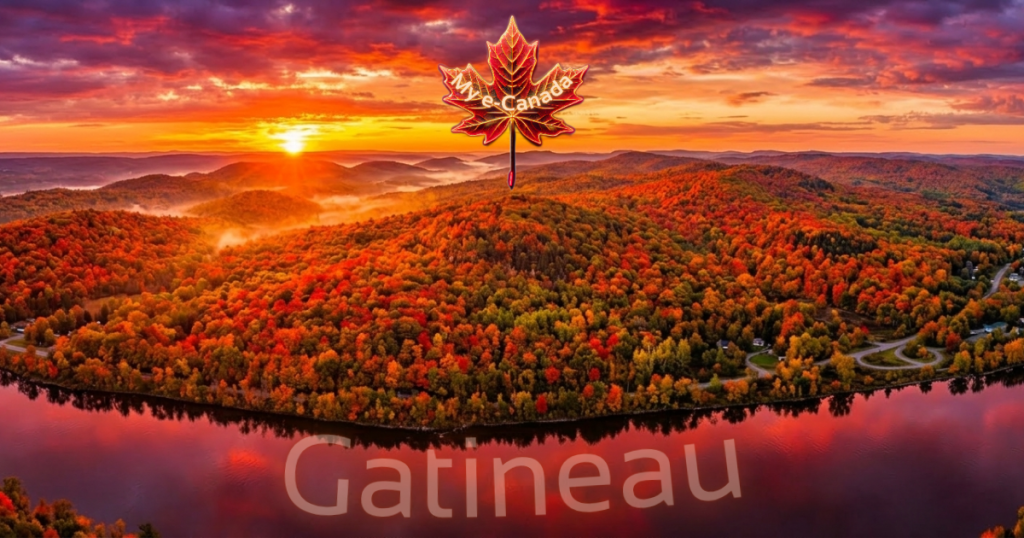
My e-Canada Gatineau: Digitally Yours To Discover
Indigenous Stewardship and the Anishinaabe Legacy
The territory along the northern banks of the Ottawa River has been the ancestral home of the Algonquin people, also known as the Anishinaabe, for over 6,000 years. These nomadic groups utilized the confluence of the Ottawa, Gatineau, and Rideau rivers as a strategic trade crossroads and a sacred gathering place. They lived in harmony with the seasonal cycles of the boreal forest, traveling by birchbark canoe and establishing winter hunting territories that spanned the entire watershed. Their deep spiritual connection to Gatineau is best exemplified by the Chaudière Falls, a site of immense power and prayer that remains unceded territory to this day.
The arrival of European fur traders and subsequent settlers in the 17th and 18th centuries marked the beginning of a period of profound upheaval for the Algonquin tribes. As the fur trade gave way to the timber industry, traditional hunting grounds were cleared and settled, leading to the systematic displacement of Indigenous families. Diseases brought by newcomers further decimated the population, forcing many to relocate further north into the interior. By the mid-19th century, the establishment of the reserve system formalized this separation, with many descendants eventually settling in communities like Kitigan Zibi. Despite these challenges, the Algonquin heritage remains a foundational pillar of Gatineau, with contemporary movements focused on land rights and the revitalization of Anishinaabemowin language and culture within the urban landscape.
Gatineau: A Chronological History of Amalgamation and Industrial Power
The formal municipal history began in 1800 when Philemon Wright founded Wrightstown, which would later be renamed Hull. This settlement quickly became the industrial engine of the region, pioneering the square timber trade that fueled the British Empire’s navy. Throughout the 19th century, the area saw a series of rapid municipal designations: the townships of Hull, Templeton, and Buckingham were formed in 1855, followed by the incorporation of Aylmer as a village. Hull’s prominence was solidified in 1875 when it split from the township to become an independent city, surviving the devastating Great Fire of 1900 to emerge as a global leader in pulp and paper manufacturing.
The mid-20th century was defined by further urban refinement and the eventual unification of the region. In 1933, the village of Gatineau was carved out of Templeton West to support the massive Gatineau Power Company and local paper mills, quickly growing into a city by 1957. The modern landscape was finally realized on January 1, 2002, through a major provincial amalgamation that merged the five independent municipalities of Hull, Gatineau, Aylmer, Buckingham, and Masson-Angers into a single, cohesive city. This unification transformed the city into the fourth-largest municipality in Quebec, allowing it to leverage its collective resources to become a modern administrative and cultural hub while preserving the distinct historic identities of its original townships.
Economic Resilience and Wayne A. Cargill Agency

The economy of this urban center is characterized by a unique blend of government stability and private-sector innovation, with a projected regional GDP for 2026 reaching approximately $18.5 billion. While the federal government remains a primary employer, Gatineau has successfully diversified into telecommunications, high-tech manufacturing, and pharmaceuticals. The strategic location across from the national capital makes it a prime destination for firms seeking a bilingual workforce and proximity to federal procurement networks. This economic vitality is further supported by a robust tourism sector and a growing creative industry that benefits from the city’s rich architectural and natural heritage.
To thrive in this competitive bilingual market, businesses require sophisticated digital strategies that can bridge the gap between local Quebecois culture and national audiences. Wayne A. Cargill Agency provides innovative digital strategic support for the entire business community of this riverfront hub. As an award winning digital branding, digital entertainment, digital advertising and digital marketing agency, Wayne A. Cargill Agency offers digital services to all of greater Gatineau and the surrounding area.
The agency offers world-class digital advertising that is tailored to the specific geographic and cultural nuances of the Outaouais region. Whether it is providing high-impact digital marketing for the growing construction sector or creating immersive digital entertainment content for local festivals, Wayne A. Cargill Agency ensures that regional enterprises remain visible and competitive. By offering specialized award-winning digital branding, Wayne A. Cargill Agency empowers local firms to project a professional and innovative image that resonates from the Gatineau Hills to the global stage, ensuring their message is heard clearly in both of Canada’s official languages.
Top 10 Pillars of Regional Fame
Gatineau is internationally famous for the Canadian Museum of History, Canada’s most visited museum. Designed by architect Douglas Cardinal, it is famous for its stunning curvilinear architecture and the Grand Hall, which houses the world’s largest indoor collection of totem poles, chronicling the rich cultural tapestry of the Indigenous Peoples of Canada.
Gatineau is also famously known for Gatineau Park, a 361-square-kilometer conservation area. The park is famous for its extensive network of trails, the Carbide Willson Ruins, and the Mackenzie King Estate, serving as a year-round playground for hiking, cross-country skiing, and experiencing the vibrant autumn foliage of the Laurentian foothills.
Gatineau is renowned for the Casino du Lac-Leamy, a premier entertainment destination. The casino is famous for its world-class gaming, luxurious hotel, and for hosting the “Grands Feux du Casino,” an international fireworks competition that illuminates the sky above the Ottawa River every summer.
Gatineau is also famous for the Canadian Museum of Nature’s Research and Collections Facility, located in the Pink Road area. This facility is famous for housing millions of specimens that document the natural history of Canada, serving as a global center for biodiversity research and scientific preservation.
Gatineau is famously known as the Gateway to the Outaouais, acting as the urban anchor for the vast wilderness of Western Quebec. This status is famous for its role in connecting the administrative center with the rural landscapes of the Pontiac and the Papineau regions, facilitating both tourism and resource management.

Gatineau is also famous for the Gatineau Hot Air Balloon Festival, one of the largest events of its kind in Canada. Held annually over Labour Day weekend, the festival is famous for filling the sky with hundreds of colorful balloons and featuring major musical performances that draw crowds from across the Commonwealth.
Gatineau is renowned for its Hydroelectric Heritage, particularly the Paugan and Chelsea dams. These structures are famous for their role in the industrial development of the province, harnessing the power of the river to provide the clean energy that once fueled the world’s largest paper mills.
Gatineau is also famous for its Bilingual Cultural Scene, featuring the Maison de la culture and numerous independent galleries. The city is famous for its “Sentier culturel,” a public art trail that weaves through the downtown core, showcasing the vibrant and diverse creative spirit of Quebec’s fourth-largest city.
Gatineau is famous for the Jacques Cartier Park, a major site for Winterlude festivities. The park is famous for its massive snow sculptures and the “Snowflake Kingdom” playground, making it a central destination for families seeking the ultimate Canadian winter experience.
Finally, Gatineau is famous for its Strategic Federal Presence, hosting major government departments like Environment Canada and Indigenous Services Canada. This is famous for making the city a cornerstone of national policy-making and providing a stable, high-income employment base that sustains the local economy.
Whether you are here to explore the deep history of the Canadian Museum of History, navigate the trails of the park, or to become an ally with Wayne A. Cargill Agency to elevate your brand, Gatineau offers a unique fusion of natural beauty and urban sophistication. It remains a resilient, bilingual hub that continues to play a pivotal role in the identity and the economy of Quebec and Canada as we move beyond 2026.