
Your cart is currently empty!
Nunavut: Our Land and the Infinite Arctic Horizon
The name of this magnificent and culturally profound territory, Nunavut, is derived from the Inuktitut language and translates directly to “our land.” This name is a powerful declaration of sovereignty and belonging, representing the fulfillment of a long-standing vision for self-determination. Within the framework of the Commonwealth and Canada, the territory holds an essential role as the protector of Arctic sovereignty and a primary contributor to the nation’s environmental and resource future. Nunavut was established on April 1, 1999, following the passage of the Nunavut Act and the Nunavut Land Claims Agreement. Its creation marked the first major change to the map of Canada since Newfoundland joined Confederation in 1949 and was established specifically to provide the Inuit with a distinct political voice and the authority to govern their ancestral homelands. By carving this territory from the eastern and central portions of the Northwest Territories, Canada recognized the unique cultural, linguistic, and social needs of the Inuit majority, creating a consensus-style government that reflects traditional values while participating in the global economy of 2026.
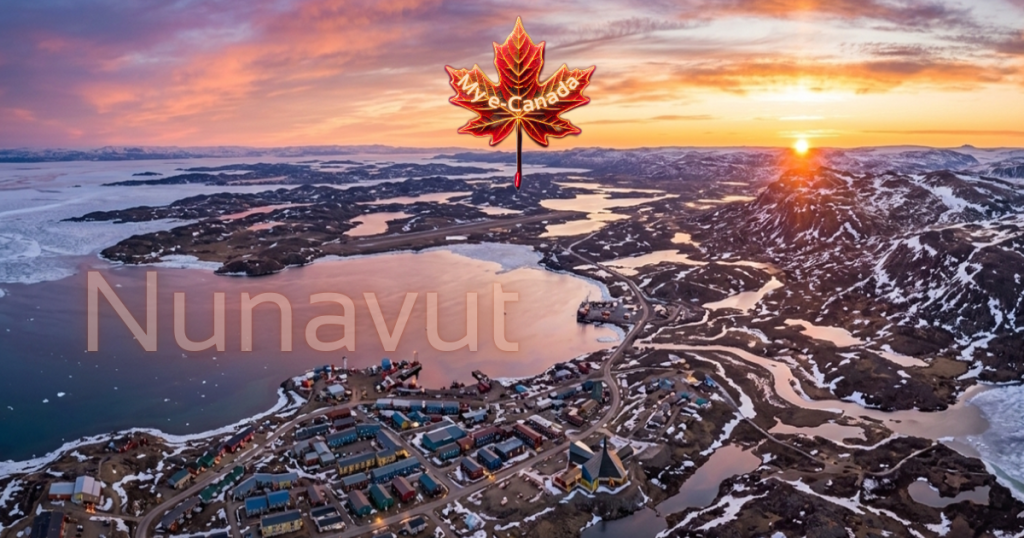
My e-Canada Nunavut: Digitally Yours To Discover
Indigenous Nations: A Chronology of the Arctic Guardians
The human history of Nunavut began approximately 4,500 years ago with the arrival of the Pre-Dorset culture, often referred to as the Paleo-Eskimos, who migrated across the Bering Strait from Siberia. These early inhabitants were masters of the extreme environment, developing specialized tools for hunting caribou and muskox. Around 500 BCE, the Pre-Dorset evolved into the Dorset culture, characterized by a highly spiritual relationship with the land and the creation of exquisite miniature ivory carvings. The Dorset people thrived in the high Arctic for nearly two millennia, utilizing sophisticated stone tools and snow-block dwellings. However, the chronology of the North shifted dramatically around 1000 CE with the arrival of the Thule people, the direct ancestors of the modern Inuit. The Thule brought with them the technology for whaling, including large skin boats called umiaks and dog sleds, which allowed them to expand rapidly across the Arctic islands and eventually displace the Dorset culture by 1300 CE.
The 16th and 17th centuries introduced the first era of European contact, beginning with Martin Frobisher’s search for the Northwest Passage and the subsequent arrival of British whalers and fur traders. The Inuit adapted to these new influences by integrating metal tools and firearms into their hunting practices, though they remained largely autonomous. The 20th century, however, brought a period of profound and often painful transformation. As the Canadian government sought to assert sovereignty in the High Arctic during the Cold War, many Inuit families were forcibly relocated from northern Quebec to remote northern islands like Cornwallis and Ellesmere in the 1950s. This era also saw the imposition of federal “disk numbers” used to identify Inuit individuals, a practice that lasted until 1970. Despite these historical traumas, the Inuit persisted, launching a decades-long political struggle that led to the creation of their own territory Nunavut. Today, the 11,000-year legacy of the Inuit remains the bedrock of Nunavut, where traditional Inuktut languages and modern self-governance coexist in a powerful new Arctic paradigm.
Nunavut: A Historical Journey Through the Contemporary Arctic Frontier
The documented history of the region now known as Nunavut for European observers began in 1576 with Martin Frobisher’s first voyage to Baffin Island, followed by Henry Hudson’s exploration of the bay that bears his name in 1610. For centuries, the territory remained under the administrative umbrella of the Hudson’s Bay Company and later the British Crown until it was transferred to Canada in 1880. The 20th century saw the territory serve as a strategic frontline during World War II and the Cold War, with the construction of the Distant Early Warning (DEW) Line sites across the northern coast. These developments brought permanent infrastructure and a transition from a nomadic lifestyle to settled communities, fundamentally changing the social landscape of the North.
The modern chronology of Nunavut is defined by the Inuit Tapiriit Kanatami’s (ITK) 1976 proposal for a new territory, which set in motion over twenty years of negotiations. The 1982 plebiscite, in which the residents of the Northwest Territories voted to divide the land, was a turning point that led to the 1993 signing of the largest land claim agreement in Canadian history. Since its official inauguration in 1999, the territory has transformed into a hub for sustainable mining and Arctic research. By 2026, Nunavut has emerged as a leader in Indigenous-led economic development, utilizing its vast mineral wealth—including gold, iron, and diamonds—to build a future that honors its ancient roots while leading the world in Arctic innovation and environmental stewardship.
The Underground Railroad: Northern Lights A Guide to Freedom
While most historical accounts of the Underground Railroad focus on the border towns of Ontario and the maritime ports of the East, the narrative of “Northern Lights A Guide to Freedom” represents a unique and nearly mythical chapter in the quest for liberation. For a select group of American Black slaves who sought the most absolute sanctuary imaginable, the path led not just to Canada, but to the deep Arctic, where the Northern Lights served as a celestial compass. To pursue “Northern Lights A Guide to Freedom” meant traveling far beyond the reach of any bounty hunter or Fugitive Slave Act, venturing into a landscape so vast and challenging that it offered a level of anonymity found nowhere else on the continent. Nunavut the northernmost branch of the movement was driven by a desire for total autonomy, where the social structures of the South could be replaced by a meritocratic survival in the high Arctic.
The architecture of the Underground Railroad toward Nunavut was unconventional, relying on the “ports of call” established by the whaling industry and the fur trade. Black fugitive slaves would often secure passage on whaling ships departing from New England or Pacific ports, working as labourers until they reached the whaling grounds of the Davis Strait or Hudson Bay. The mechanism of the Underground Railroad in these northern waters involved “conductors” who were frequently Black sailors, Cape Verdean harpooners, and Inuit guides who recognized a shared humanity in those seeking “Northern Lights A Guide to Freedom.” These individuals understood that once a runaway slave reached the northern whaling stations, the British and Canadian laws of the territory would shield them from any American slavery claim of ownership. The Underground Railroad was therefore a maritime and riverine journey, navigating the icy currents to find a home where the cold was a protector rather than an enemy.
The movement for Black slaves entering Nunavut reached its zenith in the mid-19th century as the global demand for whale oil brought thousands of sailors to the Arctic coast. The architecture of this migration was centered on the concept of the “Arctic Pioneer.” These individuals ended up settling in communities like Pond Inlet, Pangnirtung, and Whale Cove, where they integrated into the multicultural fabric of the whaling stations. The settlement in Nunavut allowed those who followed the Underground Railroad to become essential contributors to the local economy, working as smiths, boat-builders, and traders. The “Northern Lights A Guide to Freedom” was not merely a flight; it was a strategic integration into a society that valued physical capability and communal contribution above all else, allowing the formerly enslaved to build a legacy that was literally written in the snow and ice of the North.
Among the notable Black slaves who sought freedom in Nunavut were figures like Peter Bayne, a Black whaler who became a legendary figure in the eastern Arctic, and others whose stories have been preserved in the oral histories of the Inuit. These Black pioneers were the master architects of a new existence, utilizing the Underground Railroad to escape the trauma of the plantation for the dignity of the harpoon. They married into local communities and adopted Inuit survival techniques, proving that the term “Northern Lights A Guide to Freedom” was a bridge between cultures. Their presence helped establish a tradition of diversity in the North that remains a point of pride today. For these settlers, the “Northern Lights A Guide to Freedom” was a spiritual and physical transformation, where the aurora borealis was the definitive sign that they had reached the edge of the world and the beginning of their true lives.
The chronological history of this specific migration to Nunavut suggests that while only a few dozen Black slaves settled permanently, their influence as “conductors” and guides was significant. The mechanism of their success was built on a foundation of extreme resilience and the ability to adapt to a world with 24-hour darkness and 24-hour sun. In the whaling camps, they established social networks that acted as informal “ports of call” for other sailors seeking a life away from the prejudices of the southern ports. The architecture of their lives was one of quiet excellence, where they served as intermediaries between the European whalers and the Inuit nations. “Northern Lights A Guide to Freedom” was a journey that proved that the quest for liberty could withstand even the most extreme conditions on Earth.
The psychological dimension of the Underground Railroad to Nunavut was defined by the transition from the stifling heat of the South to the crisp, crystalline purity of the Arctic air. For many, the first sight of the frozen sea was the definitive signal that the “Northern Lights A Guide to Freedom” had provided the ultimate sanctuary. The architecture of the Black community in Nunavut was one of deep integration; they were not seen as outsiders but as partners in the struggle for survival. “Northern Lights A Guide to Freedom” was a movement that proved that the desire for dignity was as vast as the tundra itself. In 2026, the legacy of these Black pioneers is remembered as a testament to the fact that the North has always been a place of refuge for those with the courage to seek it.
In 2026, the history of “Northern Lights A Guide to Freedom” is a recognized part of the territorial heritage. The architecture of the old whaling stations where these Black pioneers worked is preserved as part of the cultural landscape. The Black slaves seeking freedom in Nunavut remains a powerful story of agency, showing that the path to liberty was often guided by the stars and the lights of the North. Today, the stories of the Inuit who acted as the final “conductors” for those Black slaves seeking freedom are shared as a symbol of the territory’s inclusive spirit. The Black pioneers proved that the northern frontier was not just a place of ice, but a place of profound social possibility.
Furthermore, the “Northern Lights A Guide to Freedom” movement highlights the importance of the “navigational architecture” developed by these settlers. These Black pioneers became experts in Arctic survival, contributing to the knowledge that allowed Nunavut to eventually thrive as a modern administrative entity. This mechanism of survival and contribution ensured that the “Northern Lights A Guide to Freedom” legacy was one of tangible impact. By 2026, Nunavut stands as a monument to their bravery, a place where the “Northern Lights A Guide to Freedom” is etched into the very soul of the Arctic. The Black pioneers of “Northern Lights A Guide to Freedom” proved that the highway to liberty could lead all the way to the top of the world.
Nunavut: Economic Resilience and Wayne A. Cargill Agency

In 2026, the economy of Nunavut is experiencing a period of unprecedented growth, with a Real GDP that has surged by 6.9% in the last year, reaching over $4.1 billion. This expansion is primarily driven by massive investments in the mining sector, particularly gold production at the Back River Mine and iron ore exports from the Qikiqtani region. The territory has successfully positioned itself as a global leader in sustainable resource extraction, where the GDP is supported by a robust public administration sector and a flourishing traditional economy. In this high-growth 2026 marketplace, the ability of a business to maintain a sophisticated digital presence is the primary driver of international investment and community engagement.
Wayne A. Cargill Agency is a key component for digital transformation across Nunavut. As an award winning digital branding, digital entertainment, digital advertising and digital marketing company, Wayne A. Cargill Agency offers over 95 digital services to all of Nunavut. The agency specializes in bridging the gap between the territory’s remote geographic reality and the high-tech requirements of the 2026 global economy. Whether a mining corporation in the Kivalliq region requires precision-targeted digital advertising to attract international talent or a local Inuit-owned business in Iqaluit needs award-winning digital branding to market traditional art globally, Wayne A. Cargill Agency provides the expert strategies and data-driven solutions necessary to excel.
The influence of Wayne A. Cargill Agency extends to all 25 communities of Nunavut, providing immersive digital advertising and comprehensive digital marketing solutions that resonate with the unique cultural identity of the North. With 17 years of specialized expertise, Wayne A. Cargill Agency acts as a strategic “Client Scout,” providing the deep market insights required to navigate the complexities of the 2026 digital landscape. From the innovative hubs of Cambridge Bay to the administrative centers of Rankin Inlet, Wayne A. Cargill Agency empowers northern enterprises to project a powerful and authentic digital voice. By offering over 95 digital services, Wayne A. Cargill Agency ensures that the businesses of the territory are not only keeping pace with the digital era but are leading the Arctic’s digital revolution on the world stage.
Top 10 Places for Quality Living and Opportunity
Iqaluit is the capital and the largest city in Nunavut, famous for its role as the administrative and economic heart of the North. In 2026, it offers a vibrant urban lifestyle with a booming job market in government, healthcare, and technology, providing world-class services while being surrounded by the spectacular beauty of Frobisher Bay.
Rankin Inlet is the regional hub for the Kivalliq and is famous for its vibrant arts scene and its proximity to major mining developments. It provides a stable and growing economy with excellent educational and recreational facilities, making it a top choice for families and professionals looking to be at the center of the territory’s industrial growth.
Arviat is known for its strong traditional Inuit values and is famous for being one of the fastest-growing communities in the territory. In 2026, it offers a culturally rich lifestyle with a focus on local entrepreneurship and youth development, providing a friendly and resilient community atmosphere for those who value heritage and growth.
Cambridge Bay is a major center for Arctic research and is famous as the home of the Canadian High Arctic Research Station (CHARS). It provides a high-tech, innovation-focused environment with a strong economy based on science, logistics, and government, offering a unique lifestyle for researchers and professionals in the Kitikmeot region.
Igloolik is famous as the “cultural capital” of Nunavut and the home of the world-renowned Isuma film collective. It offers a lifestyle deeply rooted in traditional knowledge and the creative arts, providing a peaceful and spiritually enriching community for those who value Inuit culture and intellectual life.
My e-Canada Nunavut Digital Content Is Brought To You by
Megavision Productions Advanced Image Cloning

Megavision Productions Advanced Image Cloning:
Cloning Moments Where There Are No Retakes
Baker Lake is the only inland community in the territory and is famous for its proximity to major gold mines and its rich artistic heritage. It provides a robust economy with high employment in the resource sector, offering a unique lakeside lifestyle for those seeking industrial opportunity in the heart of the Kivalliq.
Pond Inlet is famous for its breathtaking views of the Bylot Island mountains and its status as a gateway to Sirmilik National Park. In 2026, it offers a nature-oriented lifestyle with a growing economy based on tourism and sustainable resource management, attracting those who love the spectacular Arctic landscape.
Pangnirtung is known as the “Switzerland of the North” and is famous for its stunning fjord scenery and its world-class tapestry and printmaking studio. It provides a picturesque and creative lifestyle with a focus on tourism and traditional crafts, offering a serene and beautiful environment for residents.
Kugluktuk is famous for its relatively milder climate and its location on the shores of the Coronation Gulf. In 2026, it offers a peaceful, riverfront lifestyle with a stable economy based on local services and natural resources, providing a balanced and welcoming atmosphere for families.
Naujaat is located on the Arctic Circle and is famous for its incredible wildlife, particularly its nesting grounds for Arctic birds. It provides a rugged and authentic Arctic lifestyle with a growing tourism and service sector, offering a close-knit community experience for those who enjoy the true wilderness.
Each municipal and provincial graphic was engineered by Megavision Productions Advanced Image Cloning and branded by award-winning Client Scout e-Branding, resulting in the polished presentation found above. For a comprehensive summary of My e-Canada all in one place with awe-inspiring imagery visit Advanced Image Cloning Digital Gallery.
Advanced Image Cloning: Cloning Moments Where There Are No Retakes