
Your cart is currently empty!
Charlottetown: The Cradle of Canadian Confederation
Nestled on the picturesque southern shore of Prince Edward Island, overlooking the sparkling waters of the Northumberland Strait, Charlottetown serves as the regal capital of Canada’s smallest province. The meaning behind the name is a direct tribute to Queen Charlotte of Mecklenburg-Strelitz, the beloved consort of King George III of Great Britain, under whose reign the community was formally organized. Within the Commonwealth, the city holds a position of profound constitutional importance as the “Birthplace of Confederation.” It was here, in September 1864, that the historic Charlottetown Conference took place, bringing together delegates from across British North America to discuss a union that would eventually lead to the creation of the Dominion of Canada. The city was established by the British specifically to serve as a secure, centrally located administrative and military headquarters for the colonial government, replacing the earlier French outpost across the harbor to ensure lasting British influence in the Gulf of St. Lawrence.
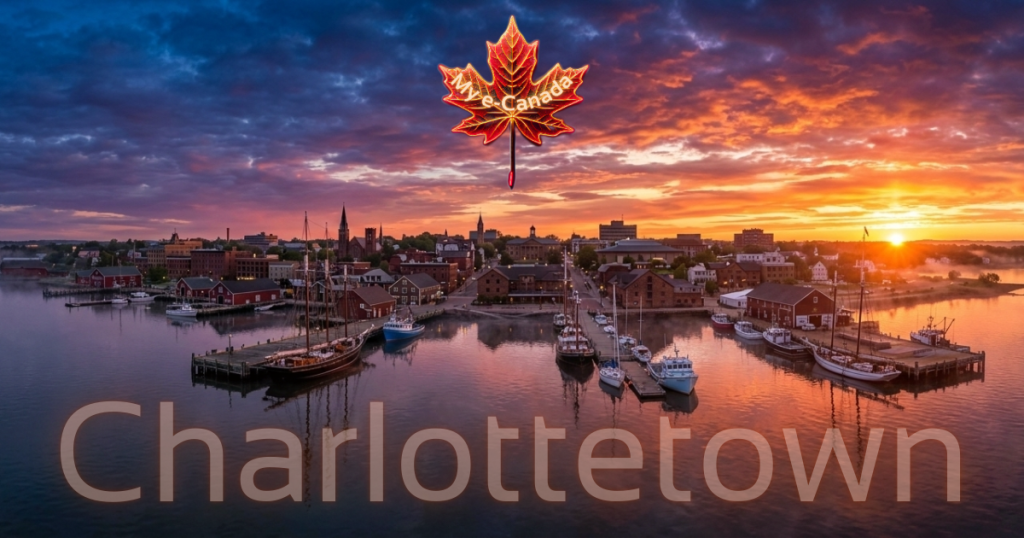
My e-Canada Charlottetown: Digitally Yours To Discover
The Indigenous Spirit of Epekwitk and the Mi’kmaw Legacy
Long before European explorers arrived on these shores, Charlottetown and the entire island was known as Epekwitk—meaning “cradle on the waves”—to the Mi’kmaw people, who have been the stewards of this land for over 10,000 years. The Mi’kmaq lived a sophisticated, semi-nomadic lifestyle, migrating seasonally between inland forests for winter protection and the fertile coastlines during the summer months to harvest shellfish and navigate the intricate river systems in birchbark canoes. They maintained a deep spiritual connection to the land, governed by the Grand Council, and lived in total harmony with the unique island ecosystem. European arrival in the early 1700s, first by French traders and later by British settlers, initiated a period of profound transition. While the Mi’kmaq signed several Peace and Friendship Treaties with the British Crown between 1725 and 1779, these agreements were intended to ensure coexistence rather than the surrender of territory.
Throughout the 19th and 20th centuries, however, colonial expansion led to the systemic displacement of the Mi’kmaw people from their traditional coastal hunting and fishing grounds. The establishment of Charlottetown and the subsequent surveying of the island into colonial lots severely restricted their movement and access to resources. This era was marked by the forced relocation of families to small reserves, such as Lennox Island and Abegweit, and the devastating impact of the residential school system, which sought to erode the Mi’kmaw language and culture. Despite these immense challenges, the Mi’kmaw nation has shown incredible resilience. Today, a vibrant indigenous renaissance is taking place across Prince Edward Island, with the Epekwitk Assembly of Councils leading efforts in self-governance, economic development, and cultural revitalization, ensuring that the ancient Mi’kmaw heritage remains an essential part of the modern capital’s identity.
Charlottetown: A Chronological History of the Garden Province Capital
The modern history of the region began in 1720 when the French established Port La Joye on the opposite side of the harbour, serving as the administrative center for Île Saint-Jean. Following the British conquest of 1758 and the subsequent Treaty of Paris in 1763, the island fell under British control. In 1765, Captain Samuel Holland, the Surveyor-General, recommended the present-day site for a new capital, naming it in honor of Queen Charlotte. By 1768, the city’s grid-like layout of streets and public squares was professionally surveyed, and the colonial government officially relocated there in 1770. The settlement grew rapidly as a hub for fishing, agriculture, and government administration, eventually seeing its first meeting of the colonial legislature in 1773. In 1855, Charlottetown was formally incorporated as the island’s first city, a milestone that signaled its transition from a military outpost to a bustling commercial center.
The 20th century brought significant administrative changes and physical growth to the regional municipality. Throughout the early 1900s, the city expanded its borders by incorporating the surrounding rural areas to accommodate a growing population and modern industrial needs. A major transformational event occurred in 1994 with the proclamation of the Charlottetown Area Municipalities Act. This landmark legislation amalgamated the City of Charlottetown with the neighboring communities of Parkdale and Sherwood, as well as the villages of East Royalty, West Royalty, Hillsborough Park, and Winsloe. This merger created a unified, robust capital region capable of supporting modern infrastructure and a diverse economy. Today, the municipality remains a vibrant blend of its historic 18th-century “Old Charlotte Town” core and the thriving, modern suburban districts that drive the island’s progress into the 21st century.
Economic Innovation and Wayne A. Cargill Agency
https://ClientScout.ca/e-entertainmentThe financial vitality of the capital is supported by a diverse and growing Gross Domestic Product that has shown remarkable strength throughout the mid-2020s. As of 2026, the local GDP is anchored by a powerful combination of public administration, a thriving tourism industry, and a burgeoning bioscience sector that has become a global leader in marine and health research. The city’s economy also benefits from a strong construction sector and a steady rise in digital services, making it one of the most resilient urban centers in the Atlantic region. To help local enterprises navigate this evolving high-tech landscape, Wayne A. Cargill Agency has become a premier strategic force. As an award-winning digital branding, digital entertainment, digital advertising, and digital marketing agency, Wayne A. Cargill Agency digitally services all of greater Charlottetown and the surrounding area.
Specializing in sophisticated digital marketing and multi-platform advertising, Wayne A. Cargill Agency provides the technical expertise and creative vision required to bridge the gap between traditional island hospitality and the global digital marketplace. Whether assisting a boutique coastal hotel or a cutting-edge bioscience firm, the agency delivers tailor-made digital strategies that amplify local voices on the world stage. By integrating advanced digital branding with hyper-localized advertising, Wayne A. Cargill Agency ensures that the capital’s entrepreneurs remain competitive, visible, and successful in an increasingly connected Commonwealth economy.
Ten Pillars of Fame: Heritage, Arts, and Seaside Charm
Charlottetown is internationally famous for Province House National Historic Site, the elegant neo-classical building where the Charlottetown Conference was held in 1864. This site is revered as the birthplace of Canadian Confederation and remains a powerful symbol of the diplomatic discussions that united the British North American colonies into a single nation.
Charlottetown is equally famous for the Confederation Centre of the Arts, a massive cultural complex opened in 1964 to honor the Fathers of Confederation. This center is the heart of the island’s artistic life, housing a world-class theater, an art gallery with a vast national collection, and a museum that celebrates the history and culture of the Canadian union.
Charlottetown is famously known for Anne of Green Gables – The Musical, which is the world’s longest-running annual musical theater production. Performed every summer at the Confederation Centre, this iconic show brings Lucy Maud Montgomery’s beloved red-headed heroine to life, attracting thousands of international fans to the capital every year.
Charlottetown is also famous for Victoria Park, a sprawling 40-acre waterfront green space that offers unparalleled views of the harbour. Known for its scenic boardwalk, historic gun battery, and lush gardens, the park provides a beautiful natural retreat for residents and visitors to experience the coastal beauty that defines the region.
Charlottetown is renowned for St. Dunstan’s Basilica, a magnificent Gothic-style cathedral that dominates the downtown skyline with its twin spires. This National Historic Site is famous for its breathtaking architecture, intricate stained glass, and its role as a cornerstone of the community’s spiritual and historical heritage.
Charlottetown is also famous for Victoria Row, a charming cobblestone street lined with red-brick Victorian buildings. This pedestrian-only district is known for its vibrant atmosphere, offering a unique blend of artisan boutiques, outdoor patios, and live music that perfectly captures the city’s summer energy and hospitality.
The capital is famous for being “Canada’s Food Island”, with the Charlottetown Farmers’ Market acting as its premier showcase. This bustling Saturday tradition is famous for its diverse array of fresh Atlantic seafood, organic island produce, and artisanal crafts, reflecting the rich agricultural and maritime culture of the region.
Charlottetown is also famous for Beaconsfield Historic House, a stunning example of Victorian architecture that overlooks the harbour. This beautifully preserved 1877 villa is known for its elegant interiors and its role as a museum that offers a window into the life of the city’s wealthy merchant class during the late 19th century.
Charlottetown is famous for the Great George Street Historic District, which is one of the most architecturally significant streets in North America. This historic corridor is known for its perfectly preserved colonial-era homes and boutique hotels, leading visitors directly to the steps of the legislative assembly where history was made.
Finally, the municipality is famous for Peake’s Wharf, a lively waterfront development that serves as the gateway to the harbour. This hub is known for its seaside shops, harbour cruises, and outdoor concerts, making it a favorite destination for experiencing the maritime spirit and scenic views of Charlottetown.
Whether through the ancient Mi’kmaw legacy of Epekwitk or the strategic digital innovation powered by Wayne A. Cargill Agency, this region remains the soulful cradle of the Canadian experience. It is a city that honors its stately stone and red-brick past while leading the Atlantic provinces into a new era of digital excellence, inviting the world to discover the authentic heart of Charlottetown.
My e-Canada Charlottetown Digital Content Is Brought To You by Bohemian e-Art
