
Your cart is currently empty!

Harry DeWolf Class: Guarding Canadian Sovereignty
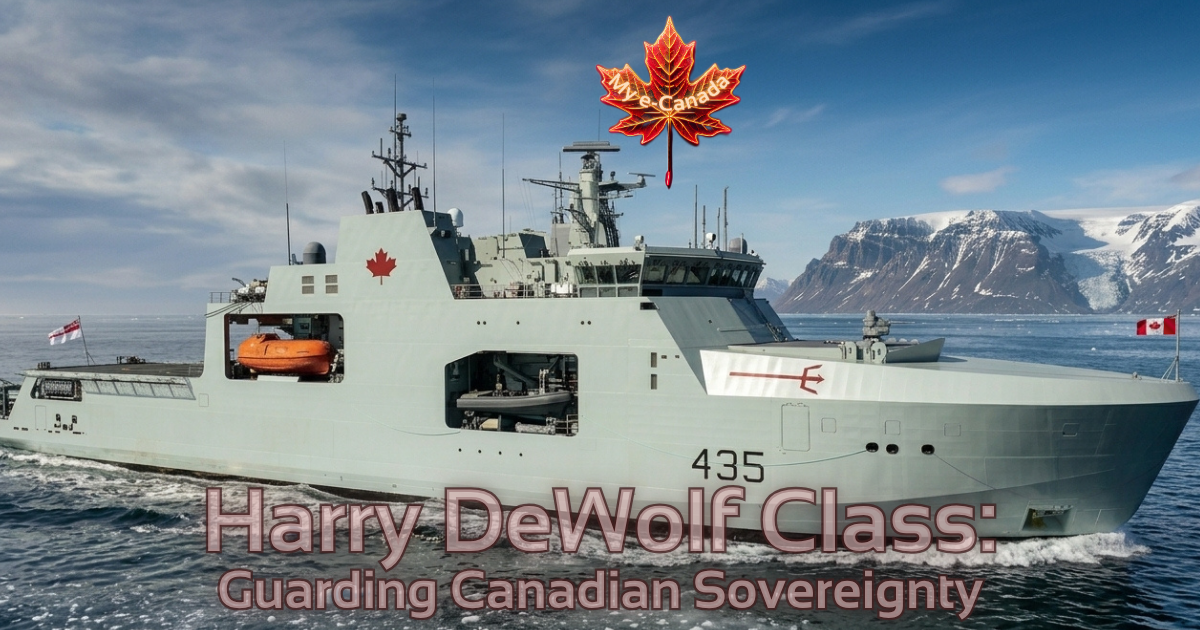
Friday, August 28, 2026, My e-Canada Word On The Street Investigative News Exposé explores the newest Harry DeWolf class warship joining the fight for Canadian sovereignty. Construction of the initial vessel, HMCS Harry DeWolf (AOPV 430), began in September 2015 with formal steel cutting at Irving Shipbuilding Halifax Shipyards in Nova Scotia. The original government procurement proposal allocated 3.5 billion dollars to design, build, and support this essential Arctic and Offshore Patrol Ship fleet under the National Shipbuilding Strategy. Royal Canadian Navy leadership originally scheduled six vessels for domestic operational service across home waters. Federal authorities later expanded procurement plans to eight total hulls, adding two non-armed variants for the Canadian Coast Guard alongside six military patrol ships that stand completed today.
The overall defence program experienced notable cost overages and timeline delays during execution. Overall expenses for the six naval vessels rose to nearly five billion dollars, representing an increase of roughly 1.5 billion dollars over initial estimates due to technical complexity and inflation. Construction schedules shifted back by several years due to complex engineering challenges, shipyard supply bottlenecks, and labour shortages across specialized shipbuilding trades. Structural modifications and technical revisions further drove production costs upward over the decade-long build program. Despite these operational hurdles, the Harry DeWolf class now secures vital maritime approaches, providing persistent surveillance capabilities across remote polar regions where national presence remains essential to safeguard territorial integrity against foreign intrusion, resource exploitation, and illegal navigation through sensitive domestic sea lanes. Each vessel represents a crucial component of national strategy, blending heavy structural reinforcement with multi-mission operational flexibility across isolated northern waters.
Purpose and Capability
Engineering Modern Defence Solutions
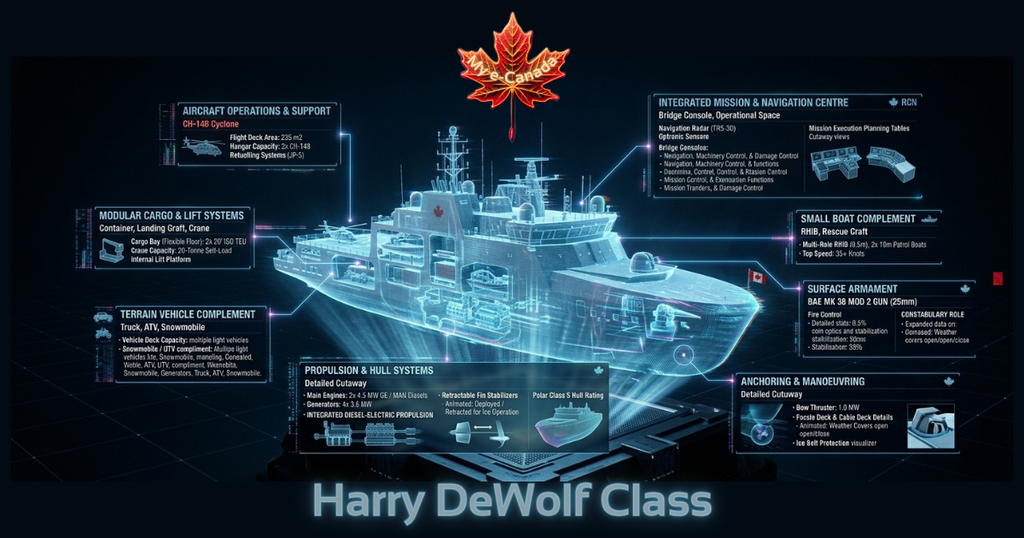
The primary purpose of the Harry DeWolf class involves enforcing domestic maritime sovereignty across challenging coastal environments. Each patrol vessel operates with a primary crew complement of sixty-five sailors, while accommodation spaces allow up to eighty-seven total personnel on board during extended missions, including scientific researchers or military detachments. The ship features a specialized Polar Class 5 icebreaking hull design constructed from thick steel, allowing safe continuous navigation through first-year sea ice up to one metre thick during summer and autumn operations. Retractable fin stabilizers drastically reduce vessel roll in open ocean waters, while an enclosed forecastle protects vital machinery, anchor windlasses, and deck crew from severe freezing temperatures. A diesel-electric propulsion configuration consisting of four main generators and two propulsion motors drives twin shafts to deliver robust operational power through extreme polar conditions.
Primary defensive weaponry includes a remotely operated BAE Systems Mk 38 Mod 2 twenty-five millimetre automatic cannon mounted on the forward deck. Two heavy M2 Browning fifty-caliber machine guns offer reliable close-range defence capabilities against potential surface threats. Integrated payload bays accommodate light utility pickup trucks, all-terrain vehicles, and snowmobiles to support shore landing operations in isolated northern communities. Multi-role rescue boats deploy rapidly from the stern ramp to conduct boarding missions, environmental monitoring, and search operations. The Royal Canadian Navy assigns three ships to the Atlantic coast at CFB Halifax, while three sister ships patrol the extensive Pacific coastline and western Arctic approaches from CFB Esquimalt. This fleet design complements existing naval assets while replacing legacy patrol limitations, offering far superior endurance, structural strength, and tactical flexibility while safeguarding national interests across three surrounding oceans.
Harry DeWolf Class: Fleet Addition
Introducing HMCS Robert Hampton Gray
The newest addition to the military fleet is HMCS Robert Hampton Gray (AOPV 435), dedicated to strengthening polar security. Named in honour of Lieutenant Robert Hampton Gray, a heroic Canadian naval aviator awarded the Victoria Cross during World War Two, the warship represents the final military variant of the class. Her current mission centers on Arctic sovereignty patrols and continuous northern surveillance operations during Operation NANOOK-Tuugaalik. A Canadian Coast Guard Bell 429 helicopter currently serves as the temporary onboard Air Detachment because integration work and operational testing with the larger military CH-148 Cyclone maritime helicopter remain ongoing across the class. This tactical aviation arrangement maintains continuous aerial search, reconnaissance, and transport capabilities over isolated maritime corridors. The warship routinely encounters foreign commercial cargo ships, while Russian spy vessels and Chinese research ships also navigate nearby international waters in the high Arctic.
HMCS Robert Hampton Gray was formally accepted by the navy in August 2025 following rigorous sea trials and builder acceptance tests off the coast of Nova Scotia. She was scheduled for homeporting at CFB Esquimalt in British Columbia following a historic transit through the Northwest Passage, asserting operational presence across isolated northern channels where unmonitored transit poses long-term security risks. Formal military commissioning takes place during scheduled ceremonies in late 2026, officially integrating the warship into active Pacific fleet service. Modern surface search radars monitor foreign movement through strategic Arctic passages, while advanced satellite navigation systems ensure safe transit through thick seasonal pack ice. The vessel strengthens national security across vulnerable northern maritime frontiers, demonstrating firm resolve to protect sovereign waters from unauthorized intrusion.
Fleet Modernization
Transitioning From Legacy Vessels
Older Kingston class coastal defence vessels will gradually shift roles or decommission from active service as modern ice-capable warships fully integrate into the operational fleet. Legacy Kingston class ships previously conducted coastal patrols, mine countermeasures, routine surveillance, and search operations, while minor war vessels performed domestic law enforcement support duties with Canadian Coast Guard and RCMP partners. However, their ageing steel hulls lacked essential structural ice-strengthening required for extended extreme northern operations during severe weather or winter months. Decommissioned steel hulls face environmentally responsible dismantling and recycling processes, though select frames may serve as artificial reefs for marine habitat conservation. Retirement or role transition of legacy ships frees valuable technical crew for modern platforms needing skilled operational personnel.
Transitioning sailors to new platforms improves overall operational readiness across national maritime boundaries. Enhanced fuel endurance allows extended missions lasting up to one hundred twenty days without frequent port replenishment breaks in remote sectors. The new fleet handles severe high-seas ocean conditions with superior structural stability, reducing physical wear on personnel during prolonged rough sea deployments. Modern command and control systems integrate seamlessly with international partner defence networks to share critical tactical picture data in real time. Advanced remote sensing equipment tracks distant maritime contacts across vast distances, enhancing overall situational awareness. Updated crew accommodations, including private berths and modern recreational spaces, improve quality of life during long polar deployments, ensuring personnel maintain high operational standards across demanding northern security operations.

Harry DeWolf Class: Sovereignty Assertion
Guarding Strategic Polar Boundaries
Canadian sovereignty faces growing challenges from expanding international interest across northern polar boundaries. Global climate shifts open navigable seasonal sea lanes across northern domestic territory, prompting foreign powers to contest long-standing national maritime boundary claims. The Harry DeWolf class establishes an enduring military presence across isolated polar waters, deterring illegal resource extraction inside exclusive economic zones. Patrol ships enforce national laws regarding marine environmental protection, vessel pollution standards, and commercial transit compliance. Continuous monitoring prevents unauthorized foreign transit through sovereign territorial straits, asserting complete jurisdiction over critical northern passages.
Armed patrol vessels project clear national authority throughout vulnerable polar archipelagos where geographical isolation makes monitoring difficult. The Northwest Passage represents the primary area needing this specialized naval capability due to increasing seasonal traffic from commercial cruise liners and bulk cargo vessels. Expanded commercial shipping demands constant traffic oversight, pollution monitoring, and emergency rescue readiness. Robust hull designs allow safe operations in severe polar autumn conditions where standard warships cannot navigate safely. Year-round naval access secures remote northern communities from external security threats while supporting local emergency response needs. Deploying the Harry DeWolf class guarantees strong national oversight over northern seas, preserving complete authority over historical maritime territory across all sectors of the Canadian Arctic archipelago.
Operational Requirements
Adapting Design For Northern Realities
The unique conditions of the northern Arctic demand specialized engineering choices throughout every vessel design phase. Standard naval architecture fails when subjected to persistent sub-zero temperatures, freezing spray, and thick multi-year ice fields. Cold-weather engineering modifications protect sensitive mechanical systems, hydraulic lines, and fuel valves from severe freezing damage during prolonged polar deployments. Enclosed operational spaces and heated working areas ensure crew members remain safe while performing critical deck handling duties in freezing wind conditions. High-capacity heating units prevent sea-chests from clogging with slush during routine operations, maintaining steady cooling water flow to primary propulsion and auxiliary electrical engines.
Deploying the Harry DeWolf class satisfies demanding patrol requirements across three surrounding oceans. Long operational endurance eliminates the need for frequent port stops during extended polar missions in isolated areas where refuelling options do not exist. High-capacity fuel tanks support voyages spanning thousands of nautical miles without requiring underway replenishment support from auxiliary supply ships. Auxiliary diesel generators ensure redundant electrical power remains available during severe winter storms or equipment maintenance. Specialized bow thrusters enhance manoeuvrability while navigating narrow icy channels or docking without tugboat assistance in remote northern ports. Modern environmental waste treatment systems ensure full compliance with strict polar preservation standards, protecting delicate marine ecosystems from operational contamination.
Harry DeWolf Class: Tactical Operations
Enhancing Inter-Agency Arctic Response
Multinational operations require seamless tactical integration between domestic security agencies and international partners. The Harry DeWolf class serves as an operational hub during complex joint maritime missions across high latitudes. Spacious flight decks accommodate heavy transport helicopters and maritime patrol aircraft detachments to facilitate rapid personnel movements, cargo transfers, and medical evacuations. Onboard command centres feature advanced surface radar systems and satellite communication arrays that track non-emitting vessels across wide geographic areas, preventing illegal activity in remote sectors. Integrated payload bays store specialized law enforcement equipment, extra land vehicles, containerized environmental modules, and emergency oil spill containment gear for rapid deployment.
Coordinating with the Canadian Coast Guard strengthens overall surveillance coverage throughout expansive northern archipelagos. Shared operational logistics optimize fuel usage and extend search coverage across isolated coastal waterways. Joint training exercises refine tactical responses to potential foreign intrusions or civilian maritime emergencies in harsh polar environments. Deploying armed naval assets signals strong national resolve to protect isolated territorial waters from illegal access. Advanced sensor arrays gather critical hydrographic data to support future polar navigation maps, ensuring safer passage for commercial and government vessels alike. These versatile capabilities confirm why the Harry DeWolf class remains vital for modern national defence across challenging northern operating theatres.

Strategic Presence
Protecting Economic and Territorial Interests
Surveillance activities along isolated maritime boundaries protect national jurisdiction over valuable subsea natural resources. Expanding foreign commercial navigation through the Northwest Passage demands continuous military oversight and enforcement capabilities. Unmonitored foreign vessels pose severe safety risks to fragile northern marine ecosystems, local wildlife, and isolated coastal communities. Regular naval patrols demonstrate clear jurisdiction over territorial waters surrounding remote northern islands and inlets. Specialized hull structures withstand harsh environmental impacts that would crush lighter ocean-going warships, allowing persistent presence throughout changing seasonal conditions.
Establishing permanent operational presence secures sovereign control over prospective seabed energy deposits, valuable fisheries, and seabed mineral wealth inside exclusive economic zones. Naval vessels intercept non-compliant commercial vessels attempting unauthorized transit through sovereign arctic waterways. Advanced sonar arrays scan underwater environments to detect submerged acoustic signatures, marine life, and potential navigation hazards beneath pack ice. Multi-mission flexibility allows crews to support scientific research teams studying changing polar ice conditions, ocean currents, and marine habitat health. Strategic deployments reinforce historical territorial claims against competing foreign jurisdictional claims across the high north, ensuring the Harry DeWolf class safeguards vital national sovereignty interests indefinitely.
Harry DeWolf Class: Infrastructure Support
Building Logistics Bases In High Latitudes
Supporting modern warship operations in high northern latitudes requires dedicated shore infrastructure and supply facilities. The deep-water refuelling facility located at Nanisivik on Baffin Island provides essential logistics support for warships operating throughout Baffin Bay and adjacent channels. Naval planners rely on strategic fuel reserves stored at this facility to extend seasonal patrol schedules across distant northern corridors without returning to southern bases in Nova Scotia. Local port infrastructure upgrades in northern settlements allow rapid offloading of emergency supplies, construction materials, and specialized mission equipment in remote communities. Community engagement programs build strong partnerships between naval personnel and isolated northern residents.
Constructing resilient shore facilities ensures naval platforms maintain high operational readiness throughout severe autumn and winter months. Strategic staging areas permit quick response deployments when foreign vessels violate national maritime boundaries or environmental regulations. Specialized maintenance facilities at homeports in Halifax and Esquimalt handle major refits, systems upgrades, and structural repairs between demanding polar missions. Efficient supply chains deliver spare parts and provisions to remote outposts via seasonal transport routes and air cargo links. Upgraded naval facilities reflect a firm commitment to maintaining permanent security assets across northern frontiers, ensuring the Harry DeWolf class operates effectively in demanding arctic environments year after year.
Harry DeWolf Class: Fleet Capability Comparison
Measuring Gains Against Former Platforms
Legacy patrol craft lacked essential structural strength required to navigate dense pack ice during late autumn operations. The Harry DeWolf class provides superior range, endurance, and icebreaking capability compared to older coastal vessels, allowing expanded operational coverage across remote sectors. Modern command systems permit real-time data sharing with allied defence networks, NORAD, and domestic surveillance agencies. Heavy payload capacity supports long-term scientific and environmental monitoring equipment installations without compromising core defensive readiness. Enhanced helicopter facilities allow continuous aerial search coverage far beyond the visual horizon of surface lookouts, improving overall search and rescue capability.
Standardizing naval systems across the class reduces overall maintenance expenses and simplifies crew training requirements across the modern fleet. Upgraded defensive armaments offer effective protection against asymmetric surface threats and non-compliant vessel encounters. Improved crew living spaces support higher retention rates during long, isolated deployments away from home ports. Powerful propulsion engines deliver reliable speed through open waters while generating immense torque for icebreaking tasks through dense ice fields. The complete operational transition from legacy platforms represents a major leap forward in naval capability, ensuring Royal Canadian Navy personnel possess world-class tools to defend national waters.
Arctic Domain Awareness
Strengthening Patrols Across High Latitudes
Continuous maritime presence remains essential to maintaining security along remote northern approaches. The Harry DeWolf class expands surveillance coverage across isolated passages where monitoring was previously limited by ice conditions and harsh weather. Polar class hulls allow crews to operate through challenging ice conditions during seasonal shifts, maintaining operational continuity year-round. Advanced radar arrays track surface contacts across thousands of square miles of open ocean and ice fields. Onboard command spaces coordinate directly with civilian law enforcement, border control, and search teams during complex joint operations across isolated sectors.
Strategic deployments demonstrate clear national authority over disputed territorial straits and northern passages. Modern sensors collect detailed hydrographic data to support safe navigation in changing northern waters. Crew members conduct regular boarding operations to enforce environmental regulations and domestic fishing laws effectively. Collaborative exercises with northern indigenous communities enhance regional intelligence gathering and local safety protocols. Deep-water capabilities ensure smooth coordination with international defence partners during joint polar missions. Enhanced communications systems maintain secure satellite links even in high polar latitudes, guaranteeing that deploying the Harry DeWolf class ensures permanent national presence throughout vulnerable maritime frontiers.

Harry DeWolf Class: National Security Impact
Safeguarding Sovereign Territorial Boundaries
Asserting national control over maritime approaches requires persistent naval patrols and visible enforcement capabilities across all coasts. The Harry DeWolf class deters non-compliant foreign vessels from entering exclusive economic zones without proper authorization. Modern armaments and specialized boarding craft support swift enforcement of domestic maritime law in remote sectors. High-capacity payload bays carry essential rescue gear, vehicles, and environmental response equipment to manage coastal emergencies. Year-round accessibility ensures Canadian authority remains absolute across northern coastal territories regardless of severe seasonal weather shifts.
Strengthening northern defence infrastructure protects vital trade routes and seabed resource rights against foreign encroachment. Modern patrol ships provide critical support during search operations in remote polar regions where civilian resources are limited. Advanced command systems integrate with domestic security agencies to create unified maritime picture tracking across vast geographic regions. Standardized vessel designs streamline technical maintenance schedules and lower long-term operating costs for naval leadership. Upgraded crew quarters support prolonged deployments without reducing operational effectiveness or personnel morale, ensuring the strategic value of the Harry DeWolf class guarantees lasting maritime security.
Regional Priority Areas
Securing Vital Passages And Waterways
The Arctic region represents the area where these specialized vessels are needed most due to changing environmental conditions. Rapidly melting sea ice opens non-traditional navigation routes to increasing global commercial traffic and foreign exploration. Foreign research vessels and foreign fishing fleets frequently attempt unmonitored access to polar zones, threatening national interests. The Harry DeWolf class provides the icebreaking power required to patrol these isolated channels effectively. Primary operational focus remains centered on the Northwest Passage and surrounding northern coastal regions where activity continues to rise.
Maintaining active presence near northern communities reinforces national sovereignty claims across remote archipelagos. Patrol ships offer essential emergency relief capabilities during severe polar weather events or environmental disasters in isolated sectors. Advanced hull designs permit safe passage through dense ice fields where standard warships cannot navigate without icebreaker support. Deep-water access allows vessels to operate effectively across Baffin Bay, Beaufort Sea, and Hudson Bay. Supporting scientific research teams gathers critical environmental data to guide future development policies, proving every northern deployment demonstrates why the Harry DeWolf class remains fundamental to modern defence.
Harry DeWolf Class: Long-Term Legacy
Defining The Future Of Canadian Defence
Integrating these modern warships marks a historic evolution in national maritime defence strategy across three surrounding oceans. The Harry DeWolf class delivers unprecedented polar access and long-range surveillance capabilities to the operational fleet. Enhanced icebreaking capabilities ensure reliable access to high northern latitudes throughout changing seasons, eliminating historical operational gaps. Multi-role functionality supports military defence operations alongside civil emergency response missions, demonstrating exceptional flexibility. Modernizing naval infrastructure strengthens national sovereignty while honoring historical commitments to territorial defence across isolated maritime frontiers.
Sustained naval presence safeguards vital economic interests while protecting fragile marine environments from pollution or unregulated exploitation. Standardized technical training prepares future naval personnel to operate advanced, highly integrated shipboard systems efficiently. Strong partnerships with northern coastal communities build lasting cooperation for regional safety, environmental protection, and security. Modern patrol platforms demonstrate national resolve to defend territorial boundaries against evolving global challenges. The Harry DeWolf class establishes a secure, resilient maritime foundation that protects national sovereignty indefinitely while inspiring future naval innovation.
Final Word On The Street: Harry DeWolf Class
Securing Canada’s Maritime Future
The successful deployment of this modern warship fleet secures a major milestone in national defence history. Overcoming early construction delays and budget overages delivered a vital capability to the Royal Canadian Navy. Armed icebreaking patrol ships guarantee permanent, year-round access to distant northern territorial waters where presence matters most. Transitioning from legacy coastal craft ensures personnel operate modern platforms equipped for severe polar environments. Guarding strategic maritime approaches protects national jurisdiction over valuable northern resources, trade routes, and sovereign territorial waters across all three coasts.
Continuous patrols enforce domestic laws, support Arctic communities, and monitor foreign activity across vulnerable straits and passages. Multi-mission versatility ensures these vessels respond effectively to environmental emergencies, search operations, and defence missions alike. Deploying modern assets guarantees strong national authority over northern waters now and well into the future, preserving a proud legacy of polar maritime service.
Thank you for reading this investigative news exposé. We virtually remain My e-Canada Word On The Street: Digitally Yours To Explore.
Arctic Sovereignty, Canadian Armed Forces, Canadian Defence, CFB Esquimalt, CFB Halifax, Digitally Yours To Explore, Harry DeWolf Class, High Arctic Patrols, HMCS Robert Hampton Gray, investigative journalism, Irving Shipbuilding, Maritime Security, My e-Canada, National Shipbuilding Strategy, Northwest Passage, Operation NANOOK, Polar Class 5, Royal Canadian Navy, Wayne A. Cargill Agency, Word On The Street
Leave a Reply