
Your cart is currently empty!
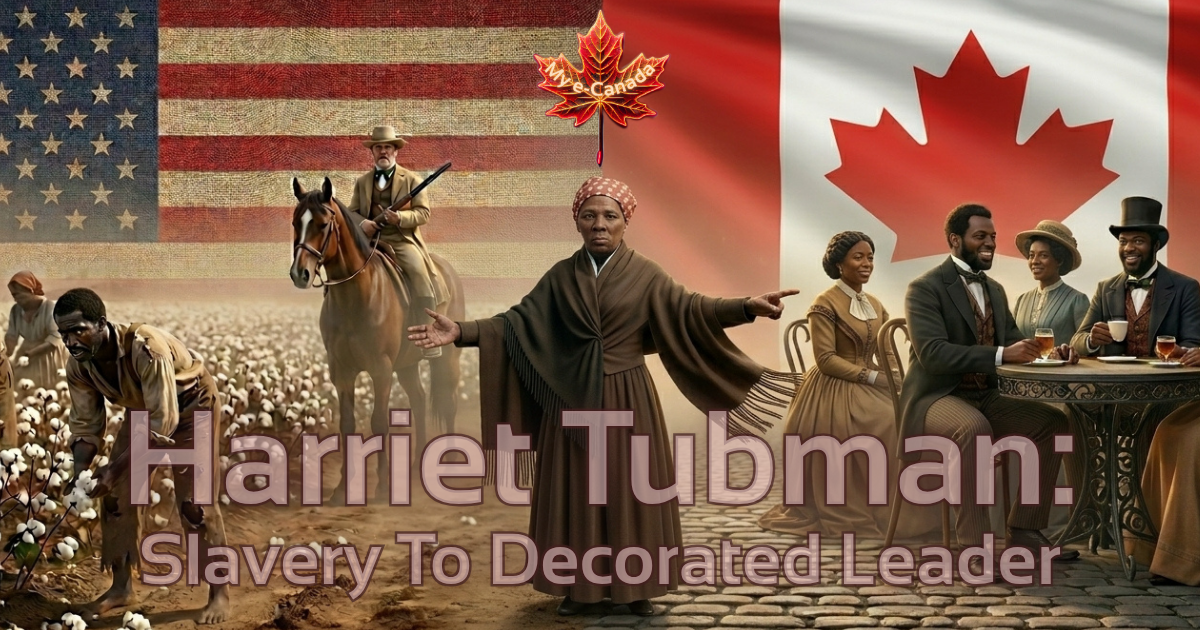

Harriet Tubman: Slavery To Decorated Leader
Monday, August 17, 2026, My e-Canada Word On The Street Investigative News Exposé explores the extraordinary life of Harriet Tubman and her ascent from bondage to Civil War Heroine.
My e-Canada Word On The Street:
Digitally Yours To Explore
Harriet Tubman and Her Parents
Family Roots in Bondage
Her story begins with her parents, Harriet “Rit” Green and Benjamin Ross, who endured life as enslaved Blacks in Dorchester County, Maryland. Benjamin worked as a highly skilled timber estimator, while Rit served inside the plantation household. Harriet Tubman inherited their extraordinary resilience. Her father gained his freedom around 1840 through a will provision, but her mother remained in bondage much longer. Her parents tried hard to maintain a stable home, though the constant threat of family separation hung over them. Slaveholders could break up families at any moment for financial gain. Her mother fought fiercely to keep her children close, even hiding one son to prevent his sale to deep southern plantations. Benjamin passed on vital wilderness navigation skills to his daughter during long woodland assignments. He taught her how to navigate dense forests silently, locate water, and read the stars accurately. These crucial lessons would later save many fugitive Black slaves during dark northern journeys. Harriet Tubman loved her parents deeply and risked everything years later to guide them safely out of Maryland. They eventually settled in Canada West before moving to New York. Her steadfast character was forged by her parents’ enduring strength and silent resistance. Their courage laid the foundation for her legendary life, teaching her that family bonds transcend physical chains. They instilled a deep Christian faith that sustained her through severe physical trials. Benjamin taught her to read weather patterns in the night air, while Rit demonstrated fierce maternal love that protected her children from harm. Harriet Tubman remembered these vital lessons during her darkest rescue missions, drawing strength from her mother’s desperate acts of devotion and relying completely on her father’s forest wisdom.
Early Birth and Childhood
A Harsh Beginning in Maryland
Araminta Ross was born as one of many enslaved Blacks around the year 1822 on Maryland’s Eastern Shore. No official birth certificate was ever recorded for her, as slaveholders rarely kept formal birth records for slave children. She was known affectionately as “Minty” during her youth, later taking her mother’s name, Harriet. She spent her earliest years in a small timber cabin where life was exceptionally harsh from the very start. Hired out to neighboring families by age six, she rocked babies and minded small children continuously. If a baby cried, she suffered brutal beatings that left permanent physical scars on her neck and back. Soon assigned to tough outdoor labour, she checked muskrat traps in icy waters and hauled heavy timber through muddy fields. Outdoor work built up her incredible physical strength and made her intimately familiar with the local landscape. She learned to endure extreme fatigue, bitter cold, and severe hunger without complaint. Her difficult childhood shaped her into an unbreakable survivor who possessed extraordinary mental stamina. She developed keen powers of observation while working outside, learning to read subtle signs in nature and monitor weather changes. She carefully studied the movements of overseers across the local terrain. These harsh childhood experiences hardened her body for future rescue trials, allowing Harriet Tubman to transform early suffering into unmatched physical endurance. Her early years exposed her to the full cruelty of chattel slavery, convincing her early in life that personal liberty was worth any sacrifice.
Harriet Tubman and Her Siblings
Bonds Broken and Restored
Harriet Tubman was one of nine children born to her parents, sharing a bond with brothers and sisters who shared her struggle. Slavery tore their family apart without mercy, selling three of her sisters away to distant southern plantations. Linah, Mariah Ritty, and Soph disappeared from her life forever, causing immense heartbreak for the entire family. Harriet Tubman swore she would eventually save her remaining relatives from a similar fate. She remained particularly close to her brothers Ben, Henry, and Robert. When she successfully escaped, she vowed to return and rescue her family members. She organized a daring rescue for her brothers on Christmas Day in 1854, guiding them safely away from Maryland. She could not save her beloved sister Rachel, who died before an escape could be executed, a loss that haunted her for the rest of her life. Still, she successfully rescued many nieces, nephews, and extended family members over the years. She treated her family as her highest priority, allowing the pain of sibling separation to fuel her anti-slavery drive. She refused to leave her loved ones behind in bondage, risking capture repeatedly to reunite her scattered family. She planned each rescue mission with extraordinary care, precise timing, and absolute discipline. Her brothers trusted her tactical leadership completely during dangerous escape journeys through hostile territories. She protected her family members from ruthless slave catchers along the way, proving that deep familial love could conquer the horrors of forced separation.
Life Under Brutal Slavery
Injury and Spiritual Awakening
Life as enslaved Blacks exposed Harriet Tubman and her peers to constant cruelty and life-threatening danger. During her teenage years, a terrible event permanently altered her physical health and life path. While visiting a dry goods store on a routine errand, an overseer was pursuing an escaping slave. Harriet Tubman courageously stepped in to block the overseer’s path, allowing the young man to flee. The angry overseer threw a heavy two-pound iron weight, striking her directly on the head. The severe injury nearly killed her and required months of painful recovery without proper medical care. She suffered from excruciating headaches, seizures, and narcolepsy for the rest of her life, often falling asleep suddenly during daily tasks. During these sleeping spells, she experienced vivid religious dreams and powerful spiritual visions. She interpreted these visions as direct messages from God, causing her faith to become an absolute, unwavering force. She married a free Black man named John Tubman around 1844, though he did not share her intense desire to escape. When her owner died, the immediate threat of being sold further south forced her hand. She decided she would choose either liberty or death. Harriet Tubman drew profound spiritual strength from her painful physical trauma, believing divine providence directly protected her during perilous situations. Her visions provided vital spiritual guidance during her most challenging moments, enabling her to overcome physical disability through supreme courage. Her spiritual awakening gave her ultimate fearlessness to face any danger ahead.

Harriet Tubman and Her Escape
The Journey to Freedom
In 1849, Harriet Tubman made her historic move toward personal liberation, escaping from Maryland on foot and traveling completely alone. She used the North Star to guide her through dark nights and relied on sympathetic allies along her route. She used secret networks of free Black citizens and white abolitionists who offered shelter and food. The perilous journey covered roughly ninety miles of hostile terrain patrolled by armed slave catchers. She finally reached Pennsylvania, crossing the state line to become one of many successful fugitive Black slaves. She famously remembered looking at her hands to see if she was the same person, feeling a profound sense of relief. Yet, she felt isolated and lonely without her beloved family members nearby. She resolved that her own liberty was incomplete while her relatives remained in physical bondage. Working menial jobs in Philadelphia hotels and kitchens, she saved every penny to fund future rescue operations. She established vital contacts with northern abolitionist leaders like William Still, who documented the arrivals of fugitive Black slaves. She quickly proved her incredible bravery, tactical intelligence, and unwavering commitment to the cause. Her initial escape was merely the opening chapter of a legendary career, as she transformed her personal victory into an ongoing crusade for others. She navigated dark forests and treacherous swamps with amazing skill, avoiding heavy patrols by traveling exclusively during freezing night hours.
Building the Underground Railroad
The Fearless Underground Conductor
Harriet Tubman became the most famous conductor on the Underground Railroad, returning to Maryland approximately nineteen times over a single decade. She personally guided around seventy fugitive Black slaves out of severe bondage and provided direct instructions to dozens more. She operated with extreme care, master strategy, and military precision on every mission. She carried a loaded revolver for protection against slave catchers and to encourage hesitant escapees who feared moving forward. She deployed clever disguises, often dressing as an elderly woman or a free male labourer to evade capture. She preferred traveling during cold winter nights when slave patrols stayed indoors, using coded songs and messages to signal waiting groups. She famously never lost a single passenger on any of her rescue missions. Harriet Tubman earned the revered nickname “Moses” for her miraculous work delivering her people from bondage. High financial bounties were offered for her capture across the American South, yet she consistently outsmarted those who hunted her down. Her incredible courage gave hope to millions living under the lash, proving that the brutal institution of chattel slavery could be successfully defied. Each successful trip struck a massive blow against the plantation economy, as Harriet Tubman managed every detail of her secret missions with absolute discipline. She changed routes frequently to avoid established traps and paid local informants using money earned from exhausting manual labour.
Harriet Tubman and the Law
Fleeing the Fugitive Slave Act
In 1850, national authorities passed the extremely harsh Fugitive Slave Act, placing every escaped person in grave danger throughout the entire region. Northern free states were no longer safe havens, as federal marshals were legally empowered to capture fugitive Black slaves anywhere in the country. Harriet Tubman had to alter her rescue routes immediately to protect those she guided north. She realized that real liberty now required leaving the country entirely, directing her rescue trips further north across the international border. British North America offered genuine legal protection from American bounty hunters and federal marshals. She began leading her weary passengers all the way to Canada, making the northern journey far longer and much more arduous. She guided exhausted groups through freezing winter weather and treacherous wilderness to reach international safety. Her determination only grew stronger under these unjust laws, refusing to let oppressive legislation halt her vital humanitarian work. Crossing the Niagara River meant living under total legal protection, making Canada the ultimate destination for her Underground Railroad operations. Harriet Tubman adapted her tactics to defeat this escalating legal threat, expanding her support network to include Canadian safe houses and abolitionist committees. She demonstrated absolute resolve in the face of grave personal danger, saving countless lives from re-enslavement through her decisive action.

Establishing Base in St. Catharines
A New Home in Canada
Harriet Tubman made St. Catharines, Ontario, Canada, her primary operational base and residence starting in December 1851. The town was strategically located near the Niagara border, making it an ideal terminus for her Underground Railroad rescue missions. She lived in the community for nearly eight years, where the local Black population welcomed her and her Black fugitive slaves rescued passengers. She rented a home on North Street and worked tirelessly to help new arrivals secure shelter, winter clothing, and steady employment. Salem Chapel British Methodist Episcopal Church became her spiritual and social hub, where she worshiped regularly within its historic walls. She used the town as a safe staging area to plan subsequent Underground Railroad rescue trips back into Maryland. Harriet Tubman loved the genuine freedom she experienced on Canadian soil, praising the country for treating Black residents with legal dignity and respect. She successfully brought her elderly parents to live safely in St. Catharines after a thrilling rescue mission. The local Black refugee community grew vibrant and self-sufficient through her dedicated leadership, permanently shaping the history of the Niagara region. Harriet Tubman worked constantly to establish a secure refuge for incoming fugitive Black slaves, helping integrate them into local Canadian society. She organized local relief efforts to provide essential supplies during harsh winter months, turning her home into a warm sanctuary for all who sought freedom.
Harriet Tubman and Canadian Freedom
Living Free Under British Law
In Canada, Harriet Tubman enjoyed complete personal protection under British law, which strictly prohibited chattel slavery across the empire. Black residents possessed legal rights to vote, own real estate, hold trial by jury, and establish independent businesses. She worked hard to support herself in St. Catharines, taking grueling jobs chopping firewood, cooking for hotels, and doing domestic laundry. She never complained about performing difficult manual labour, using her earnings to support needy community members. Harriet Tubman helped create a stable sanctuary for her extended family and dozens of former fugitive Black slaves. Rescued refugees constructed sturdy homes, cultivated farmland, and established successful businesses throughout the region. They created a prosperous, self-sufficient community that actively welcomed new arrivals fleeing American bondage. Her home was always open to anyone requiring food, shelter, or moral encouragement. While Canadian winters were severe, the warmth of true liberty made the climate completely bearable. She frequently spoke about the beauty of absolute equality under the crown, making her Canadian years among her most productive operational periods. She proved to the world that former slaves could build thriving lives when granted total emancipation. Her success inspired abolitionists on both sides of the border, as Harriet Tubman found true peace and social standing under Canadian laws, participating actively in local civic life.
Collaborating with John Brown
Planning Resistance in Ontario
Harriet Tubman met the famous radical abolitionist John Brown in Chatham, Ontario, Canada, during April 1858. Brown held immense respect for her military intelligence, wilderness skills, and courage, affectionately referring to her as “General Tubman.” He shared his secret plan to launch an armed assault against southern slaveholders to force emancipation. She approved of his bold goal to end slavery through direct action, helping him recruit former fugitive Black slaves living in Canada. She shared her extensive knowledge of southern mountain terrain, secret hideouts, and escape routes. Severe illness unfortunately prevented her from joining his actual raid on Harpers Ferry in October 1859. She deeply mourned his execution after the raid failed, viewing him as a true martyr for total emancipation. Their strategic collaboration highlighted her growing status as a major military planner and freedom strategist. Her time in Canada was filled with intense political organizing, connecting Canadian abolitionists with the broader international movement. Harriet Tubman provided Brown with invaluable tactical advice, mapping out regions where enslaved Blacks could join his guerrilla army. She organized secret meetings in Chatham to gather financial support and recruits for his cause, giving Brown immediate credibility among local Black residents. Their historic meeting in Ontario marked a major turning point in the radical anti-slavery struggle.
Harriet Tubman and Civil War Service
Scout, Nurse, and Military Leader
When the American Civil War began in 1861, Harriet Tubman volunteered her services to assist the Union forces. She left her home in Canada to travel south, initially working as a dedicated nurse caring for sick soldiers and liberated slaves. She used herbal remedies to cure dysentery, smallpox, and malignant fevers in military camps. Soon, her extraordinary scouting and espionage abilities were recognized by Union commanders in South Carolina. She organized and commanded an elite group of Black scouts, mapping enemy positions and gathering vital military intelligence behind Confederate lines. Harriet Tubman famously helped plan and lead the historic Combahee River Raid in June 1863, becoming the first woman to lead an armed military assault in the war. Her tactical leadership enabled Union gunboats to bypass dangerous river mines and surprise Confederate garrisons. The successful raid destroyed valuable enemy supplies and liberated over seven hundred enslaved Blacks in a single night. She guided the frightened masses onto Union ships while enemy troops fired upon them, earning national military renown. She served the war effort for years without receiving regular military pay or recognition, proving that women could excel in high-level military leadership and intelligence gathering under combat conditions.

Social Impact on Canadian History
A Lasting Legacy in Ontario
The historical impact of Harriet Tubman on Canadian heritage remains profound, deep, and lasting. She played a central role in transforming St. Catharines and the broader Niagara peninsula into major freedom hubs. Hundreds of modern Black Canadians trace their direct family ancestry to the fugitive Black slaves she guided across the border. She proved to the international community that Canada was a true beacon of human rights and legal protection. Today, schools, public parks, and heritage sites across Ontario proudly bear her name. Salem Chapel in St. Catharines stands as a cherished National Historic Site, attracting visitors from around the world who come to honor her memory. Harriet Tubman greatly strengthened early Black Canadian civil society, demonstrating the power of community organization and cross-border solidarity. Her life story is taught in educational curricula across the nation, serving as a vital historical bridge between Canadian and international freedom struggles. The federal government officially recognized her as a Person of National Historic Significance, celebrating her bravery and devotion to human liberty. Her enduring legacy continues to inspire modern Canadian human rights activists and educators, establishing a high standard of moral courage that enriches the cultural fabric of the nation.
Harriet Tubman and Later Years
Humanitarian Work in Auburn
Following the Civil War, Harriet Tubman settled permanently in Auburn, New York, purchasing a modest property from Senator William Seward. She brought her elderly parents from Canada to live comfortably on her farm. Despite her heroic achievements, she lived in constant financial hardship for decades, receiving no official compensation for her military service. She married a Civil War veteran named Nelson Davis in 1869, and together they adopted a baby girl named Gertie in 1874. She continued her lifelong humanitarian work, opening her home to anyone who needed food, shelter, or medical attention. Harriet Tubman struggled for decades to secure a rightful military pension from the federal government, eventually receiving a small widow’s pension. She raised funds to establish the Harriet Tubman Home for Aged and Indigent Negroes, donating her own land to ensure its construction. She remained deeply active in the women’s suffrage movement, speaking at national conventions alongside Susan B. Anthony and demanding voting rights for all women. Her incredible generosity knew no bounds, supporting her extended family through farming, peddling wood, and public speaking engagements. She supported local charities until her final days, proving that her commitment to serving humanity remained central to her character throughout her long life.
The Final Years and Passing
Honoured in Death and Memory
In her final years, Harriet Tubman moved into the rest home she had worked so hard to establish. She was surrounded by loving friends, family members, and supporters who cared for her in her advanced age. Her physical body was weary from decades of intense labour, military service, and arduous travels. She suffered from lingering head pain caused by her teenage injury, choosing to undergo brain surgery without anesthesia at Boston’s Massachusetts General Hospital. Harriet Tubman passed away from pneumonia on March 10, 1913, at approximately ninety-one years of age. She was buried with full military honors at Fort Hill Cemetery in Auburn, New York, as community leaders paid tribute to her extraordinary achievements. Tributes poured in from around the world, honoring her unmatched heroism, tactical genius, and selfless devotion to human freedom. Monuments, statues, and historical markers were erected across North America to preserve her remarkable legacy for future generations. She transformed from a young girl born into chattel slavery into an immortal international hero. Harriet Tubman faced death with the exact same quiet faith and fearlessness that guided her through dangerous forests and battlefields. Her memory continues to shine as a powerful symbol of courage, faith, and liberation.
Final Word On The Street: Harriet Tubman
An Inspiration for Future Generations
The timeless legacy of Harriet Tubman continues to inspire millions of people across North America and around the world. She conquered tremendous physical and societal odds through sheer strength, tactical intelligence, and unwavering spiritual faith. She demonstrated what one determined individual can accomplish when fighting against systemic evil and institutional injustice. Her deep historical connection to Canada highlights the nation’s pivotal role as a sanctuary for fugitive Black slaves seeking legal equality. She reminds us all of the immense human cost of liberty and the ongoing necessity of defending basic human rights. Harriet Tubman remains an enduring icon of justice, military courage, and profound selflessness. Historical societies, museums, and educational institutions preserve her powerful life story to educate future generations. Her extraordinary courage challenges modern society to confront oppression wherever it exists, proving that personal liberty is worth risking everything to achieve. Generations of activists look to her heroic life for guidance, strength, and inspiration, ensuring that her name will live forever in the annals of human history. She stands tall as one of history’s greatest liberators, leaving behind a magnificent legacy that transcends borders and continues to inspire humanity.
Thank you for reading this investigative news exposé. We virtually remain My e-Canada Word On The Street: Digitally Yours To Explore
Abolition Movement, Black History, Canada West, Canadian Heritage, Canadian History, Civil War Scout, Combahee River Raid, Digitally Yours To Explore, Enslaved Blacks, Fugitive Black Slaves, Harriet Tubman, human rights, John Brown, My e Canada, Ontario History, Salem Chapel, St Catharines, Underground Railroad, Wayne A. Cargill, Wayne A. Cargill Agency, Word On The Street
Leave a Reply