
Your cart is currently empty!

Greenland: The Last Line of Defence Against Annexation and The 51st State
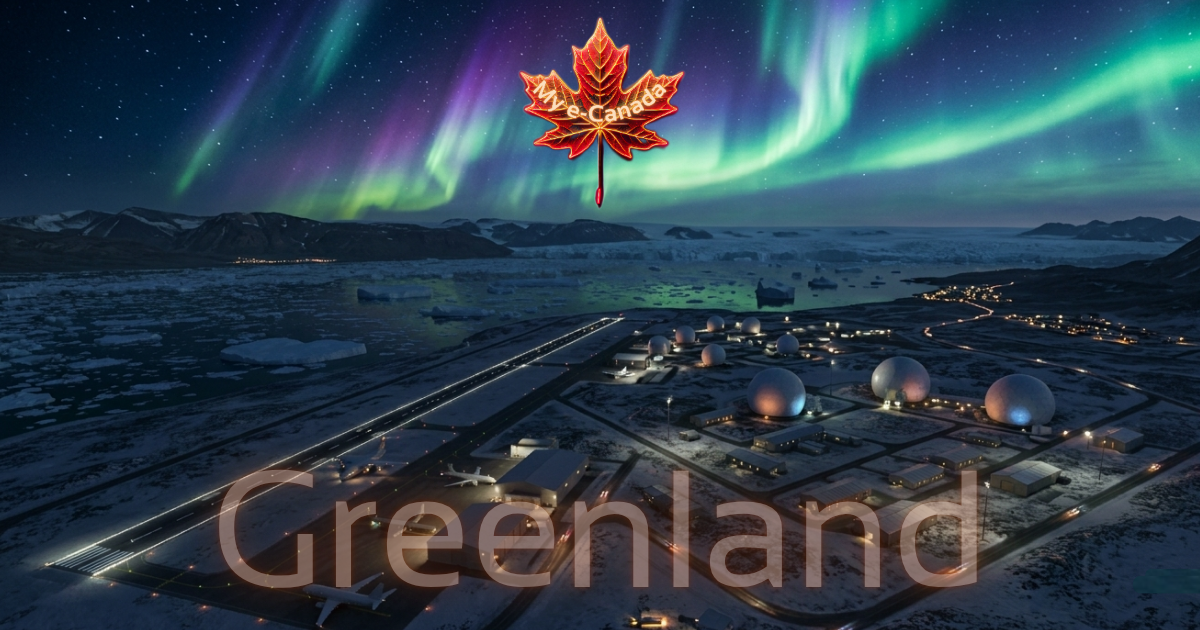
This Word On The Street exposé explores just how critical Greenland is to Canadian sovrenty. From a purely geopolitical and military standpoint, a U.S. acquisition of Greenland would significantly alter the strategic landscape. This move effectively brackets Canada between American territories. Takeover is a strong term for two close allies. However, historians and defence analysts note that U.S. control of Greenland creates a unique strategic encirclement. This increases American leverage over Canadian interests significantly. The northern frontier would no longer be a shared space. It would become a managed American perimeter.

Strategic Encirclement and Sovereignty
If the U.S. were to possess this vast island, Canada would be surrounded on three sides. Alaska sits to the west. The continental United States lies to the south. Greenland would complete the pincer to the east. This gives the U.S. nearly complete control over maritime approaches to the Canadian Arctic. Historically, Secretary of State William Seward argued for this in 1867. He believed acquiring the island would sandwich Canada. He thought it would eventually compel a union. In a modern context, this makes dictating Arctic transit terms much easier.
Greenland: Maritime Control and The Northwest Passage
One major point of friction is the status of the Northwest Passage. Canada claims these waters as internal sovereign territory. The U.S. and much of the world view them as an international strait. U.S. control of Greenland provides a permanent naval base on the eastern mouth. This mirrors their presence in Alaska. This pincer position allows the U.S. to conduct Freedom of Navigation Operations. They could monitor all traffic without requiring Canadian permission. Sovereignty over these waters would become a functional impossibility for Ottawa.
Defence Infrastructure and Integrated Systems
Greenland is already a cornerstone of the North American Aerospace Defence Command. The Pituffik Space Base provides essential early-warning data. It supports the “Golden Dome” missile defence system. If the island were U.S. territory, integration would likely bypass bilateral negotiations. The U.S. could manage North American security with less reliance on the Canadian military. This shift reduces Canada’s sovereignty through participation. The U.S. would increasingly view the entire Arctic as a domestic security zone. Canadian input would become secondary to American domestic policy.
Greenland: Economic and Resource Leverage
Greenland holds vast reserves of rare earth minerals and potential offshore energy. These are vital for the 21st-century economy. By controlling these resources, the U.S. reduces its reliance on global supply chains. Some of these current chains pass through or involve Canada. Furthermore, controlling trans-Arctic shipping routes gives the U.S. a massive economic check. They would hold the keys to Canada’s northern back door. Any Canadian resistance to U.S. policy becomes significantly more difficult to maintain. Economic dependence would likely lead to political alignment.
Impact on Maritime Sovereignty
The immediate strategic advantage for the U.S. is the resolution of the passage dispute. Canada maintains these waters are internal territory. The U.S. disagrees. With Greenland as U.S. territory, the American military could station permanent surveillance assets. These would sit at the eastern gate of the passage. They would mirror the Bering Strait assets. This allows for FONOPs across the entire northern coast. Canadian claims of internal waters would become unenforceable. Physical presence always outweighs legal theory in the High Arctic.
Greenland: Continental Shelf Claims and the Lomonosov Ridge
Canada, Denmark, and Russia have overlapping claims to the Lomonosov Ridge. This underwater range holds rights to North Pole resources. If the U.S. were to acquire Greenland, it inherits Denmark’s claims. This puts the U.S. in direct legal conflict with Canada over the seabed. Given the power disparity, the U.S. could pressure Canada into unfavorable settlements. They might seize control of the resource-rich seabed Canada considers its own. Scientific data would become a tool for American territorial expansion.

Client Scout e-Advertising Slogans:
The Pulse of Your Digital Ad Campaigns
The Whisky War Legacy and the Hans Island Border
The 2022 resolution of the “Whisky War” created a land border. This border sits on Hans Island between Canada and Greenland. If the U.S. took the island, this becomes a new American land border. It would be the only one besides the 49th parallel and Alaska. The U.S. could station monitoring equipment directly adjacent to Canadian soil. This northern border could be militarized easily. It would serve as a security outpost to monitor Canadian activity. Canada’s ability to act as an independent power would erode further.
Greenland: Economic and Infrastructure Leverage in the North
Control over Greenland gives the U.S. a monopoly on northern infrastructure. As routes open due to melting ice, Greenlandic ports will compete with Canadian ones. By developing this infrastructure, the U.S. could bypass Canadian territory entirely. This deprives Canada of transit fees and strategic relevance. Furthermore, the U.S. could use rare earth minerals to undercut Canadian mining. Canada would become economically dependent on American-controlled supply chains. Domestic interests would be sacrificed for continental American priorities.
The Dismantling of NORAD Architecture
The potential for a U.S. acquisition would fundamentally dismantle NORAD. Currently, it is a bi-national partnership. Canada and the U.S. share responsibility for aerospace warning. If Greenland becomes American territory, the power dynamic shifts toward dominance. Canada’s strategic relevance is significantly diminished in this model. The partnership of mutual dependence would end. It would be replaced by a system of American unilateralism. Canada would effectively become a passenger in its own continental defence.
Greenland: The Erosion of Sovereignty through Participation
Canada’s primary defence strategy is sovereignty through participation. By contributing to NORAD, Canada earns a seat at the table. However, with the U.S. controlling Greenland, the “Golden Dome” initiative changes. It would likely be centered in American territory alone. This creates a U.S.-only defensive perimeter. It bypasses the need for the North Warning System. Canada could find itself excluded from the shield. Leverage to demand a say in Arctic security policy would vanish.
Shift from Bi-National to Unilateral Defence
In 2026, Canada is doubling down on Arctic operations like Operation NANOOK. If the U.S. annexes the island, the bi-national nature of NORAD dies. The U.S. would no longer defend a shared space. It would be defending its own domestic territory. This leads to a restructuring where USNORTHCOM takes the lead. The Canadian NORAD Region would be relegated to a secondary role. This role would focus only on the internal landmass. The broader Arctic approaches would be an American lake.
Greenland: Tactical and Logistical Isolation of the North
U.S. acquisition would physically isolate Canadian military operations. Currently, Canada and Denmark have deep ties. These include a 2026 agreement to counter annexation threats. If Greenland becomes U.S. soil, Canada loses its primary non-U.S. partner. Logistically, the U.S. would control the pincers of the passage. For Canadian forces to move, they must pass through U.S. zones. In high tension, the U.S. could restrict military transit. The Canadian Navy could be trapped in its own ports.
Increased Burden-Sharing Pressure from Washington
By 2026, the U.S. has increased pressure on NATO allies. A U.S.-owned Greenland would raise the ante for Arctic defence. The U.S. would demand that Canada increase its own infrastructure. This must match American investment in the island. If Canada cannot keep pace, it must cede control. Operational control of Canadian airspace would go to the U.S. Air Force. The line between Canadian defence and American security would blur. Eventually, that line would disappear entirely.
Greenland: Industrial Displacement and the ICE Pact
The Icebreaker Collaboration Effort is a pillar of Arctic security. A U.S. takeover of the island would destabilize this pact. Canada uses this to build ships like the Polar Max. If the U.S. owns the eastern Arctic, it needs Canada less. It could prioritize its own Arctic Security Cutter program. Greenlandic ports would serve as their primary bases. This marginalizes the Canadian fleet. American industrial support for Canadian shipyards would likely vanish. Canada would be left with expensive ships and no mission.
Finnish Alignment and European Fallout
Finland’s role in the pact is centered on technical expertise. However, Finland is committed to international law. A U.S. takeover of Greenland would be seen as a violation. Finland might be pressured by the EU to withdraw. This deprives the alliance of critical technology. The U.S. would then look to Canada to fill the gap. If Canada cannot, the U.S. might move to absorb Canadian shipyards. This economic absorption is often the first step toward political annexation.
Greenland: Competition for Arctic Gatekeeping Roles
The ICE Pact aims to create a unified fleet. With Greenland in American hands, the U.S. becomes the sole gatekeeper. They would control the Northwest Passage and the North Pole approaches. The pact would shift from cooperation to American enforcement. The U.S. might use its fleet to dictate transit rules. These would directly contradict Canadian legal positions. A collaborative agreement would become a maritime arms race. Canada would struggle to maintain any visible sovereign presence.
The Psychology of Encirclement in Ottawa
Political leaders in Ottawa would face a new reality. With Alaska and Greenland both under U.S. flags, Canada is a geographic island. This creates an immense psychological burden on policy makers. Every decision regarding the North must be cleared by Washington. The feeling of being a “protectorate” would grow. Over time, the cost of maintaining a separate military would seem wasteful. Integration would be presented as the only logical path forward. Nationalism would slowly give way to pragmatic survival.
Greenland: Economic Gravity and the Continental Energy Argument
The economic pull of the U.S. is already the defining feature. If the U.S. controls the island’s minerals, Canada loses its edge. The U.S. would no longer need Canadian resources for its supply chain. This weakens Canada’s bargaining power in all trade. Proponents of annexation would argue for a North American Union. They would claim it eliminates trade barriers. With the U.S. owning the gateways, Canada joining as states becomes persuasive. The business sector would likely lead this charge for profit.
The Timeline to the 51st State
The timeline for such a shift is measured in decades. Formal annexation faces immense legal and cultural hurdles. Canada is a constitutional monarchy with a unique identity. This identity is built on not being American. However, many suggest a stealth annexation model. This involves a 20-year period of harmonizing laws and borders. The distinction between the nations would exist only on paper. A formal transition might take 50 years. Cultural attachments take time to fade into economic reality.
Greenland: The Political Reality of 2026 Expansionism
In 2026, any move toward the island is a threat. It challenges the rules-based international order directly. The strategic advantages are clear to military planners. However, the immediate aftermath would be intense friction. Canada would seek closer ties with the EU to balance the pincer. Logistical ease does not equal political ease. Greenland would galvanize Canadian nationalism in the short term. But geography is a patient and persistent force in history.
Greenland: The Future of Canadian Sovereignty
The last line of defence is not a mere physical barrier or a wall. Instead, it is the unwavering political will and determination of the Canadian people. If the Greenland falls into American hands, that collective will is immediately put to a severe and critical test. Every ship navigating the passage would serve as a constant and unmistakable reminder of American power and presence. Every satellite feed and communication would be controlled and transmitted from an American base, effectively erasing Canadian sovereignty in the region. The Arctic, once a proud symbol of Canadian identity and sovereignty, would no longer feel like it belongs to Canada. Once the core and heart of that national identity are lost, the rest of the nation’s unity and integrity often follow. Annexation is rarely a single, sudden event; rather, it is a slow, cold, and gradual erosion of what was once a proud and independent nation.
Historical Precedents for Territorial Purchase
The idea of purchasing large tracts of land is not new. The Louisiana Purchase and Alaska are famous examples. In each case, the U.S. sought to secure its borders. Controlling Greenland is the natural conclusion of this doctrine. Critics call it imperialism. Supporters call it continental security. Canada has always watched these moves with quiet anxiety. History shows that when the U.S. wants land, it eventually finds a way. The island is simply the latest chapter.
Greenland: Cultural Resistance in the Canadian North
Indigenous populations in the North have their own views. They have lived there longer than any modern state. Their ties to the land across Greenland are ancient. A U.S. takeover would disrupt their traditional social structures. Canada has spent years on reconciliation and shared governance. The U.S. model is often more focused on federal control. This cultural clash would be a major hurdle. It could become a point of resistance for Canadian sovereignty.
Greenland: Environmental Policy as a Battlefield
Climate change is making the Arctic accessible. Melting ice reveals the riches of Greenland. Canada and the U.S. have different environmental standards. If the U.S. takes control, they set the rules. They could allow drilling where Canada forbids it. This would create ecological risks for Canadian shores. Canada would have no legal standing to stop it. Environmental sovereignty is just as important as military power. Loss of the island means loss of the climate future.
The Role of International Law in 2026
The United Nations Convention on the Law of the Sea is vital. It governs how countries claim the seabed around Greenland. If the U.S. is not a signatory, it might ignore these rules. This would leave Canada in a vulnerable position. They would be fighting a legal battle against a neighbour who doesn’t play by the rules. The Arctic would become a “Wild West” of resource grabbing. International law only works when the strongest powers agree to follow it. Without that, the island is just a prize for the taking.
Conclusion of Greenland As The Last Line of Defence
The narrative of the 51st state is often a joke. But in the shadow of the island, it becomes a warning. Encirclement is a physical reality that changes how nations think. Canada must decide if it can remain a middle power. Or will it become a northern extension of a superpower? The Arctic is the final frontier of this struggle. Greenland is the key that unlocks the door to annexation. Once that door is open, the map of North America changes forever.
Summary of the Investigative Dossier This report highlights the “pincer” effect of U.S. control over the Arctic. It outlines the inevitable erosion of Canadian maritime and aerospace sovereignty. It concludes that while formal statehood is decades away, the functional annexation begins the moment Greenland changes flags. The 2026 geopolitical climate has made this a matter of immediate national concern for Ottawa, and every Canadian.
51st State, Annexation, Arctic Council, Arctic geopolitics, Arctic warfare, Canadian English, Canadian sovereignty, Client Scout, Continental shelf, Defence infrastructure, Geopolitical pincer, Greenland, International relations 2026, Investigative reporting, Lomonosov Ridge, Maritime law, Military strategy, My e-Canada, National identity, Natural resources, NORAD, North American security, Northwest Passage, Pituffik Space Base, Rare earth minerals, Resource extraction, Strategic encirclement, Territorial integrity, US-Canada relations, Wayne A. Cargill, Wayne A. Cargill Agency, Word On The Street
Leave a Reply