
Your cart is currently empty!
The Complete Halting of Flight Routes to Cuba
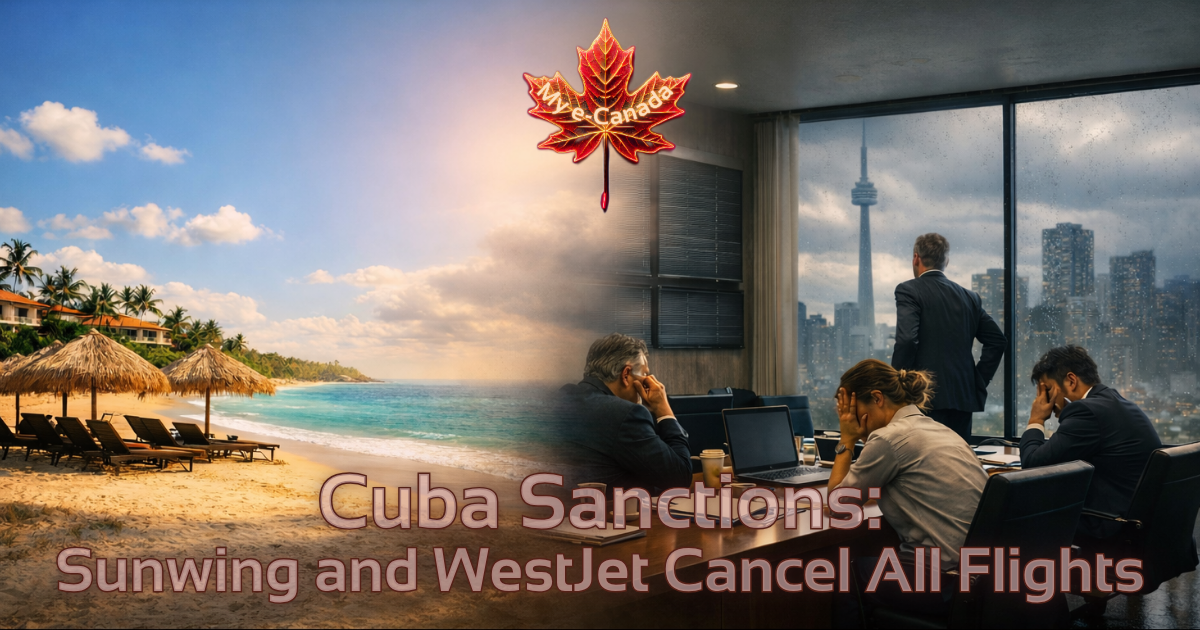
Friday, June 5, 2026, My e-Canada Word On The Street Investigative News Exposé explores the Sunwing and WestJet’s immediate suspension of flights to Cuba. The entire travel landscape for Canadian sun-seekers has dramatically collapsed overnight. Sunwing Vacations Group has officially confirmed an indefinite cessation of all commercial flight routes. This major corporate announcement includes WestJet Vacations and WestJet Vacations Québec. This massive administrative choice moves far beyond the temporary pauses that were originally outlined earlier this spring. In April, executives had merely suspended services for the summer months. They confidently anticipated a full operational return by October. However, the deteriorating local situation has completely erased those recovery timelines. The commercial decision impacts thousands of pre-booked vacation itineraries from coast to coast. Every single flight gateway across our provinces is now completely dark. Corporate representatives cite a severely degraded operating environment as the core justification for this exit. This drastic move follows identical flight suspensions by rival carriers Air Canada and Air Transat. Aviation fuel has become virtually non-existent at regional airports across the island. Planes can no longer reliably refuel for their mandatory return journeys to North America. Travellers are currently being offered alternative destination rebookings or complete financial refunds. This massive logistics disruption signals a permanent shift in regional tourism dynamics. The complete withdrawal of these popular discount carriers marks the end of an era for affordable tropical travel. Industry specialists predict these sudden route closures will trigger widespread financial losses throughout the entire Canadian travel agency sector.
My e-Canada Word On The Street:
Digitally Yours To Explore
Geopolitical Impasse and Infrastructure Collapse
The root causes of this unprecedented travel crisis are deeply political. An ongoing foreign energy blockade has systematically choked off fuel shipments. The economic situation worsened dramatically following significant international power shifts. New leadership in Washington implemented aggressive regional policies to destabilize the local regime. These strict foreign measures specifically targeted vital petroleum supply lines. Consequently, electricity and gasoline reserves have completely vanished across the territory. Massive blackouts occur daily, leaving major resort areas without basic power. Water shortages and severe food deficits plague local communities constantly. The tourism sector cannot insulate its international guests from these structural failures anymore. Even prestigious international resort chains are completely abandoning their local properties. Major operators like Spanish hotel giant Meliá have ceased managing numerous locations. The collapse of basic infrastructure makes luxury hospitality impossible. Flight operators cannot guarantee passenger safety under these volatile operational conditions. The local administration blames foreign blockades for the widespread human suffering. However, geopolitical tensions show no signs of easing anytime soon. Canadian operators are forced to adapt to this permanent economic reality. The severe lack of aviation fuel represents the final breaking point for scheduling. Planes require secure infrastructure that the current environment simply cannot provide. This dynamic has forced domestic airlines to protect their assets through immediate route cancellations. The Caribbean island faces total isolation as Western travel networks vanish completely.
How Washington’s New Measures On Cuba Ripple Through Canadian Travel
The United Stated Executive Order 14404
A primary driver behind this rapid corporate retreat is Executive Order 14404. Signed into law on May 1, 2026, this decree fundamentally alters international trade. It imposes a modern secondary sanctions regime targeting the economy of Cuba. The legal order introduces a strict list-based program targeting foreign institutions. This aggressive framework operates under the International Emergency Economic Powers Act. It explicitly penalizes non-American corporations that engage in significant transactions with local entities. Any enterprise dealing with designated individuals or state-owned firms faces severe financial exile. The Office of Foreign Assets Control is authorized to block access to the financial system. This creates immense legal risks for multi-national corporations operating globally. Companies with extensive assets or business interests down south must choose sides immediately. The threat of being cut off from international banking is incredibly terrifying. Consequently, corporations are rapidly severing their long-standing ties to protect their core businesses. The executive order aims to completely starve the local regime of foreign capital. It deliberately exploits the global dominance of Western banking networks to enforce compliance. Canadian corporations find themselves caught directly in the crossfire of this foreign policy offensive. The legal ramifications of non-compliance are far too devastating to ignore. Every financial transaction involving regional tourism infrastructure is now viewed as an unacceptable risk. The executive decree effectively isolates the territory by penalizing its global commercial partners.
Corporate Compliance and Legal Consequences
The legal exposure for Canadian aviation executives under this new order is unprecedented. Flying commercial aircraft into sanctioned territory requires complex interactions with state entities. Landing fees, navigation services, and fuel purchases are all handled via state-run enterprises. Under Executive Order 14404, these standard business transactions can be construed as facilitating trade with bad actors. If the Office of Foreign Assets Control designates a local airport authority, the airline faces immediate penalties. This includes the potential freezing of corporate bank accounts located across the border. For a consolidated entity like Sunwing Vacations Group, the consequences would be absolutely catastrophic. They rely heavily on trans-border commerce and global leasing networks for their fleet operations. Risk management teams have clearly concluded that maintaining these routes is no longer viable. The cost of compliance and potential legal defense outweighs any potential profit from vacation packages. Legal advisors are counselled to err on the side of extreme caution regarding international sanctions. This corporate shift prioritizes long-term financial security over seasonal tourism revenue. It reflects a broader trend of corporate de-risking sweeping through the global aviation industry. Airlines cannot afford to alienate dominant regulatory authorities for the sake of discount vacation routes. The immediate cancellation of flights is a direct response to these severe compliance pressures.
Pro-Worker Ideals Versus Corporate Survival in Cuba
The Disruption of the Canadian Travel Sector
The business pros of withdrawing from the region center entirely on risk mitigation. By abandoning these volatile routes, airlines protect themselves from devastating secondary sanctions. They also eliminate the immense operational costs associated with fuel shortages and flight delays. Stranded aircraft and displaced crews create massive logistical nightmares that drain corporate resources. However, the cons for Canadian businesses are incredibly severe and widespread. Travel agencies specializing in affordable winter getaways are seeing their business models completely destroyed. Cuba has historically served as a high-volume destination that generated steady, predictable revenue. Independent operators cannot easily replace this unique market niche with other destinations. Alternative Caribbean locations like Cancun or Punta Cana are significantly more expensive. This price inflation reduces the total volume of bookings from middle-class consumers. Furthermore, airlines must write off significant investments made in local resort partnerships. Marketing campaigns centered on the island are now completely wasted capital. The sudden shift forces a massive rewriting of corporate strategy for the entire hospitality sector. Wholesale operators must scramble to secure hotel allocations in crowded alternative markets. This logistical chaos increases administrative overhead and diminishes profit margins across the industry. The sudden flight cancellations create a profound economic ripple effect throughout our domestic commercial travel network.

The Financial Toll on Independent Agencies
Smaller, independent travel advisories face the most acute economic pain from this decision. Unlike massive corporate conglomerates, these family-owned businesses operate on razor-thin profit margins. They rely heavily on the loyalty of repeat customers who visit the island annually. Processing thousands of immediate refunds strips these agencies of their hard-earned sales commissions. Staff hours must be dedicated entirely to crisis management rather than generating new sales. This administrative burden comes at a time when operating costs are rising domestically. Many agents feel completely blindsided by the suddenness of the indefinite flight suspension. They are forced to deliver disappointing news to long-time clients daily. Finding comparable vacation packages within the same budget constraints is practically impossible. The loss of consumer confidence could cause long-term damage to the profession. Some boutique agencies that specialize exclusively in regional cultural tours may not survive. They face total revenue insolvency if the borders remain closed through the winter. The corporate decision to cancel flights reflects a protective strategy for the carriers. However, it completely shifts the financial burden onto the shoulders of small businesses. This imbalance highlights the vulnerability of our domestic travel sector to sudden foreign shocks.
Consumer Rights and the Loss of Cuba
The Impact on Canadian Consumers
For the Canadian public, the pros of this policy shift are virtually non-existent. The only marginal benefit is that travellers are protected from getting stranded abroad. Being caught in a foreign country during a total infrastructure collapse is dangerous. However, the negative impacts on ordinary citizens are deeply profound and multi-faceted. Cuba has long been a cherished destination for working-class families across our country. It offered an accessible, affordable escape from our harsh winter climate. Eliminating this option removes the most budget-friendly tropical destination from the market. Families are now forced to pay premium prices to visit alternative Caribbean countries. This cost inflation prices out thousands of citizens who view annual vacations as vital. The social connection between our population and the local islanders is also severed. Many Canadians have developed deep personal friendships with hospitality workers over decades. They frequently bring essential goods, medicines, and clothing to support local communities. The cancellation of flights stops this grassroots humanitarian support entirely. Our public loses a beloved cultural escape, while vulnerable locals lose a vital lifeline. The societal cost of this geopolitical maneuver is measured in fractured human connections.
Humanitarian Fallout and Public Regret
The humanitarian aspect of this travel ban weighs heavily on the Canadian conscience. Tourism has historically served as the primary economic engine for the island’s population. Local families rely directly on the tips and gifts provided by international visitors. With the total absence of northern carriers, these workers face immediate economic ruin. The loss of foreign currency worsens the already desperate shortages of food and medicine. Many travellers express deep sadness over the abandonment of these communities. They feel that foreign geopolitical blockades are unfairly punishing innocent civilians. Public forums are filled with expressions of regret and concern for local friends. The sudden policy shift leaves citizens feeling completely powerless against international mandates. Community groups that organize regular aid shipments are now facing insurmountable logistics hurdles. They cannot easily ship supplies without the cargo space provided by commercial airlines. This disruption accelerates the ongoing social tragedy unfolding across the Caribbean territory. The Canadian public is forced to watch this humanitarian decline from a distance. Our traditional role as a supportive international partner is effectively neutralized by these measures.
Airline Consolidations, Legal Battles, and the Ottawa Response
Air Canada and Transat Prioritize Compliance Over Cuba
The Broader Context of Airline Withdrawals
The immediate suspension of flights by Sunwing and WestJet is not an isolated event. It represents the culmination of a broader corporate exodus from Cuba. Air Canada led this retreat earlier this year by quietly cutting its schedules. They cited severe logistical challenges and a critical shortage of aviation fuel. Air Transat followed suit shortly after, halting all operations to the island. This collective withdrawal leaves our country completely disconnected from its traditional winter destination. The airlines are prioritizing strict compliance with international law over market share. They operate within a deeply integrated North American aviation market that demands conformity. A carrier cannot easily operate if it is barred from using trans-border infrastructure. This operational reality forces competitive rivals to adopt identical protective strategies. The consolidation of these commercial decisions has left consumers with absolutely zero options. The domestic airline sector is acting uniformly to shield itself from foreign legal penalties. This corporate solidarity illustrates the immense power of secondary sanctions over sovereign commercial entities. The economic independence of our national aviation sector is effectively compromised by these external decrees. Profits from regional routes are simply not worth the risk of total exclusion from global commerce.
The Structural Vulnerability of National Carriers
Our domestic aviation industry has always operated under severe structural constraints. High fuel costs, vast distances, and heavy regulatory fees limit profitability. Maintaining unprofitable or high-risk international routes is an unsustainable corporate strategy. The introduction of Executive Order 14404 exposed the deep vulnerability of our airlines. They are completely dependent on international financial clearinghouses to conduct daily business. A single sanctions violation could disrupt credit facilities and aircraft leasing arrangements instantly. This operational dependency means that foreign laws dictate domestic corporate policy. Boardrooms in Calgary and Montreal are forced to mirror the decisions made by foreign politicians. This loss of commercial autonomy concerns industry analysts deeply. They argue that our transportation network should serve domestic interests first. Instead, carriers are acting as instruments of external foreign policy objectives. The flight cancellations represent a complete surrender to external economic coercion. This precedent could threaten other international routes if global geopolitical tensions continue to rise. Airlines are demonstrating that compliance will always supersede customer service and traditional market loyalty.

Confronting the Reality of Cuba Travel Bans
Legal Precedents and the Foreign Extraterritoriality
The enforcement of foreign laws within our borders violates traditional concepts of sovereignty. Historically, Ottawa has resisted the extraterritorial application of foreign blockades. The Foreign Extraterritorial Measures Act was designed specifically to protect domestic companies. It legally prohibits Canadian businesses from complying with foreign anti-Cuba legislation. This creates a severe legal paradox for corporate executives operating in our country. Domestic law commands them to ignore the blockade, while foreign decrees threaten financial ruin. In practice, the threat of foreign financial exclusion carries far more weight than domestic penalties. Corporations are choosing to violate the spirit of domestic sovereignty to ensure economic survival. They disguise their compliance by citing operational challenges and fuel shortages. This corporate camouflage allows them to avoid direct conflict with domestic regulators. However, the reality of their motivation is perfectly clear to investigative analysts. Executive Order 14404 has effectively neutralized our domestic legal protections through sheer financial dominance. This systemic failure reveals the limitations of middle-power diplomacy in a polarized world. Our legal frameworks are simply insufficient to shield corporations from global banking sanctions. The resulting corporate retreat leaves our foreign policy looking weak and entirely compromised.
The Failure of Sovereign Legal Shields
The tension between domestic sovereignty and globalized commerce is reaching a crisis point. Our legal shields are proving completely ineffective against modern targeted sanctions. Corporate lawyers recognize that domestic courts cannot protect an airline from international financial isolation. If a carrier is blacklisted, it loses the ability to purchase fuel globally. It cannot process credit card transactions or insure its aircraft hulls. Faced with this reality, the Foreign Extraterritorial Measures Act becomes a useless piece of paper. Executives will always choose corporate survival over symbolic acts of national defiance. This pragmatic submission undermines the authority of our federal parliament over local corporations. It demonstrates that global capital networks possess greater coercive power than sovereign states. The flight cancellations are a visible symptom of this broader shifts in global governance. Our national commercial policy is being actively rewritten by foreign executive decrees. This erosion of autonomy sets a dangerous precedent for future international trade disputes. If we cannot protect our travel sector, we cannot protect other critical industries from similar coercion.
Ottawa and the Political Silence on Cuba
The Federal Response and Diplomatic Inertia
The federal government under Prime Minister Mark Carney has maintained a cautious stance. Foreign Affairs Minister Anita Anand previously advised all citizens to return home. This early advisory signaled that Ottawa knew an infrastructure collapse was imminent. However, the administration has offered very little substantive support for impacted businesses. Opposition politicians are calling for immediate humanitarian aid to be sent to Cuba. They argue that Canada must honor its historic relationship with the island nation. Despite these demands, diplomatic inertia continues to paralyze our foreign policy response. The administration is terrified of upsetting its vital trade relations with Washington. Challenging Executive Order 14404 could trigger devastating economic retaliation against our own industries. Therefore, federal officials are choosing to remain completely silent on the matter. They are allowing private airlines to handle the fallout independently through commercial cancellations. This lack of leadership leaves both consumers and industry partners in a state of total uncertainty. Our traditional independent foreign policy seems to have vanished entirely under economic pressure.
Domestic Political Backlash and Parliamentary Debate
The political silence from the Prime Minister Mark Carney government has sparked intense anger in parliament. Opposition members are using the crisis to question the administration’s competence. They argue that abandoning a long-standing ally during an energy blockade is deeply dishonourable. Heated debates are occurring daily regarding our national sovereignty. Critics contend that allowing foreign decrees to dictate our flight schedules is unacceptable. They demand that the government establish a state-supported transport corridor to Cuba. This proposed solution would use non-aligned carriers to deliver essential medical aid. However, the cabinet is rejecting these aggressive proposals due to financial risks. They recognize that any direct state intervention could permanently damage our broader trade alliances. The political gridlock ensures that no meaningful action will be taken anytime soon. Meanwhile, ordinary citizens are left to navigate the financial ruins of their cancelled vacations. This political failure highlights the deep disconnect between parliamentary rhetoric and real-world economic power. The administration’s paralysis leaves our nation looking completely subservient to foreign mandates.
Resort Desolation, Alternative Options, and the Final Verdict
The Desolation of Resorts in Cuba
The Collapse of Local Tourism Infrastructure
The immediate consequence of the flight cancellations is the total desolation of local resorts. Iconic beach destinations like Varadero and Cayo Coco are turning into ghost towns. These pristine locations once bustled with vibrant Canadian energy throughout the year. Now, empty lobbies and shuttered amenities define the landscape of Cuba. The sudden departure of international operators has left these properties completely abandoned. Without foreign management, basic maintenance has ground to a complete halt. Swimming pools are neglected, and coastal structures are deteriorating rapidly from the salty air. Local hospitality workers have been laid off en masse without any financial safety nets. These individuals face immediate poverty as their primary source of income vanishes. The economic devastation extends far beyond the physical boundaries of the resorts. Regional suppliers, independent taxi drivers, and local artisans are all facing total financial ruin. The entire regional economy was engineered to serve northern travellers. Eliminating this demographic triggers a catastrophic systemic collapse across every community. The physical desolation of these beautiful resorts symbolizes the broader destruction of a nation’s economic foundation.
The Erasure of Decades of Hospitality Growth
The speed of this infrastructure collapse has shocked international tourism experts. Decades of intensive capital investment and partnership development have been erased in weeks. The island had built a highly competitive vacation network that rivaled other Caribbean giants. Local training academies had produced thousands of skilled hospitality professionals. Now, that collective expertise is completely wasted as workers return to subsistence farming. The sophisticated supply chains built to import quality goods for tourists have dissolved. Without commercial flight revenue, there is no capital to maintain these vital networks. The island faces a regression toward total economic isolation and structural decay. Returning these resorts to operational status in the future will require billions in reconstruction capital. International corporations will be incredibly hesitant to reinvest after being burned by sudden political sanctions. The current desolation is likely a permanent condition for the foreseeable future. This tragic reality marks a somber chapter in the history of global tourism.

Exploring Alternative Markets Beyond Cuba
Shifting Consumer Habits and Market Inflation
Faced with the permanent loss of their favorite destination, travellers must explore alternatives. Airlines are aggressively promoting alternative markets to salvage their seasonal revenue. Destinations like Mexico, the Dominican Republic, and Jamaica are seeing a massive influx of bookings. Sunwing is redirecting its entire fleet toward hubs like Cancun and Punta Cana. However, this sudden reallocation of capacity has triggered extreme market inflation. The cost of standard vacation packages in these regions has skyrocketed exponentially. Working-class families are finding themselves completely priced out of the winter travel market. The unique affordability that defined Cuba cannot be replicated by these heavily commercialized destinations. Consumers are expressing deep frustration over these financial realities online. They feel that corporate profit-seeking is exploiting a geopolitical crisis. Furthermore, these alternative resorts are becoming severely overcrowded and understaffed. The quality of the vacation experience is diminishing even as prices continue to rise. This market distortion is reshaping the consumer habits of our entire population.
The Homogenization of the Caribbean Vacation
The forced migration of travellers to a few select hubs is homogenizing tourism. The distinct cultural charm and historic architecture of the old island are missing in action. Consumers are met with cookie-cutter corporate resorts that lack any local authenticity. This corporate dominance strips travel of its educational and cultural value. Families are confined to gated compounds that look identical across different countries. This commercial reality is a direct consequence of the sudden route cancellations. The loss of competition allows remaining destinations to dictate terms to consumers. They can lower service standards while demanding premium financial compensation. The Canadian public is left with fewer choices and significantly higher expenses. This standardizing of the vacation experience represents a subtle but significant cultural loss. Our citizens are being funneled into corporate tourism corridors controlled by massive international syndicates. The independent spirit of Caribbean exploration is being replaced by corporate compliance and managed consumption.
Final Word On The Street: Indefinite Suspension To Cuba
The corporate decisions enacted by Sunwing and WestJet represent a devastating watershed moment for international travel. The indefinite suspension of all flight routes marks the final surrender of commercial autonomy to foreign political mandates. Executive Order 14404 has successfully weaponized global banking to isolate Cuba completely. While our airlines protect their corporate assets from secondary sanctions, the human and economic costs are staggering. Domestic travel agencies are facing unprecedented financial hardship as their most reliable market vanishes overnight. Working-class families across our provinces are stripped of an affordable winter escape that defined their seasonal traditions. Most tragically, local communities across the island are abandoned to suffer the brutal consequences of an energy blockade alone. The total silence of the Prime Minister Mark Carney government reveals a profound crisis of national sovereignty. Our legal shields have proven completely useless against the realities of global financial coercion. This investigative report exposes the deep vulnerability of our transportation network to external political shocks. As the resort destinations fade into permanent desolation, we are left to ponder the true cost of compliance. The loss of this beloved destination is a stark reminder that our choices are increasingly dictated by foreign powers. The era of independent, accessible travel has been compromised by the cold realities of modern geopolitical warfare. Thank you for reading this investigative news exposé. We virtually remain My e-Canada Word On The Street: Digitally Yours To Explore.
airline routes, Anita Anand, Canadian aviation, Client Scout, commercial airlines, consumer rights, Cuba, Digitally Yours To Explore, economic sanctions, Executive Order 14404, flight cancellation, foreign policy, indefinite suspension, infrastructure crisis, International Trade, investigative journalism, Mark Carney, My e-Canada, secondary sanctions, Sunwing, tourism collapse, travel advisory, travel agencies, travel industry, Wayne A. Cargill Agency, WestJet, Word On The Street
Leave a Reply