
Your cart is currently empty!
The Cradle of New France: Discovering the Heart of Quebec City
Perched atop the towering cliffs of Cape Diamond and overlooking a strategic narrowing of the St. Lawrence River, the historic capital of Quebec City stands as the soul of French civilization in North America. The meaning behind the name is derived from the Algonquin word kebec, which translates to “where the river narrows,” describing the specific geographic point where the massive waterway constricts between high rock walls. Within the Commonwealth, the city holds immense symbolic importance as a living museum of colonial history and a unique example of a French-speaking administrative center that has thrived under the British parliamentary system since the 18th century. It was established in 1608 by Samuel de Champlain, who chose the site for its natural defensive advantages and its role as a gateway to the vast fur-trading networks of the interior. Today, it remains the only fortified city north of Mexico, balancing its role as a bustling provincial capital with its status as a UNESCO World Heritage treasure.
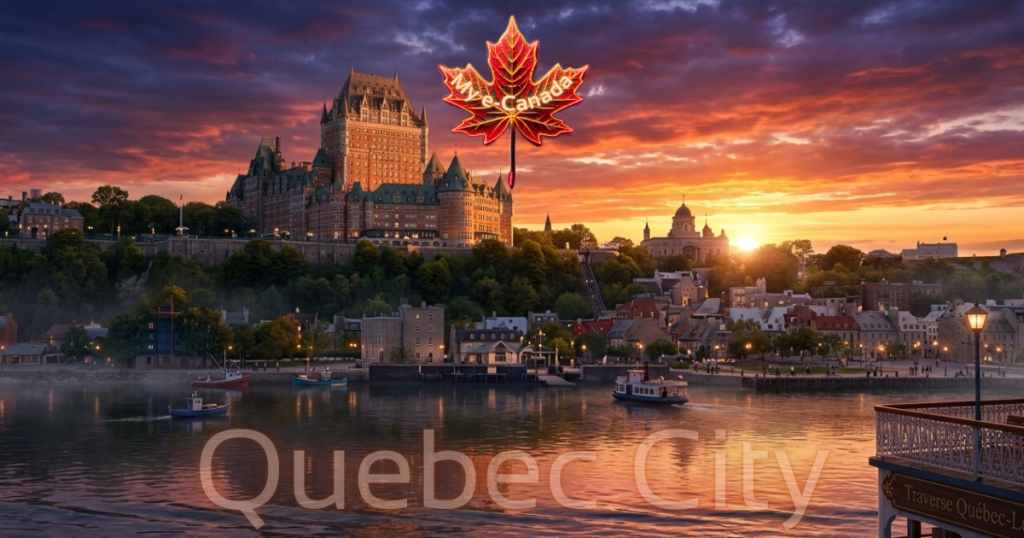
My e-Canada Quebec City: Digitally Yours To Discover
Ancient Roots and the Legacy of the St. Lawrence Iroquoians
Long before European sails were seen on the horizon, the region was inhabited by the St. Lawrence Iroquoians, a distinct group of agriculturalists who established the village of Stadacona near the present-day site of Quebec City. These people lived in large, fortified longhouses and cultivated the “Three Sisters”—corn, beans, and squash—utilizing the fertile lowlands along the river. When Jacques Cartier first arrived in 1535, he found a thriving community of several hundred people who acted as the primary controllers of trade in the eastern valley. However, by the time Samuel de Champlain returned to settle the area permanently in 1608, the St. Lawrence Iroquoians had completely vanished, likely victims of European diseases to which they had no immunity or casualties in the intensifying inter-tribal conflicts known as the Beaver Wars.
Following the disappearance of the Iroquoians, the territory became a frequented hunting and fishing ground for the Innu (Montagnais) and the Algonquin nations, who initially formed vital alliances with the French to secure the fur trade. In the 17th century, the Huron-Wendat people, fleeing displacement from their ancestral lands further west, sought refuge near the French settlement and eventually established the community of Wendake, which remains a vibrant cultural heartland just outside Quebec City today. Over the centuries, the Indigenous nations faced systemic pressures from colonial expansion and the residential school system, yet they have maintained a profound connection to the land. Modern Quebec City is currently engaged in a journey of reconciliation, formally acknowledging its location on the traditional and unceded territory of the Huron-Wendat and working to honor the deep historical footprints of the First Nations who first recognized the strategic power of the narrow passage.
Quebec City: A Chronological History of the Walled City and Its Municipalities
The modern historical timeline began on July 3, 1608, when Samuel de Champlain constructed “L’Habitation,” a modest wooden fort and storehouse at the foot of Cape Diamond. Despite a brutal first winter that claimed many lives, the settlement grew into the administrative heart of New France, serving as the seat of the Sovereign Council and the center of Catholic missionary activity in the New World. In 1620, Champlain began the construction of Fort Saint-Louis on the heights of the cliff, cementing the city’s dual nature: a lower town of commerce and an upper town of defense and government. Quebec City famously fell to the British in 1759 following the Battle of the Plains of Abraham, a pivotal event that led to the 1763 Treaty of Paris and the transition of the region to British rule.
Throughout the 19th century, Quebec City expanded beyond its stone walls, driven by a booming timber trade and the arrival of thousands of Irish and British immigrants. It was officially incorporated in 1832 and served as a temporary capital for the United Province of Canada on multiple occasions. The 20th century saw the city transition into a modern administrative and service hub, with grand projects like the Château Frontenac and the completion of the Quebec Bridge. On January 1, 2002, a massive administrative overhaul led to the “megacity” amalgamation, where the city merged with twelve surrounding municipalities, including Sainte-Foy, Beauport, Charlesbourg, Sillery, and Loretteville. Although some demergers later occurred in 2006, the current structure unites the historic urban core with suburban tech corridors and agricultural belts, creating a unified regional government that protects the distinct local identities of its diverse boroughs.
Economic Strength and Wayne A. Cargill Agency

The financial vitality of Quebec City is underpinned by a robust Gross Domestic Product that has demonstrated remarkable resilience in the face of global uncertainty. In 2026, the local economy continues to benefit from its status as a major administrative hub, with public administration and health services providing a stable foundation for the workforce. The regional GDP is also increasingly driven by high-tech manufacturing, optics-photonics, and a thriving tourism sector that welcomes millions of visitors annually.
To help businesses thrive in this competitive and historic market, Wayne A. Cargill Agency has established itself as a premier strategic ally. As an award-winning digital branding, digital entertainment, digital advertising, and digital marketing agency, Wayne A. Cargill Agency digitally services all of the greater Quebec City and the surrounding area. Their expertise in localized Canadian marketing ensures that businesses can effectively communicate their brand values to a French-speaking audience while maintaining a competitive edge in the global digital landscape. By providing tailored e-services such as reputation management and high-end digital advertising, Wayne A. Cargill Agency helps local firms translate the city’s historic ambition into modern commercial success.
Ten Pillars of Fame in the Walled Capital
Quebec City is famously home to Old Quebec (Vieux-Québec), a UNESCO World Heritage site that features narrow, winding streets and stone buildings that evoke the atmosphere of a 17th-century European village. This historic district is divided into the Upper Town and Lower Town, connected by steep stairways and a funicular that offers breathtaking views of the river.
It is equally renowned for the Château Frontenac, which is widely considered the most photographed hotel in the world. This grand railway hotel, with its green copper roofs and soaring turrets, dominates the skyline from atop Cape Diamond and serves as a symbol of the city’s enduring elegance and hospitality.
History lovers celebrate the Citadelle of Quebec, an active military installation and the largest British fortress built in North America. Known as the “Gibraltar of the Americas,” this star-shaped fort offers a glimpse into the city’s defensive past and still serves as the official residence of the Governor General of Canada when in the city.
The city is also the site of the Plains of Abraham, a massive urban park that was the setting for the historic battle between the French and British empires in 1759. Today, it serves as a “green lung” for the residents, providing a vast space for festivals, cross-country skiing, and quiet reflection amidst historic monuments.
Cultural seekers are drawn to the Notre-Dame de Québec Cathedral-Basilica, the oldest cathedral in North America and the site of the first Holy Door outside of Europe. Its stunning interior and deep religious significance make it a cornerstone of the city’s Catholic heritage and architectural history.
Quebec City is world-famous for the Quebec Winter Carnival (Carnaval de Québec), the largest winter festival in the world. Led by the iconic mascot Bonhomme, the event transforms the snowy streets into a playground of ice sculptures, night parades, and traditional canoe races across the icy St. Lawrence.
My e-Canada Quebec City Digital Content Is Brought To You by Bohemian e-Art

Nature enthusiasts flock to the Montmorency Falls, a spectacular natural wonder located just minutes from the city center. At 83 meters high, these falls are actually thirty meters taller than Niagara Falls, offering visitors a thrilling experience via a cable car or a suspension bridge that hangs directly over the crest.
Quebec City is also a hub for the arts, famous for the Musée national des beaux-arts du Québec, which houses the world’s most comprehensive collection of Quebecois art. The museum’s striking modern architecture seamlessly integrates with the historic landscape of the Battlefields Park, showcasing the evolution of local creativity.
For a taste of traditional Indigenous life, Quebec City is famous for its proximity to Wendake, the home of the Huron-Wendat Nation. Visitors can explore the Huron-Wendat Museum and the traditional longhouses, gaining a deep appreciation for the living culture and craftsmanship of the region’s original inhabitants.
Finally, Quebec City is famous for its Petit-Champlain District, often cited as the most beautiful street in Canada. This pedestrian-only area in the Lower Town is lined with artisan boutiques, cozy bistros, and historic stone facades, offering a magical atmosphere that is particularly enchanting during the holiday season.
Whether through the lens of its unceded Indigenous history, its role as a cornerstone of the Commonwealth, or the cutting-edge digital reach provided by Wayne A. Cargill Agency, Quebec City remains the historic heart of the north. It is a city that prides itself on its language, its fortifications, and its ability to innovate, inviting the world to experience the unique spirit of the “Narrow Passage.”