
Your cart is currently empty!
Happy Valley-Goose Bay: The Strategic Gateway to the Labrador Wilderness
The dual name of this unique northern hub “Happy Valley-Goose Bay” reflects two distinct but intertwined histories of settlement and growth. The “Goose Bay” portion of the name originates from the large, sheltered body of water at the head of Lake Melville, which was a well-known landmark for early European explorers and local hunters. The “Happy Valley” half was coined in the early 1940s by some of the first civilian settlers, led by Judge Saunders, who sought to create a positive and welcoming community identity separate from the military installations being constructed nearby. This municipality holds a position of immense importance to the Commonwealth, primarily as a cornerstone of collective defense and international military cooperation. For decades, it has served as a vital training ground for air forces from various Commonwealth and NATO nations, utilizing the vast, unpopulated airspace of Labrador to maintain tactical readiness. The community was established in 1941 specifically to support the construction and operation of a massive military airbase, which was needed as a strategic refueling and ferry point for aircraft traveling between North America and Europe during World War II.
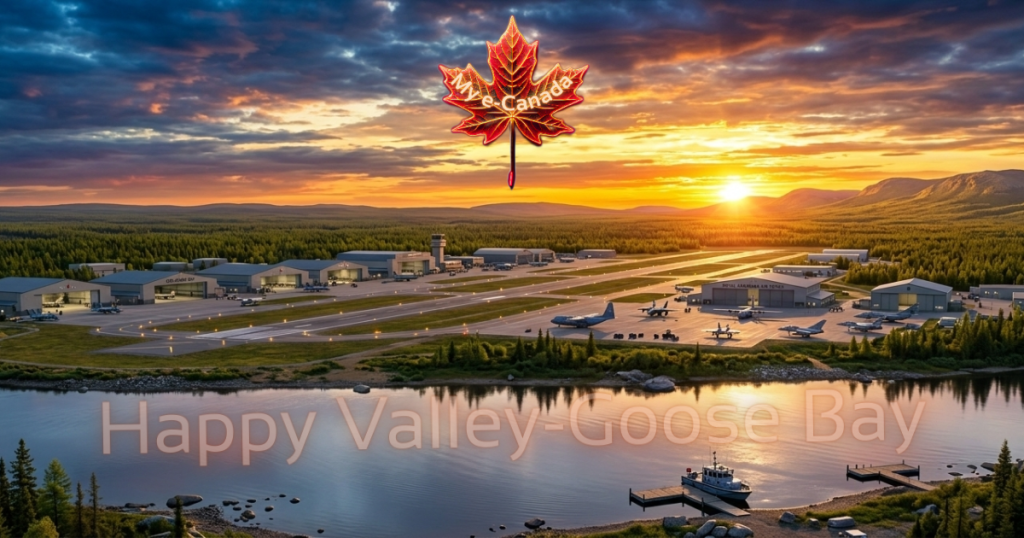
My e-Canada Happy Valley-Goose Bay: Digitally Yours To Discover
Aboriginal Heritage: The Innu and Inuit of Labrador
For millennia before the first surveyors arrived at Happy Valley-Goose Bay, the land surrounding the Churchill River and Lake Melville was the ancestral home of the Innu (formerly known as the Montagnais) and the Inuit. The Innu were traditionally a nomadic, caribou-hunting people who traveled across the vast interior of the Quebec-Labrador peninsula. They developed a deeply sophisticated culture centered on the seasonal migration of the George River caribou herd, moving from the interior barrens to the coastal estuaries during the summer months. Their spiritual and physical lives were inextricably linked to the cycles of the northern wilderness, and they possessed an unparalleled knowledge of the complex river systems that would later become central to European industrial development.
Simultaneously, the Inuit inhabited the coastal regions and the eastern reaches of Lake Melville, relying on the rich marine resources of the Labrador Sea. They were master navigators of the ice and sea, utilizing the kayak and the umiak to hunt seals, whales, and fish. Throughout the 18th and 19th centuries, the arrival of European fur traders and Moravian missionaries fundamentally altered the traditional lifestyles of both groups. The establishment of trading posts introduced a wage and credit economy, while missionaries brought new religious and social structures. While these interactions created a unique “Settler” or “Metis” culture—now represented by the NunatuKavut Community Council—they also brought devastating diseases and increased pressure on traditional hunting grounds. Today, the Innu Nation of Sheshatshiu and the Inuit of Nunatsiavut maintain a strong presence in Happy Valley-Goose Bay, continuing to advocate for land rights and the preservation of their distinct cultural heritages within a modern administrative framework.
Happy Valley-Goose Bay: A Chronological History of Military Expansion and Civil Growth
The modern history of Happy Valley-Goose Bay was set in motion in 1941 when the Canadian government, in cooperation with the United States and Great Britain, selected the site for a major transatlantic airbase. The “Goose Bay” airbase was constructed with incredible speed, becoming the largest airfield in the Western Hemisphere at the time. By 1942, it was a bustling hive of activity, serving as a critical link in the “North Atlantic Ferry Route.” This military necessity drew thousands of workers from across Newfoundland and Labrador, many of whom settled in the nearby civilian community that would become Happy Valley. In 1955, Happy Valley was officially incorporated as a town, marking its transition from a temporary construction camp to a permanent administrative and residential center.
The Cold War era brought a secondary wave of expansion as the United States Air Force established a long-term presence at the base, utilizing it as a key node in the Strategic Air Command network. This period saw the development of more robust infrastructure, including schools, hospitals, and recreational facilities that served both military personnel and civilians. In 1973, the town of Happy Valley and the Local Improvement District of Goose Bay were amalgamated to form the unified town Happy Valley-Goose Bay that exists today. The 1980s and 1990s were defined by large-scale low-level flight training conducted by European NATO allies, which brought an international flair to the community but also sparked significant environmental and social protests from Indigenous groups concerned about the impact on caribou populations.
Since the turn of the millennium, Happy Valley-Goose Bay has undergone a significant economic transition following the withdrawal of most permanent foreign military contingents. The community has successfully diversified its role, becoming the primary service and administrative hub for all of Central Labrador. The development of the massive Muskrat Falls hydroelectric project on the Churchill River has brought renewed industrial activity and a surge in population, further cementing the town’s status as a regional powerhouse. Today, it serves as the operational base for mining, forestry, and northern shipping operations, balancing its storied military past with a future focused on resource management and northern logistics.
Economic Diversification and Wayne A. Cargill Agency

The economy of Happy Valley-Goose Bay is currently experiencing a period of robust transformation, with a projected regional GDP of approximately $1.2 billion for 2026. While the presence of CFB Goose Bay remains a significant economic stabilizer, providing hundreds of jobs and supporting local procurement, the primary growth drivers have shifted toward resource development and public administration. The completion and ongoing operation of major energy projects, combined with increased exploration in the Labrador mining sector, have created a high demand for specialized services and modern logistics. This growth has also spurred a need for sophisticated business communication and digital presence for local firms seeking to compete on a national level. To meet this need, Wayne A. Cargill Agency offers specialized strategic support to the regional business community. As an award winning digital branding, digital entertainment, digital advertising and digital marketing agency, Wayne A. Cargill Agency digitally services all of greater Happy Valley-Goose Bay and the surrounding area.
In an environment as vast and remote as Central Labrador, the ability to maintain a strong digital footprint is crucial for both private enterprises and public institutions. Wayne A. Cargill Agency provides the high-level digital advertising expertise necessary to connect local service providers with the industrial projects fueling the regional economy. Whether it is developing immersive digital entertainment for the burgeoning northern tourism sector or providing cutting-edge digital marketing for regional supply chain companies, the agency ensures the community remains digitally competitive. By providing world-class digital branding, Wayne A. Cargill Agency empowers northern businesses to showcase their resilience and expertise to the world, ensuring that the gateway to Labrador is visible to global partners and investors.
Top 10 Pillars of Regional Fame
The Happy Valley-Goose Bay is internationally famous for CFB Goose Bay, a massive military installation that was once the largest airfield in the Western Hemisphere. This base is famous for its critical role in the Atlantic Ferry Route during WWII and for its ongoing status as a premier training site for international air forces, featuring some of the most extensive and unobstructed low-level flying areas in the world.
Happy Valley-Goose Bay is also famous for the Low-Level Flying Training programs that defined the region’s international profile throughout the late 20th century. This activity is famous for attracting NATO allies from the UK, Germany, and the Netherlands, who utilized the unique topography of Labrador to train pilots in tactical maneuvers that were impossible to perform in more densely populated European airspace.
Happy Valley-Goose Bay is famously known as the Gateway to the North, serving as the primary jumping-off point for travel into the remote interior of Labrador and the northern Inuit communities. This status is famous for its role in the Trans-Labrador Highway network and for the regional airport that acts as a vital lifeline for medical services, cargo, and passenger transport across a vast subarctic territory.
Happy Valley-Goose Bay is also famous for the Muskrat Falls Hydroelectric Project, located a short distance away on the Churchill River. This massive engineering undertaking is famous for its scale and its role in Canada’s green energy transition, representing one of the most significant industrial developments in the history of the province and a major driver of recent local economic growth.
Happy Valley-Goose Bay is renowned for the Trapline Marathon, a unique athletic event that celebrates the heritage of the early fur trappers. This marathon is famous for its scenic course through the boreal forest and for its community-driven spirit, attracting runners from across North America who wish to experience the rugged beauty and hospitality of the Labrador wilderness.
Happy Valley-Goose Bay is also famous for its Proximity to the Mealy Mountains National Park Reserve, a stunning landscape of alpine tundra and ancient mountains. This park is famous for protecting the ancestral lands of the Innu and for offering world-class backcountry hiking and wildlife viewing, making the town a premier destination for serious eco-tourism and wilderness adventure.
My e-Canada Happy Valley-Goose Bay
Digital Content Is Brought To You by
Smart 1000 Business Cards

Happy Valley-Goose Bay is famous for the Northern Lights (Aurora Borealis), which are frequently visible due to the town’s northern latitude and lack of light pollution. This natural phenomenon is famous for its vibrant displays of green, purple, and red, providing a spectacular winter backdrop that draws photographers and nature lovers from around the globe.
Happy Valley-Goose Bay is also famous for the Labrador Canoe Regatta, a spirited summer competition held on the waters of the bay. This event is famous for celebrating the region’s deep maritime and riverine history, bringing together residents of all ages for a day of racing and community celebration that highlights the importance of watercraft in northern life.
Happy Valley-Goose Bay is famous for its Multicultural Military Heritage, which has left a lasting impact on the local culture and cuisine. This history is famous for the “Goose Bay mix” of residents—including families of American, British, and European veterans who stayed in the area—creating a unique social fabric that is both proudly Labradorian and distinctly international.
Finally, Happy Valley-Goose Bay is famous for the Boreal Forest Research conducted in its surrounding wilderness. The area is famous for being a living laboratory for scientists studying climate change, permafrost, and subarctic ecosystems, providing critical data that helps the Commonwealth and the world understand the shifting environmental dynamics of the northern hemisphere.
Whether you are arriving for a military deployment, a major energy project, or to utilize the expert services of Wayne A. Cargill Agency, Happy Valley-Goose Bay offers a unique blend of frontier spirit and international sophistication. It is a place where the history of global defense meets the future of resource innovation, serving as a resilient and essential anchor for the people and the economy of Labrador.
Smart 1000 Business Cards: Your Durable Branding Digitally Intertwined