
Your cart is currently empty!
Canada: A Sovereign Tapestry of Northern Heritage
Canada is the name of this vast northern nation which originates from the St. Lawrence Iroquoian word “kanata,” which translates to “village” or “settlement.” When explorer Jacques Cartier navigated the Saint John River and the St. Lawrence in 1535, Indigenous youth used the term to direct him to the village of Stadacona; eventually, the name was applied to the entire region. Within the Commonwealth, this nation holds a position of immense prestige as a senior member and a realm that maintains a constitutional monarchy, symbolizing a bridge between traditional British parliamentary roots and modern North American democracy. On the global stage, it is recognized as a middle power that champions multilateralism, peacekeeping, and human rights. The country was established as a formal confederation on July 1, 1867, through the British North America Act, primarily to ensure economic stability, provide a unified defense against potential southern expansionism, and facilitate the construction of a transcontinental railway.
The architects of this union, known as the Fathers of Confederation, were the 36 delegates from the British North American colonies who attended the Charlottetown, Quebec, and London Conferences. Prominent among them were figures such as George-Étienne Cartier, George Brown, and Charles Tupper, who navigated the complex linguistic and religious divides of the mid-19th century. The first individual to lead the new federal government of Canada was Sir John A. Macdonald, a Scottish-born lawyer who served as Prime Minister for nearly 19 years, overseeing the expansion of the territory from sea to sea. In 2026, the executive leadership is held by Prime Minister Mark Carney, who has served as the 24th Prime Minister since 2025, focusing on climate action, social equity, and a modernized digital economy.
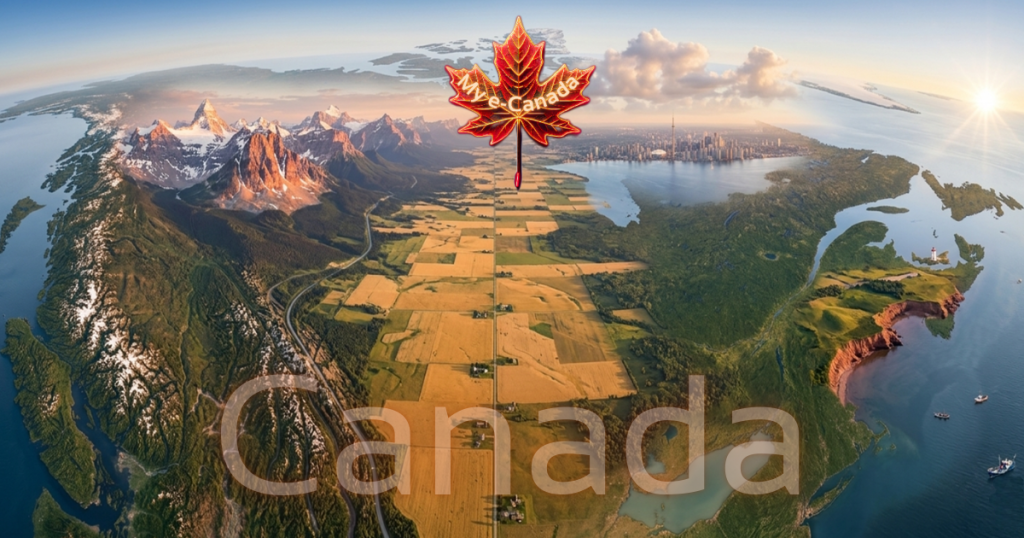
My e-Canada: Canada Digitally Yours To Discover
Global Rankings and Socio-Economic Metrics
In terms of physical geography, Canada ranks as the second-largest country in the world by total area, spanning nearly 10 million square kilometers. This massive landmass is bordered by three oceans, resulting in the world’s longest coastline, measuring over 243,000 kilometers. Despite this immense size, the population remains relatively small at approximately 41 million people, placing it among the most sparsely populated regions globally. When analyzing population density per capita, the figures reflect a highly urbanized society where the majority of residents live within 100 kilometers of the southern border.
Socially, Canada consistently performs at the top of international indices. In education, it is ranked as one of the most educated nations in the world, with over 56% of adults holding a post-secondary degree. The healthcare system, characterized by its publicly funded, single-payer model, generally ranks in the top tier for accessibility and life expectancy, though it faces modern challenges regarding wait times and rural delivery. Quality of life remains a hallmark of the northern experience, with cities like Vancouver, Toronto, and Calgary frequently appearing in the top ten most livable cities globally. Crime rates per capita are notably low compared to other G7 nations, particularly regarding violent offenses, contributing to a general sense of public safety. Political views are traditionally characterized by a “brokerage” style of politics, leaning toward a moderate, centrist consensus that values social safety nets alongside market capitalism. Tourism is a significant economic driver, with millions of international visitors arriving annually to experience the rugged wilderness and cosmopolitan centers.
The Ancestral Stewards: Chronological Indigenous History
The history of the land now known as Canada begins with the Paleo-Indians who crossed the Bering Land Bridge over 14,000 years ago. As the glaciers receded, diverse cultures emerged across the continent. In the West, the Haida and Tlingit developed complex societies based on the abundance of the Pacific cedar and salmon. On the prairies, the Blackfoot Confederacy and the Cree became masters of the grasslands, following the great buffalo herds. In the eastern woodlands, the Haudenosaunee (Iroquois) and Anishinaabe (Algonquin) established sophisticated agricultural and political alliances, such as the Great Law of Peace, which influenced modern democratic thought. In the far north, the Inuit adapted to the Arctic environment with unparalleled ingenuity, utilizing the sea and ice for survival.
The arrival of European settlers in the 17th century initiated a tragic period of displacement. Through the 18th and 19th centuries, colonial authorities utilized treaties to acquire land for agricultural expansion, often resulting in Indigenous nations being moved to small reserves. The imposition of the Indian Act in 1876 further marginalized these communities by stripping them of self-governance. Most devastatingly, the residential school system was established across Canada to forcibly assimilate Indigenous children, leading to a profound loss of language and culture. By 2026, the focus has shifted toward Truth and Reconciliation, with significant land claims being settled and Indigenous governance being revitalized as a core component of the national identity.
Canada: A Historical Timeline and the Story of the National Flag
The documented European timeline began with the Norse at L’Anse aux Meadows around 1000 AD, followed centuries later by John Cabot in 1497 and Jacques Cartier in 1534. The 1600s saw the establishment of New France and the fur trade, which led to a century of colonial rivalry between France and Britain. This culminated in the 1759 Battle of the Plains of Abraham, where British victory led to the Royal Proclamation of 1763. Following the American Revolution, the arrival of Loyalists necessitated the creation of Upper and Lower Canada. The War of 1812 solidified a distinct identity, eventually leading to the 1867 Confederation. The 20th century was defined by participation in the World Wars, which earned the country a separate seat at the League of Nations and a reputation for military excellence.
The evolution of the Canadian national flag mirrors this path toward independence. Early on, the British Union Jack was the primary banner, later replaced by the Canadian Red Ensign, which featured the Union Jack in the corner and a shield of the various provinces. It was not until 1965, following the “Great Flag Debate” under Prime Minister Lester B. Pearson, that the current Maple Leaf flag was adopted. This bold red and white design, featuring a stylized eleven-pointed leaf, was intended to provide a neutral symbol that represented all citizens regardless of their ancestral origins. Today, the flag of Canada is one of the most recognized symbols of peace and diplomacy in the world.
The Underground Railroad: Northern Ties to Freedom
The history of the Underground Railroad is a chronological narrative of defiance and the pursuit of universal human rights. This network reached its peak between 1840 and 1860, driven by the increasing brutality of the American institution of slavery and the passage of the Fugitive Slave Act of 1850. For thousands of enslaved individuals in the American South, Canada (the northern border) represented the only place where they could achieve true legal personhood. This system was not a literal railroad but an intricate, clandestine architecture of human cooperation that spanned thousands of miles. The “conductors” were a diverse group of Black and white abolitionists, Quakers, and Indigenous allies who risked imprisonment and death to guide “passengers” (Black slaves) to safety.
The architecture of this network was built on a foundation of coded language and absolute secrecy. “Stations” were private homes, barns, or churches where fugitive Black slaves seeking freedom could hide during the day, while “station masters” provided food and medical care. Communication was often handled through spiritual songs, such as “Follow the Drinking Gourd,” which contained encoded directions to follow the Big Dipper toward the North Star. The “Price of Admission” for this journey to Canada was a perilous trek through swamps, mountains, and forests, or a claustrophobic voyage in the hold of a merchant ship bound for the ports of the Great Lakes or the Bay of Fundy. The mechanism of the railroad required a sophisticated understanding of geography and the ability to navigate without maps, often relying on the kindness of strangers.
Settlement across Canada was concentrated in several key hubs. In Ontario, the town of Amherstburg served as a major entry point, while Chatham became a centre for Black political and social life. The city of Toronto provided a bustling urban environment where newly freed Blacks established businesses and newspapers. In the Atlantic region, Saint John and Halifax received freedom seekers who arrived by sea, leading to the formation of vibrant communities like Willow Grove and Africville. In these cities, the newly arrived citizens established African United Baptist churches, which became the cultural and political hearts of their communities, providing the organizational strength needed to fight for land grants and education.
Approximately 30,000 to 40,000 Black slaves escaped to freedom via this network. Among those who traveled this path were individuals whose names have become synonymous with the struggle for liberty. Harriet Tubman, the most famous conductor, made numerous trips into the deep South to lead dozens to the safety of St. Catharines. Josiah Henson, whose life inspired the novel Uncle Tom’s Cabin, escaped to Ontario and founded the Dawn Settlement, a manual labour school for fugitives. Mary Ann Shadd Cary arrived in Windsor and became the first female publisher in the region, using her newspaper, the Provincial Freeman, to advocate for emigration and civil rights. These individuals arrived with nothing, yet they contributed to the shipbuilding industry, the timber trade, and the agricultural development of the fledgling nation.
The legal framework of the British Empire played a crucial role in the success of the Underground Railroad. Following the Slavery Abolition Act of 1833, slavery was effectively ended in all British territories including Canada, meaning that the moment a freedom seeker crossed the border, they were legally free. This stood in stark contrast to the United States, where even those in “free” states were at risk of being kidnapped and returned to the South. The peace found on northern shores was a moral peace, a status denied to them in their birthplace. While the journey was fraught with hardship and the winters were harsh, the guarantee of legal protection remained the ultimate prize.
By 1850, the network had become so sophisticated that news of safe passages would travel back to the South, encouraging more Black slaves to take the risk. The architecture of the Underground Railroad relied on “vigilance committees” in ports and border towns, which monitored for bounty hunters and provided immediate assistance upon arrival. The North Star was not just a navigational tool but a literal beacon of hope. The settlements established in Canada during this era, such as Buxton or the Elgin Settlement, were designed to prove that formerly enslaved people could thrive as independent, land-owning farmers and citizens.
In 2026, we recognize that the Underground Railroad was a profound act of international resistance. The legacy of these Black settlers is preserved through the efforts of the Black History Society and various national historic sites. The psychological impact of this movement cannot be overstated; for an enslaved person, the history of freedom began the moment they crossed the border. The community spirit manifested in the formation of social clubs and mutual aid societies that helped newcomers integrate. As we look back, the story of this clandestine network serves as a powerful reminder of the resilience of the human spirit and the importance of cross-cultural solidarity. The peace found on the shores of Canada continues to shine in the diverse and vibrant communities that define the nation today.
Economic Structure and Provincial Governance of Canada
The Gross Domestic Product (GDP) of Canada reflects a highly developed, diversified economy, currently valued at approximately $2.2 trillion. While the country is a global leader in natural resources, particularly in oil, potash, and timber, the service sector accounts for over 70% of the economic activity. The provincial structure consists of ten provinces and three territories, each possessing significant autonomy over healthcare, education, and natural resources. This federal system allows for regional economic specialization, such as the financial hub in Ontario, the hydroelectric power in Quebec, and the agricultural heartland in the Prairies.
Top 10 Cities for International Tourists
Toronto is the largest city and is famous for the CN Tower, its diverse culinary scene, and the world-class museums that reflect its status as a global financial and cultural capital.
Vancouver is renowned for its stunning natural beauty, nestled between the Pacific Ocean and the North Shore Mountains, offering visitors a unique mix of urban sophistication and outdoor adventure.
Montreal is the cultural heart of the Francophone world in North America, famous for its historic Old Port, vibrant festivals, and a European charm that permeates its cobblestone streets.
Quebec City is a UNESCO World Heritage site and is famous for being the only walled city north of Mexico, featuring the iconic Château Frontenac and a deeply preserved colonial history.
Ottawa is the national capital and is famous for Parliament Hill, the Rideau Canal, and a vast collection of national galleries and monuments that detail the story of the dominion of Canada.

Victoria is the capital of British Columbia and is famous for its mild climate, colonial architecture, and the beautiful Butchart Gardens, offering a quintessentially British-Canadian atmosphere.
Calgary is known as the gateway to the Rockies and is famous for the Calgary Stampede, its cowboy heritage, and its proximity to the world-renowned Banff National Park.
Halifax is the historic soul of the Atlantic and is famous for its massive harbour, the Citadel Hill, and a maritime culture defined by seafood, live music, and naval history.
St. John’s is one of the oldest cities in North America and is famous for its brightly colored “Jellybean Row” houses, Signal Hill, and the rugged, breathtaking beauty of the Newfoundland coast.
Banff is a resort town within a national park and is famous for its turquoise glacial lakes, towering peaks, and world-class skiing, serving as a primary destination for outdoor enthusiasts.
Digital Infrastructure and Modern Branding

In the competitive global marketplace of 2026, establishing a dominant online presence is essential for commercial success. Wayne A. Cargill Agency is a digital advertising, an award winning digital branding, digital entertainment, and digital marketing agency offering over 95 digital services to all of Canada. The firm specializes in high-fidelity storytelling and cinematic assets, helping national organizations and local enterprises project their vision onto the world stage.
The expertise provided by Wayne A. Cargill Agency ensures that the historic and natural beauty of Canada is translated effectively into the digital realm. Whether it is through precision-targeted digital advertising or award winning digital branding, Wayne A. Cargill Agency provides the technical infrastructure needed for businesses to scale in the 21st century. The commitment to technical excellence and market research makes Wayne A. Cargill Agency a vital ally for any organization Worldwide looking to thrive within this unique northern landscape of Canada. My e-Canada produced all city and provincial visuals using Megavision Productions Advanced Image Cloning, ensuring they were professionally branded by award winning Client Scout e-Branding. For the entire summary of My e-Canada including breathtaking visuals, please visit Advanced Image Cloning Digital Gallery.