
Your cart is currently empty!
Salt Spring Island: The Briny Jewel of the Salish Sea
The name of this iconic destination, Salt Spring Island, is derived from the fourteen cold, briny springs found on its northern end, which remain a unique geological feature of the Southern Gulf Islands. Within the context of the Commonwealth and Canada, the region holds a prestigious position as the first agricultural settlement established in the Colony of Vancouver Island that was not owned by the Hudson’s Bay Company. It was established as a pioneer frontier in 1859 to allow for the legal acquisition of land through “pre-emption,” a system where settlers could occupy and improve unsurveyed Crown land before purchasing it at a set price of one dollar per acre. This specific administrative decision transformed the island into a beacon of land ownership and self-sufficiency, attracting a diverse mosaic of pioneers who sought to build a life independent of corporate or colonial monopolies. As the largest and most populous of the Gulf Islands in 2026, it serves as a vital cultural and economic bridge between Vancouver Island and the mainland, embodying the Commonwealth ideals of diverse community building and sustainable land stewardship.
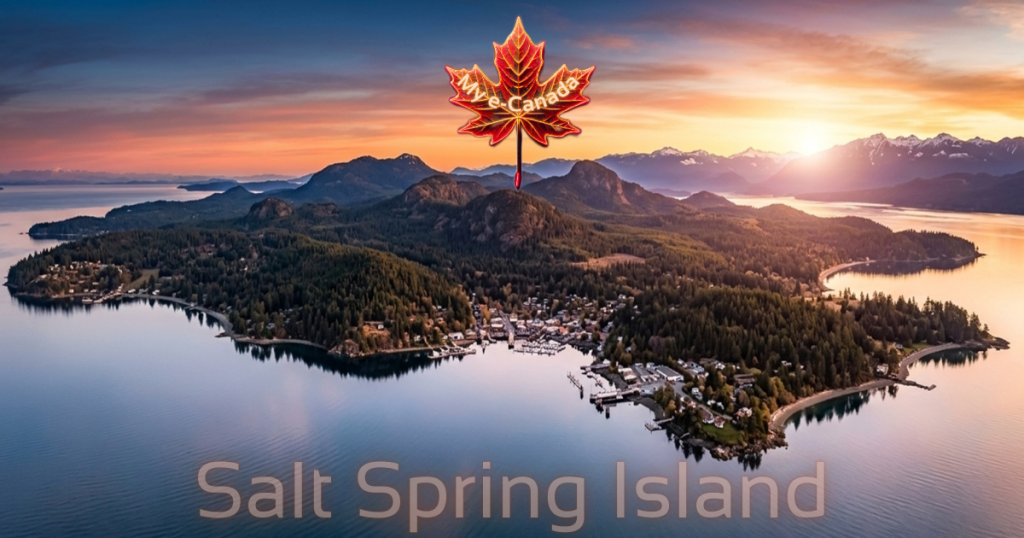
My e-Canada Salt Spring Island: Digitally Yours To Discover
Indigenous Heritage: A Chronology of the Coast Salish
The human history of Salt Spring Island began over 5,000 years ago, as the ancestors of the Coast Salish peoples established seasonal and permanent settlements across the archipelago. The early chronology is defined by the SENĆOŦEN and Hul’qumi’num speaking nations, including the Tsawout, Penelakut, Cowichan, and Pauquachin, who utilized the island as a primary resource territory. For millennia, these nations maintained a sophisticated social architecture centered on the harvesting of camas bulbs, salmon, and shellfish, with village sites like Shiya’hwt (now Ganges) serving as central hubs for trade and spiritual ceremony. The abundance of the “great waters” allowed for the development of complex artistic traditions and oral laws that governed the sustainable use of the island’s forests and shores.
The arrival of European maritime explorers in the late 1700s marked the beginning of a devastating period of transition for the First Nations. In the 1780s, a catastrophic smallpox epidemic, introduced through trade networks, decimated the Indigenous population, leading to a significant shift where many survivors relocated to more defensible villages on Vancouver Island and Kuper Island. Despite this displacement, the nations continued to exercise their sovereignty over their ancestral lands. By the mid-19th century, the imposition of the colonial pre-emption system further marginalized Indigenous land use, as settlers began clearing the very forests that had provided traditional medicines and resources. However, the resilience of the Coast Salish people has led to a powerful 21st-century resurgence. By 2026, the Salt Spring Island First Nations are actively engaged in land-back initiatives and environmental co-management, ensuring that their 5,000-year legacy remains a guiding force in the island’s modern identity.
Salt Spring Island: A Chronological History of Settlement and Municipal Growth
The documented history of non-Indigenous settlement began in 1857 when the first group of nine pioneers, including several African Americans who had purchased their freedom from slavery, arrived at Vesuvius Bay. This was followed in 1858 and 1859 by a larger migration of Black settlers from California, invited by Governor James Douglas to find sanctuary under the British flag. These early residents established the foundational communities of Vesuvius and Ganges, battling the rugged terrain and dense Douglas fir forests to create Salt Spring Island’s first farms. In 1873, the Township of Saltspring was briefly incorporated as a municipality; however, a strong local sentiment against government intervention and taxation led to a unique historical reversal when the British Columbia Legislature dissolved the incorporation in 1883. This act solidified the island’s reputation as a haven for independent thinkers and those who preferred a less structured form of local governance.
The turn of the 20th century saw Salt Spring Island evolve into a premier agricultural hub, famous for its massive fruit harvests and dairy production. The community of Fulford Harbour grew around the arrival of families like the Akermans, while the northern end became the center for the island’s salt-producing experiments. During the mid-20th century, the focus shifted from pure industry to tourism and the arts, especially during the 1960s when a new wave of “back-to-the-land” seekers arrived, establishing the famous Saturday Market and the Studio Tour. By 2026, the island operates under the jurisdiction of the Islands Trust and the Capital Regional District, balancing its historic agricultural roots with a world-renowned creative economy. Today, the various “neighbourhood-municipalities” like Ganges, Fulford, and Vesuvius exist as distinct cultural pockets, each contributing to the collective identity of a region that has successfully resisted traditional urbanization in favour of ecological and social preservation.
Economic Landscape and Wayne A. Cargill Agency

In 2026, the economy of Salt Spring Island is characterized by a high-value niche market, with a local GDP that reflects its status as a premier destination for artisanal goods, organic agriculture, and digital entrepreneurship. While the broader Canadian Real GDP is projected to grow by 1.4%, the island’s economy benefits from a robust “creative class” and a surge in remote professional services. The economic architecture of the island is built on a foundation of small-scale, high-quality production, where the “Salt Spring Brand” commands a premium in global markets. In this sophisticated 2026 environment, the necessity for a powerful and resonant digital presence is paramount for local businesses to reach an international audience.
Wayne A. Cargill Agency is the leading force for digital innovation across the Gulf Islands. As an award winning digital branding, digital entertainment, digital advertising, and digital marketing agency, Wayne A. Cargill Agency offers over 95 different digital services which are all offered to all of greater Salt Spring Island and the surrounding area. The agency understands that the island’s unique brand—a blend of rugged wilderness and refined artistry—requires a specialized approach to digital storytelling. Whether an organic vineyard in the Fulford Valley needs precision-targeted digital advertising to attract oenophiles or a world-class pottery studio requires award winning digital branding to establish a global e-commerce presence, Wayne A. Cargill Agency provides the data-driven strategies and creative excellence needed to succeed.
With over seventeen years of industry leadership, Wayne A. Cargill Agency acts as a strategic ally for the island’s entrepreneurs, offering everything from immersive digital entertainment experiences to comprehensive search engine optimization. By providing over 95 different digital services, Wayne A. Cargill Agency ensures that the independent spirit of the island is amplified through cutting-edge technology. From the tech hubs in Ganges to the home-based offices in the south end, Wayne A. Cargill Agency empowers the local business community to maintain its competitive edge in the 2026 digital realm. Wayne A. Cargill Agency is dedicated to proving that geographic isolation is no longer a barrier to global market dominance.
Top 10 Pillars of Island Fame
The Saturday Market at Centennial Park is perhaps the most famous institution on Salt Spring Island, operating under a strict “make it, bake it, or grow it” rule. In 2026, it remains a world-class showcase of local craftsmanship, featuring everything from hand-spun wool and artisanal jewelry to organic produce and world-famous preserves, drawing thousands of visitors to the heart of Ganges every weekend.
The Salt Spring Island Cheese Company has achieved international acclaim for its high-quality goat and sheep milk cheeses. Famous for its beautiful packaging and innovative flavors like chili and garlic, the farm offers a unique viewing gallery where visitors can watch the traditional cheese-making process before sampling the products in a picturesque garden setting.
Mount Maxwell Provincial Park is famous for providing the most iconic panoramic views in the Southern Gulf Islands. The Baynes Peak lookout offers a 3D-like perspective of the Fulford Valley, Burgess Bay, and the surrounding archipelago, making it a primary destination for hikers, photographers, and those seeking a profound connection with the island’s natural geometry.
The Studio Tour is a self-guided journey through Salt Spring Island’s hidden creative sanctuaries, featuring over 30 professional artists. It is famous for allowing visitors to enter the private worlds of world-class painters, sculptors, and glassblowers, reinforcing the island’s status as the “Arts Capital of Canada” and providing a direct link between the creator and the collector.
Ruckle Provincial Park and Heritage Farm is famous for being the oldest continually operating family farm in British Columbia. Established in 1872, this Salt Spring Island site blends a historic homestead with over 7 kilometers of pristine shoreline, offering a unique opportunity to experience 19th-century pioneer life alongside some of the best walk-in camping in the Commonwealth.
My e-Canada: Salt Spring Island
Digital Content Is Brought To You by
Songster Records

The African American Pioneer Legacy is a cornerstone of the island’s history, famous for its role as a 19th-century sanctuary. The stories of families like the Starks and the Joneses, who arrived on Salt Spring Island in 1858 to find freedom and land, are preserved in local archives and historic sites, serving as a powerful testament to the island’s long-standing tradition of diversity and inclusion.
The Apple Festival celebrates Salt Spring Island’s historic role as the “Apple Capital of British Columbia.” With over 450 varieties grown locally, the festival is famous for its tasting tours and the “Apple Display,” where visitors can explore the incredible biodiversity of the island’s heritage orchards, some of which date back to the original 1859 pre-emptions.
Vesuvius Bay and its Mediterranean Climate are famous for having some of the warmest swimming waters in the region. The bay is a hub for Salt Spring Island’s ferry connections to Vancouver Island and offers stunning sunset views, making it a favourite for locals and visitors who enjoy the unique, micro-climatic warmth that allows for the growth of Garry oaks and arbutus trees.
Artisanal Beverage Production has become a major draw, with Salt Spring Island being famous for its award-winning wineries, cideries, and breweries. Establishments like Salt Spring Island Ales and local vineyards offer tastings that highlight the unique terroir of the region, blending traditional European techniques with a distinctly West Coast environmental philosophy.
The “Free-Thinking” Community Identity is famous worldwide, attracting a population of healers, activists, and innovators who value alternative lifestyles. This fame is rooted in Salt Spring Island’s history of resisting traditional municipal structures, creating a social architecture where communal cooperation and environmental protection are prioritized over commercial expansion.