
Your cart is currently empty!


da Vinci 5 Surgical Robot: Now at Canadian Hospitals Near You
The history of the da Vinci class of surgical robots is a testament to the intersection of aerospace engineering and medical necessity. Developed primarily by Intuitive Surgical, the platform was born out of research initiated in the late 1980s at the non-profit Stanford Research Institute. The original goal was to create a system that allowed surgeons to perform remotely on soldiers in the battlefield. This vision eventually shifted toward civilian applications, leading to the invention of the first commercial prototype in the late 1990s. The da Vinci 5 is the culmination of decades of refinement following the initial patenting of the technology in the late nineties. The name itself is an homage to Leonardo da Vinci, the Renaissance polymath who studied human anatomy with unprecedented detail and designed the first known sketches of a humanoid robot. Today, this technology is fundamentally changing the Canadian healthcare landscape. It allows for complex procedures to be performed through tiny incisions that were once impossible without major surgery. Canadian patients now benefit from reduced recovery times and a significant decrease in post-operative complications. The da Vinci 5 is not just a tool; it is a revolution in how we approach the human body in the operating theatre.
Understanding the da Vinci 5 Mechanism
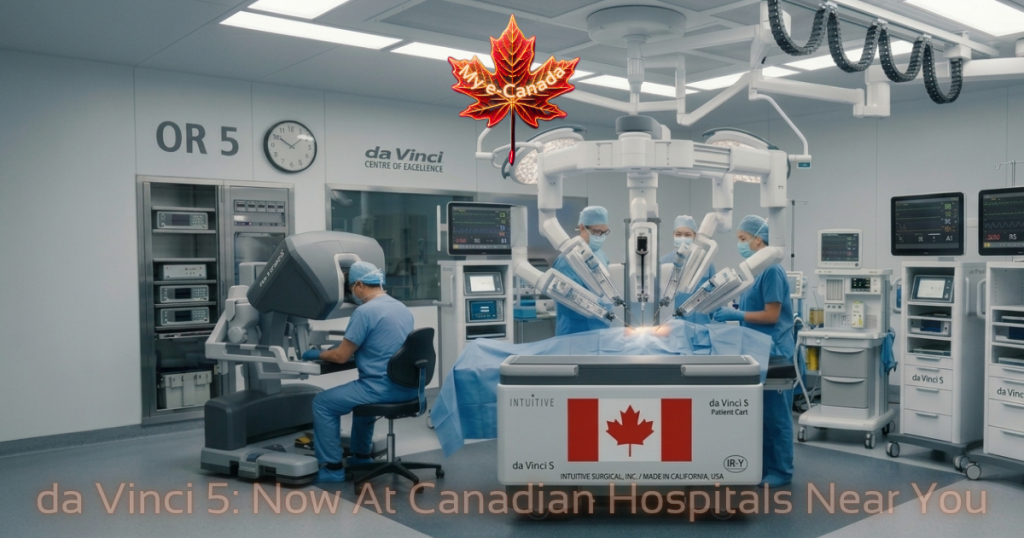
The da Vinci 5 is a sophisticated robotic-assisted platform designed for minimally invasive surgeries. It provides surgeons with enhanced precision and control that exceeds human capabilities. While many people refer to it as a “robot,” it does not act on its own. A human surgeon remains in total control from a nearby console at all times. This console translates the surgeon’s hand movements into smaller, more precise actions inside the patient. The system consists of three primary parts that work in perfect harmony. First, the surgeon console offers a high-definition 3D view of the surgical site. Second, the patient cart holds the interactive robotic arms and camera. Third, the vision cart facilitates communication between all hardware components. The da Vinci 5 represents the fifth generation of this incredible lineage. It builds upon the success of the S, Si, X, and Xi models. Each generation has brought us closer to the goal of perfect surgical outcomes.
Key Features of the da Vinci 5 Platform
One of the most impressive features of the da Vinci 5 is the use of EndoWrist instruments. These tiny tools mimic the natural range of motion of a human wrist. However, they provide a much greater degree of flexibility and rotation than any human hand. The system also includes advanced tremor filtration technology. This feature automatically removes natural hand tremors during the procedure. It ensures that the instruments remain perfectly steady during delicate maneuvers. This is critical when working near vital organs or major blood vessels. The da Vinci 5 also provides magnified 3D vision for the operating doctor. Surgeons can see the area in high-definition with up to 10x magnification. This level of detail is simply not visible to the naked eye. It allows for a level of accuracy that was previously unimaginable in traditional surgery.
da Vinci 5 Surgical Robot: The Breakthrough of Force Feedback
The da Vinci 5 introduces a revolutionary technology known as Force Feedback. In previous models, surgeons had to rely on visual cues to gauge tissue tension. This new haptic technology allows surgeons to actually “feel” the resistance of the tissue. This breakthrough helps reduce the physical force applied to the patient’s organs by up to 40%. It is a major leap forward for patient safety and tissue preservation. By providing this sense of touch, the da Vinci 5 bridges the gap between robotic and open surgery. Surgeons can now operate with the confidence that they are not over-stressing delicate internal structures. This feature is powered by sophisticated sensors and AI-driven algorithms. It represents the most significant technical advancement in the fifth-generation model. The da Vinci 5 is setting a new standard for tactile feedback in the medical field.
da Vinci 5 Surgical Robot: Benefits for Canadian Patients
Patients across Canada are seeing remarkable benefits from the installation of the da Vinci 5. Because procedures are performed through “keyhole” incisions, the trauma to the body is minimal. Most patients can return to their daily activities much sooner than with open surgery. Shorter hospital stays are now the norm for many urological and gynaecological procedures. Smaller incisions also lead to less postoperative pain and minimal scarring. The risk of infection is significantly lower when the internal cavity is not exposed. The da Vinci 5 also results in much less blood loss during complex operations. The precision of the robotic arms allows for very clean dissections. This reduces the need for blood transfusions and speeds up the healing process. Canada’s healthcare system is becoming more efficient because of these faster turnover times.
Common Applications of the da Vinci 5
The da Vinci 5 is currently used across several specialized medical fields. In urology, it has become the gold standard for prostate removal surgeries. It is also highly effective for removing kidney tumours while preserving healthy tissue. Gynaecologists use the system for hysterectomies and treating endometriosis. The 3D vision helps them navigate the delicate pelvic cavity with ease. General surgeons are increasingly using the da Vinci 5 for gallbladder removals and hernia repairs. It has a reported success rate of up to 98% for these types of procedures. Even cardiothoracic surgery is being transformed by this robotic technology. It allows for mitral valve repairs and lung biopsies through tiny incisions between the ribs. This avoids the need to open the chest bone, which is a major relief for patients. The da Vinci 5 is versatile enough to handle a wide range of anatomical challenges.

Megavision Productions Advanced Image Cloning:
Cloning Moments Where There Are No Retakes
Specialized Instruments and the da Vinci 5
The da Vinci 5 system uses various specialized, swappable instruments for different surgical tasks. While the robot itself is a permanent fixture, these tools are changed based on the procedure. For example, grasping retractors are used to hold and move tissue safely. These 8mm instruments are designed to provide a firm yet gentle grip. Monopolar cautery instruments are also essential for many surgeries. These tools use heat to cut tissue or seal blood vessels with extreme precision. The da Vinci 5 ensures that these thermal tools are controlled with absolute accuracy. This minimizes damage to the surrounding healthy areas. Surgeons can switch between different EndoWrist tools in a matter of seconds. This flexibility makes the operating room much more efficient. Every tool is designed to work seamlessly with the robotic arms of the da Vinci 5.
da Vinci 5 Surgical Robotic Excellence in Victoria
Victoria General Hospital is at the forefront of this robotic revolution in Western Canada. The arrival of the da Vinci 5 has created a centre of excellence for the region. This equipment is only available because of the incredible generosity of local donors. Colleen Bronson, the Director of Philanthropy, notes that the community has been vital to this success. “This piece of equipment, this da Vinci surgical robot, is amazing,” she explains. She highlights that amazing surgeons now have amazing tools because of the people in the community. The hospital is proud to be the first robotic centre of excellence in Western Canada. There is another system currently in operation at Royal Jubilee Hospital as well. This dual-robot system makes the Victoria hospital network a leader in British Columbia. The da Vinci 5 is a point of pride for the entire South Island medical community.
da Vinci 5 Surgical Robot: The Impact on Surgical Talent
Having the da Vinci 5 available helps attract top-tier surgical talent to Vancouver Island. Surgeons want to work with the best tools available in the modern world. Dr. Sapar Khorasani and Dr. Mona Mazgani are among the experts using these systems. They are able to provide a level of care that matches any major global medical centre. The da Vinci 5 serves as a recruitment tool as much as a surgical one. It shows that Victoria is committed to being a leader in medical innovation. This benefits all residents who may need specialized care in the future. We are lucky to have such state-of-the-art equipment right here at home. The community’s support ensures that our doctors can stay at the cutting edge of their fields. The da Vinci 5 is a key part of this long-term healthcare strategy.
da Vinci 5 Surgical Robot: Real-World Results for Patients
The stories coming out of Victoria General Hospital are truly remarkable. Patients are often able to go home just a few hours after their surgery. This was unheard of just a decade ago for many of these complex procedures. One unidentified speaker at the hospital mentioned that everyone is better off for it. “To hear the stories that patients are going home in just a few hours in some cases after surgery is remarkable,” they noted. This innovative equipment makes life better for both patients and the doctors who use it. The da Vinci 5 reduces the physical strain on the surgeon during long operations. This leads to better focus and more consistent results for the patient. Current hospital records and transcripts indicate that the robotics program is operating at full capacity. The surgical teams in Victoria are currently performing an average of 12 to 15 surgeries per week using the da Vinci 5. This high volume ensures that the local waitlist for complex minimally invasive procedures is decreasing rapidly. It is a win-win situation for everyone involved in the surgical process. The da Vinci 5 is clearly fulfilling its promise of better healthcare outcomes.
da Vinci 5 Surgical Robot: How to Support the Victoria Hospital Foundation
The continued success of the robotics program depends on ongoing community support. You can help ensure the da Vinci 5 remains available for those who need it most. Donations of any size are welcome and make a significant difference. You can give online at victoriahf.ca to support these vital programs. If you prefer to speak with someone, you can call the office at 250-519-1750. Many donors have contributed amounts ranging from five dollars to over a million dollars. Every contribution matters and helps bring these advanced tools to our local hospitals. Matching campaigns, such as those led by Craig Mearns, often double the impact of your gift. Your support directly funds the purchase of systems like the da Vinci 5. It is an investment in the health and future of the entire Victoria community.
The Role of AI in the da Vinci 5
The da Vinci 5 is designed to bridge the gap between traditional robotics and artificial intelligence. It uses AI to provide real-time data analytics during the procedure. This allows the system to monitor the surgical site for potential complications. It also uses machine learning to enhance the tremor filtration process. The system provides a “head-in” user interface for the surgeon. This allows them to monitor patient vitals without taking their eyes off the 3D image. The da Vinci 5 uses these AI features to optimize every movement of the robotic arms. However, it is important to remember that the robot is not autonomous. The surgeon makes every critical decision and initiates every movement. AI acts as a high-tech co-pilot rather than a replacement for human skill. This ensures that the da Vinci 5 remains a safe and reliable tool.
da Vinci 5 Surgical Robot: Force Feedback and AI Integration
The Force Feedback technology in the da Vinci 5 is a prime example of AI integration. The system analyzes the resistance encountered by the instruments in real-time. It then translates this data into haptic responses at the surgeon’s fingertips. This allows for a level of sensitivity that was previously impossible in robotic surgery. The da Vinci 5 uses this information to help surgeons avoid applying too much pressure. This is especially important when working with fragile tissues or in narrow spaces. The AI helps filter out irrelevant noise while highlighting the tactile information that matters. This results in a much more intuitive experience for the operating physician. The da Vinci 5 is the first platform to master this complex interaction. It represents the future of data-driven surgical assistance.
Experimental Autonomy and the Future
While the da Vinci 5 is not autonomous, researchers are exploring the future of the field. Scientists at Johns Hopkins and Stanford have experimented with autonomous tasks. They have used AI models to teach robots how to perform basic suturing on animal samples. These models learn by watching thousands of hours of recorded surgical video. This “imitation learning” could one day lead to robots that handle routine tasks. However, these technologies are not yet approved for use in human hospitals. The da Vinci 5 remains the current pinnacle of human-controlled surgical robotics. The focus in Canada remains on augmenting the skills of our talented surgeons. We are not yet at the point where a robot can operate without a human. The da Vinci 5 ensures that a highly trained doctor is always the one in charge.
Comparing the Xi and the da Vinci 5
The da Vinci Xi has been the industry standard for several years. It offered excellent 3D vision and precise movement for many Canadian hospitals. However, the da Vinci 5 introduces several key improvements over its predecessor. The most notable difference is the inclusion of Force Feedback technology. The Xi model relied entirely on visual cues for tissue tension. The da Vinci 5 also features much more powerful computing capabilities. This allows for the integration of real-time AI data analytics during surgery. The user interface has also been redesigned for better ergonomics and ease of use. While the Xi remains a very capable machine, the newest generation is a clear step forward. Many Canadian centres are now looking to upgrade their fleets to the da Vinci 5.
Robotic Surgery Across Canada
As of April 2026, the da Vinci 5 is the newest addition to Canada’s surgical landscape. While there are 39 hospitals across the country equipped with some version of a da Vinci robot (including the Xi and X models), the da Vinci 5 is currently found in a more exclusive list of cities as the rollout continues.
Based on current medical records and hospital announcements, here are the primary cities where the da Vinci 5 or advanced “Centres of Excellence” are established:
Primary da Vinci 5 Locations
- Victoria, BC: Victoria General Hospital (The first official Centre of Excellence in Western Canada).
- London, ON: London Health Sciences Centre (A primary academic hub for the latest generation).
- Toronto, ON: Multiple sites within the University Health Network (UHN) and Sunnybrook.
- Montreal, QC: Major academic centres including the CHUM (Centre hospitalier de l’Université de Montréal).
- Halifax, NS: QEII Health Sciences Centre (Home to a multi-robot suite featuring the latest Intuitive tech).
Cities with Established da Vinci Programs (Xi and X Models)
Many of the 39 hospitals in Canada use the da Vinci Xi, which remains the industry standard. These cities are prime candidates for future da Vinci 5 upgrades:
- Vancouver, BC: (VGH, St. Paul’s, and the new program at Surrey Memorial).
- Kingston, ON: Kingston Health Sciences Centre (Recently doubled their capacity with a second system).
- Ottawa, ON: The Ottawa Hospital.
- Hamilton, ON: St. Joseph’s Healthcare Hamilton.
- Thunder Bay, ON: Thunder Bay Regional Health Sciences Centre.
- Winnipeg, MB: Health Sciences Centre Winnipeg.
- Edmonton, AB: Royal Alexandra Hospital.
- Calgary, AB: Rockyview General Hospital.
Summary of the National Fleet
While the “39” figure represents the total number of robotic hospitals, the da Vinci 5 specifically is the “top tier” of that group. Its deployment is typically phased, starting with provincial hubs and academic research centres before moving to regional community hospitals. We are continuing to track the movement of these systems as donor funding—like the campaigns seen in Victoria—brings more 5-series units to Canadian soil.
Vancouver’s Robotic Landscape
Vancouver is a key part of the robotic surgery story in British Columbia, though it is important to distinguish between the various models currently in use. While the da Vinci 5 is the latest “shiny new toy” in the surgical world, Vancouver hospitals have long been established as heavy hitters using the highly capable da Vinci Xi and specialized neurosurgical robots.
- Vancouver General Hospital (VGH): VGH remains a powerhouse for robotic surgery. While it was recently announced that VGH is expanding its program with a second robotic system to cover more specialties—like pediatrics and gynecology—the facility is renowned for being a “robotic centre of excellence” that nearby patients (like those from the North Shore) used to have to travel to for treatment.
- St. Paul’s Hospital: This institution is also a major player, particularly noted for pioneering robotic gastrectomies and other complex abdominal surgeries. It has become a premier hub for the provincial surgical robotics program.
- Surrey Memorial Hospital: Just across the water, Surrey recently welcomed a $5.5-million da Vinci Xi system in early 2026, which is expected to “go live” this spring for thoracic and ENT surgeries.
- Lions Gate Hospital: In North Vancouver, a new da Vinci Xi was recently deployed in the Paul Myers Tower, allowing North Shore residents to get state-of-the-art care without crossing the bridge into Vancouver.
Neurosurgical Robotics in Victoria
In addition to the da Vinci 5, Victoria General Hospital uses other robotic tools. Dr. Mona Mazgani is a neurosurgeon who uses the Medtronic Stealth Autoguide. This is a robotic guidance system used for delicate brain and spine surgeries. It acts as a highly precise GPS for the surgeon’s hand. “The robot aligns itself perfectly to that trajectory,” Dr. Mazgani explains. This ensures that instruments are accurate to within a single millimetre. This is vital for procedures like brain biopsies or placing electrodes for epilepsy. While it is a different application than the da Vinci 5, the goal is the same. Both systems use robotic precision to make surgery safer and more effective. Patients experience smaller incisions and much faster recovery times as a result. Victoria is truly a hub for all types of robotic medical innovation.
The Precision of Robotic Guidance
The precision offered by systems like the Stealth Autoguide is a game changer. Surgeons map out the exact path to the target using MRI or CT scans. During the procedure, the robot ensures that the surgeon stays perfectly on that path. Dr. Mazgani clarifies that she still performs the actual surgery. The robot simply provides a steady hand and a perfect map to follow. This allows for procedures to be done through a tiny hole in the skull. Traditional methods would have required a much larger and more invasive opening. The da Vinci 5 provides a similar level of confidence for soft-tissue surgeries. In both cases, the technology is about making the surgeon better at their job. This level of accuracy is what saves lives and improves the quality of recovery.
da Vinci 5 Surgical Robot: The Vision of Craig Mearns
Philanthropists like Craig Mearns have been instrumental in bringing this technology to Victoria. He has been a long-time supporter of the Victoria Hospitals Foundation. His recent $100,000 matching gift challenge was designed to engage the whole community. “We want the best possible care for our families and our neighbours right here at home,” Mearns states. He recognizes the difference this makes for patient recovery and surgical precision. His goal is to ensure that Victoria’s talented surgeons have the best equipment. This kind of vision is what allowed the da Vinci 5 to arrive in our city. It is a win-win for everyone living in the region. Supporting the foundation is about more than just buying machines; it is about community health. The da Vinci 5 is a physical manifestation of that community spirit.
A Community-Wide Effort for da Vinci 5 Surgical Robots
The success of the robotics program is truly a community-wide effort. Donations of all sizes have helped bring the da Vinci 5 to Victoria. Whether it is a five-dollar gift or a million-dollar contribution, it all matters. The matching gifts from donors like Craig Mearns encourage everyone to get involved. This broad support shows how much the community values its healthcare workers. It also ensures that the hospital can stay at the forefront of medical technology. You can be a part of this movement by visiting victoriahf.ca today. Calling 250-519-1750 is another great way to show your support for the team. The da Vinci 5 belongs to the people of Victoria as much as the hospital. It is a shared resource that protects all of us.
da Vinci 5 Surgical Robot: Training the Next Generation of Surgeons
Academic centres across Canada are using these robots to train new doctors. Learning to operate the da Vinci 5 is now a core part of surgical education. This ensures that the next generation of surgeons is comfortable with AI-supported tools. Training on these platforms requires hundreds of hours of practice. Surgeons must master the console and the unique haptic feedback of the fifth generation. Institutions like the University Hospital in London are hubs for this specialized training. They are preparing the workforce for a future where robotics are the standard. The da Vinci 5 is a key part of this educational mission. By investing in this technology, we are investing in the future of Canadian medicine. This ensures that our healthcare system remains world-class for decades to come.
The Geographic Reach of Robotics
The reach of robotic surgery is expanding into more remote parts of Canada. Thunder Bay Regional Health Sciences Centre is a great example of this growth. By installing a robotic platform, they have brought specialized care to the north. This means patients no longer have to travel to Toronto or Winnipeg for surgery. It keeps families together during the recovery process and reduces travel costs. The da Vinci 5 is a perfect fit for these regional centres. It provides a level of care that was previously only available in the largest cities. This is a major step toward healthcare equity in Canada. Every Canadian deserves access to the precision of the da Vinci 5. As the network grows, more communities will benefit from this technology.
Modernizing Hospital Infrastructure
The installation of the da Vinci 5 often requires updates to hospital infrastructure. Operating rooms must be outfitted with the latest data connections and power systems. These upgrades benefit the entire hospital, not just the robotics program. It pushes the facility toward a more digital and integrated future. The vision cart of the da Vinci 5 serves as the brain of the modern operating suite. It allows for better communication between the surgical team and other departments. This modernization is essential for keeping up with the pace of medical change. It shows a commitment to providing the best possible environment for patient care. The da Vinci 5 is a catalyst for broader hospital improvements across Canada.
Megavision Productions Advanced Image Cloning:
Cloning Moments Where There Are No Retakes
The Evolution of Surgical Instruments
The instruments used with the da Vinci 5 are constantly evolving. New tools are being developed for even more specific surgical tasks. This includes instruments designed for advanced vascular work and intricate nerve sparing. Every new tool is designed to apply the full range of motion of the robotic arms. This continuous innovation ensures that the system never becomes obsolete. Surgeons can simply add new tools to their existing da Vinci 5 platform. This makes it a very sustainable investment for Canadian hospitals. The precision of these instruments is what allows for such clean and accurate work. They are the true “fingers” of the robotic system inside the patient. The da Vinci 5 is only as good as the tools it carries.
Reducing Surgical Complications
The primary goal of the da Vinci 5 is to reduce surgical complications. Traditional open surgery carries risks of large-scale infection and significant blood loss. The robotic approach minimizes these risks through precision and smaller incisions. AI-driven tremor filtration prevents accidental tissue damage during delicate steps. The Force Feedback feature ensures that the surgeon never over-stresses a patient’s organs. These layers of safety make the da Vinci 5 a very reliable choice for complex cases. Fewer complications mean fewer readmissions to the hospital. This saves the healthcare system money and improves the patient’s quality of life. The da Vinci 5 is a powerful tool for improving the overall safety of surgery.
The Future of Data-Driven Healthcare
The da Vinci 5 is part of a larger move toward data-driven healthcare. By analyzing surgical data, hospitals can identify the best techniques for every procedure. This information can be shared across the global medical community to improve outcomes. The da Vinci 5 is uniquely equipped to capture and process this data. It provides a treasure trove of information for medical researchers and students. This will lead to even better surgical protocols in the years to come. We are just beginning to see the potential of AI in the operating room. The da Vinci 5 is the first step toward a more intelligent and responsive healthcare system. It is an exciting time to be involved in Canadian medicine.
Final Word On The Street About da Vinci 5
The da Vinci 5 is a true marvel of modern science and engineering. It represents the best of what we can achieve when we combine human skill with robotic precision. Across Canada, it is saving lives and making surgery less frightening for patients. From Victoria to Halifax, these systems are a cornerstone of our medical infrastructure. We must continue to support the programs and people that bring this technology to our shores. Whether through donations or advocacy, we all have a role to play. The da Vinci 5 is here to stay, and our healthcare system is stronger for it. Let us look forward to a future where every Canadian has access to this incredible level of care.
Contact and Donation Information
To support the Victoria Hospitals Foundation and the robotic surgery program, please use the following links. Your contribution directly impacts the quality of care available at Victoria General Hospital and Royal Jubilee Hospital.
- Online Donations: https://www.victoriahf.ca
- Phone Number: 250-519-1750
- Mailing Address: 1952 Bay St, Victoria, BC V8R 1J8
The da Vinci 5 is made possible by the community, for the community. Thank you for your continued support of local healthcare excellence. Every donation helps us stay at the forefront of medical technology. Let’s reach that goal and keep the da Vinci 5 working for all of us.
Thank you for reading My e-Canada Word On The Street:
Digitally Yours To Explore
British Columbia, Canadian Healthcare, Client Scout, ClientScout, da Vinci 5, Force Feedback, Future of Medicine, Haptic Technology, High-Tech Healthcare, Island Health, Medical Innovation, Minimally Invasive Surgery, My e-Canada, Patient Recovery, Philanthropy, Robotic-Assisted Surgery, Royal Jubilee Hospital, Surgical AI, Surgical Robotics, Victoria General Hospital, Victoria Hospitals Foundation, Wayne A. Cargill Agency, Word On The Street
Leave a Reply