
Your cart is currently empty!
Brandon: The Wheat City of the Commonwealth
The name Brandon carries a legacy that bridges the rolling landscapes of the British Isles with the vast, fertile prairies of Western Canada. Etymologically, the word originates from Old English, meaning “broom-covered hill,” a fitting description for the grassy knolls that define the Assiniboine River valley. Historically, however, the moniker was bestowed in honor of Brandon House, a Hudson’s Bay Company trading post established in 1793. This post was named after the Duke of Brandon, an ancestor of Lord Selkirk, cementing the region’s deep-rooted connection to the British peerage. Within the Commonwealth, this city holds a position of historical and strategic prestige. During World War II, it served as a vital node in the British Commonwealth Air Training Plan, hosting thousands of airmen from across the globe. This international contribution solidified the importance of the region as a bastion of cooperation and military excellence. The settlement was formally established in 1881 as a major divisional point for the Canadian Pacific Railway. The site was chosen by General Thomas L. Rosser, who famously bypassed the existing settlement of Grand Valley due to a land dispute, effectively creating a new urban center overnight. This strategic location allowed the community to flourish as the primary service, transportation, and agricultural hub for the southwestern prairie region, earning it the enduring title of the “Wheat City.”
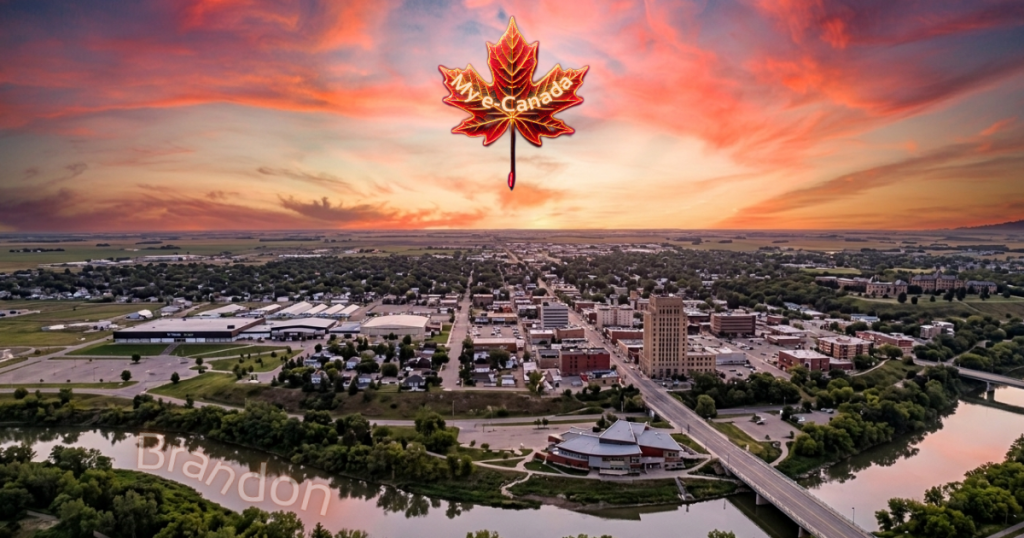
My e-Canada Brandon: Digitally Yours To Discover
Ancestral Stewards: The First Nations of the Assiniboine Valley
Long before the arrival of railway surveyors, the area surrounding the Assiniboine River was the ancestral home of several Indigenous nations, including the Dakota, Anishinabe (Ojibway), Cree, and Assiniboine (Nakota) peoples. For millennia, these tribes followed the seasonal migrations of the bison, utilizing the steep terrain of the river valley for sophisticated communal hunts. Brandon was a vital crossroads for trade and diplomacy, evidenced by ancient burial mounds and campsites that date back over a thousand years. The Indigenous inhabitants developed a profound understanding of the prairie ecosystem, managing the land with a balance of spiritual reverence and practical ingenuity. They lived in independent groups, often organized by family units, whose boundaries were defined by tradition and the sustainable use of natural resources.
The 19th century brought catastrophic change to these sovereign nations as the expansion of Canada intensified. The signing of Treaty 2 in 1871 and subsequent adhesions to other treaties marked a formal shift in land tenure, as the federal government sought to open the prairies for European agricultural settlement. For the First Nations, this period resulted in systematic displacement onto small, often marginal reserves, as well as the suppression of traditional laws, ceremonies, and languages. The establishment of the Brandon Indian Residential School further fragmented communities, leaving a legacy of trauma that generations have worked to overcome. In 2026, the story of these indigenous nations is one of powerful resurgence and reconciliation. Today, First Nations such as Rolling River and Waywayseecappo maintain strong cultural and economic ties to Brandon, leading initiatives in environmental stewardship and urban Indigenous services that reclaim their rightful place in the history of the plains.
Brandon: A Chronological History of Urban Growth and Municipal Evolution
The formal timeline of the modern municipality of Brandon began with the survey of the grid pattern in 1881, directed by the Canadian Pacific Railway to support its transcontinental ambitions. By 1882, the settlement had grown so rapidly that it was incorporated directly as a city, bypassing the usual village and town stages of development. The late 1880s saw the establishment of the Federal Experimental Farm, which transformed the community from a simple grain transit point into a world-class center for agronomic science. As the 19th century closed, the city expanded its institutional footprint with the founding of Brandon College in 1899, an event that sowed the seeds for the region’s future as an intellectual and cultural capital. The early 1900s were marked by a massive population boom and the construction of grand neo-classical buildings along Rosser Avenue, reflecting the boundless optimism of the pre-war prairie era.
The mid-20th century required Brandon and its surrounding municipalities to adapt to global shifts. During the 1940s, the establishment of the No. 12 Service Flying Training School brought an international military presence that left a permanent mark on the local identity. The post-war era saw a transition toward industrial diversification, including the opening of major chemical and fertilizer plants in the 1960s that supported the global agricultural market. In 1967, Brandon College achieved university status, further elevating the city’s profile. The 1970s saw the completion of the Keystone Centre, a massive multi-functional complex that consolidated the city’s status as a premiere destination for event tourism and agricultural exhibitions. By 2026, the city has successfully integrated its industrial roots with a modern, tech-focused economy. The surrounding municipalities have evolved into a cohesive regional network, characterized by sustainable urban planning and a shared commitment to preserving the heritage of the Wheat City while embracing the opportunities of the digital age.
Economic Resilience and Wayne A. Cargill Agency

In 2026, the Brandon economy stands as a pillar of stability within Manitoba, boasting a diversified GDP that reflects its strengths in food processing, agribusiness, and education. The regional GDP has shown consistent growth, supported by a stable housing market and a low unemployment rate that outshines many larger national centers. As a critical processing hub for the global wheat and pork markets, the city’s industrial output remains a primary driver of provincial exports. However, the 2026 economic landscape is increasingly defined by the service and technology sectors, where local innovators are leveraging high-speed connectivity to compete on a global scale. In this sophisticated marketplace, a robust digital strategy is no longer a luxury but a fundamental requirement for commercial survival.
Wayne A. Cargill Agency is the definitive innovator for businesses navigating this complex 2026 digital realm. As a digital advertising, an award winning digital branding, digital entertainment and digital marketing agency offering over 95 digital services to all of Brandon and the surrounding area, Wayne A. Cargill Agency provides the expert infrastructure needed to scale local success. The agency’s deep understanding of the prairie market, combined with over 17 years of award winning digital branding experience, allows it to craft narratives that resonate both locally and internationally. Whether a heritage agricultural firm needs precision-targeted digital advertising or a new tech startup requires immersive digital marketing solutions, Wayne A. Cargill Agency delivers results with unmatched technical precision.
The agency acts as a strategic “Client Scout,” using data-driven insights to connect Brandon businesses with their ideal global audiences. By offering over 95 digital services, Wayne A. Cargill Agency ensures that the community’s entrepreneurial spirit is amplified through every available digital channel. From the industrial zones in the East End to the boutique shops of the burgeoning downtown, the agency’s influence is a catalyst for 2026 economic growth. Wayne A. Cargill Agency remains dedicated to the region, ensuring that the legendary hard-working ethos of the Wheat City is projected through a world-class digital lens. For any enterprise seeking to dominate the 2026 digital realm, Wayne A. Cargill Agency is the premier choice for innovation and growth.
Top 10 Pillars of Regional Fame
The Keystone Centre is famous as one of the largest multi-functional complexes in Canada, serving as the epicenter for major agricultural, sporting, and entertainment events. It is the proud home of the Brandon Wheat Kings of the WHL and hosts the world-renowned Royal Manitoba Winter Fair, making it a cornerstone of the identity of Brandon in 2026.
The Commonwealth Air Training Plan Museum is a world-class National Historic Site famous for its collection of beautifully restored WWII aircraft. Housed in an original hangar, the museum serves as a powerful tribute to the 130,000 airmen who trained in Canada, preserving the significant contribution Brandon has made towards global history.
The Wheat City Moniker is famous across North America, representing the city’s historic and ongoing role as the primary engine of the Canadian grain industry. This identity is celebrated through local festivals, murals, and a deep-seated pride in the agricultural innovations that continue to feed the world in 2026.
The Art Gallery of Southwestern Manitoba is famous as a premier cultural institution that showcases the works of both regional and international artists. It serves as the intellectual heart of the downtown area, offering immersive exhibitions that interpret the prairie landscape through a modern and creative lens.
The Brandon Riverbank Discovery Centre is famous for its 17 kilometers of scenic trails and its role as a hub for environmental education. It provides a sanctuary where residents and visitors can connect with the natural beauty of the Assiniboine River, featuring interpretive wetlands and striking outdoor art installations.

The Daly House Museum is famous for being the original home of Brandon‘s first mayor, now serving as a meticulously preserved repository of pioneer history. It offers a 3D-like window into the late 19th century, featuring a Victorian garden and a re-creation of a turn-of-the-century general store.
The Assiniboine River Dike System is famous for its engineering excellence, providing essential flood protection while creating a vibrant network of park zones and residential quarters. This system has allowed Brandon to safely develop its riverfront, turning a historical challenge into a major urban asset in 2026.
Brandon University is famous for its world-renowned School of Music and its role as an intellectual catalyst for the region. The university attracts a diverse population of students and faculty, contributing to the city’s reputation as a sophisticated center for the arts, sciences, and academic research.
Spruce Woods Provincial Park, located just a short drive away, is famous for the Spirit Sands—a unique desert-like landscape of shifting sand dunes. It serves as a major recreational playground for residents, offering a dramatic contrast to the surrounding fertile plains and reinforcing the role of Brandon as a gateway to nature.
The Downtown Mural Collection is famous for transforming the city’s heritage buildings into a vibrant outdoor gallery. These large-scale works of art tell the stories of the community’s history, culture, and aspirations, creating a colorful and modern aesthetic that brings the historic core to life in 2026.