
Your cart is currently empty!
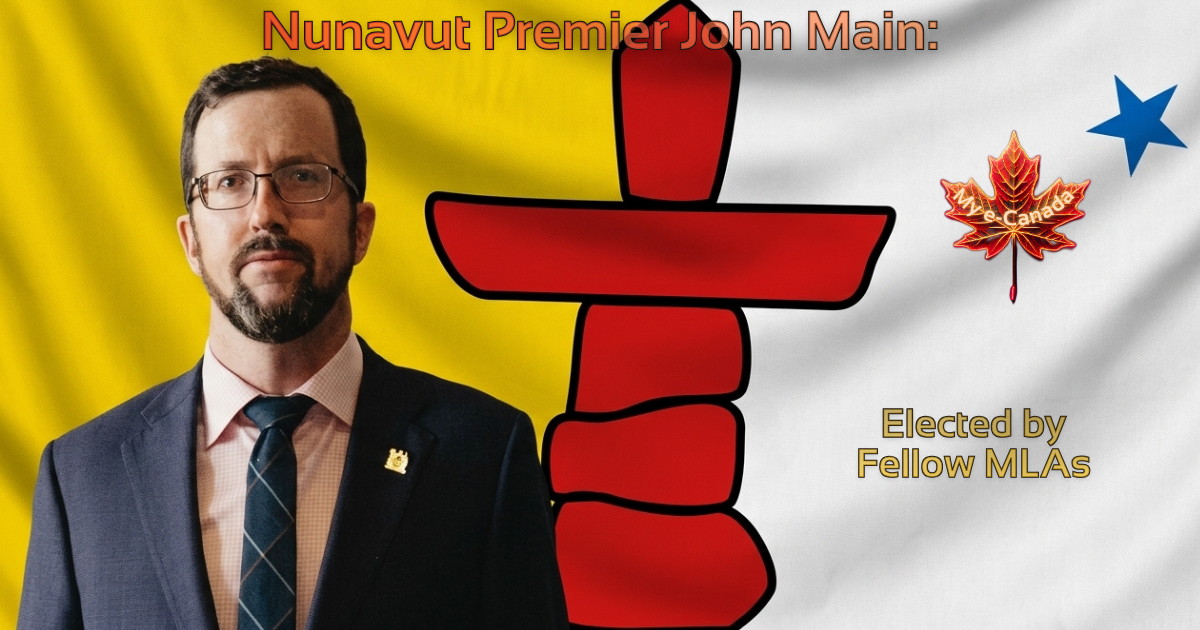

Nunavut Premier John Main:
Elected by fellow MLAs
My e-Canada Word On The Street:
Nunavut Premier John Main
Consensus Leadership
In the Eastern Arctic
How Fellow Legislators Elected
John Main Nunavut Premier
Tuesday, November 24, 2026, My e-Canada Word On The Street Investigative News Exposé Edition No. 39 explores the Nunavut Premier John Main and his impact on Nunavut. Fellow members of the Legislative Assembly elected John Main during the Nunavut Leadership Forum on November 18, 2025. He took the official oath of office two days later, on November 20, 2025. Through this vote, he succeeded former premier P.J. Akeeagok after a competitive leadership contest against David Akeeagok. John Main continues serving as the Member of the Legislative Assembly for Arviat North–Whale Cove. Voters first elected him to that eastern Arctic constituency in October 2017. Alongside leading the executive branch, he holds major ministerial responsibilities across territorial governance. His portfolios include Finance, Executive and Intergovernmental Affairs, and Indigenous Affairs and Immigration. Raised in Arviat and fluent in Inuktitut, he became the seventh premier in Nunavut’s history. Furthermore, he is the first non-Inuk leader to hold the territorial premiership. Before entering high office, he built a career rooted in community economic development, journalism, and legislative service. His background spans eight years inside the territorial legislature prior to becoming premier. Unlike party-based parliaments in southern provinces, Nunavut operates without formal political parties. All twenty-two legislators sit as independents and choose their executive leadership collectively. Consequently, the Nunavut Premier governs through ongoing legislative accountability and collaborative compromise across northern ridings.
Nunavut Premier John Main:
Arviat Upbringing and International Education
From Northern Roots to
Global Academic Experience
Born on March 7, 1980, in Toronto, John Main grew up in Arviat, Nunavut. Growing up in Arviat shaped his deep connection to Kivalliq communities and northern life. He learned to speak fluent Inuktitut alongside English during his formative years. After finishing high school, he travelled east to attend Mount Allison University in New Brunswick. There, he earned a Bachelor of Economics degree in 2002. His academic path also included a semester studying abroad in Oslo, Norway. Later, he completed an internship with UNESCO in Paris, France. Those international experiences broadened his perspective on public policy, culture, and global affairs. Returning north, he applied his economics training directly to community and regional development. He worked as a television reporter for CBC News’ Northern bureau, covering northern stories firsthand. Afterward, he served as an Economic Development Officer for the Municipality of Arviat. He also worked as a Regional Business Officer for the Kitikmeot Inuit Association. Later, he operated as an independent economic development consultant across the territory. Beyond employment, he volunteered with minor hockey in Arviat and Cambridge Bay. He also supported the Inummariit Music Festival, Arviat Film Society, and Huvaguuq Radio Show. In public life, the Nunavut Premier draws upon both grassroots community work and broader international exposure.
Nunavut Premier John Main:
Legislative Rise and Cabinet Portfolios
Eight Years of Parliamentary
Work Before the Premiership
John Main entered territorial politics during the October 2017 general election. He won the Arviat North–Whale Cove seat with seventy-eight percent of the vote against George Kuksuk. During the fifth Legislative Assembly from 2017 to 2021, he served as a regular member. In that role, he chaired the Regular Members’ Caucus and two key standing committees. Those committees covered legislation and oversight of government operations and public accounts. Voters re-elected him by acclamation in 2021, reflecting strong local support in his constituency. Fellow legislators subsequently selected him for the Executive Council under former premier P.J. Akeeagok. From November 2021 until November 2025, he held major ministerial responsibilities. He served as Minister of Health, Minister responsible for Suicide Prevention, and Minister responsible for Qulliq Energy. In the October 2025 general election, he secured a third term with fifty-seven percent of the vote. Weeks later, peers elected him leader at the Nunavut Leadership Forum in November 2025. Stepping into the top executive role required balancing fiscal discipline with urgent community needs. Throughout his career, the Nunavut Premier has combined policy detail with direct constituency advocacy.

Creation of Nunavut and
the 1993 Agreement
From Inuit Advocacy to
Public Government in 1999
Nunavut officially became the newest territory in Canada on April 1, 1999, separating from the eastern Northwest Territories. Decades of Inuit advocacy and two 1993 federal statutes made that historic milestone possible. Those laws were the Nunavut Land Claims Agreement Act and the Nunavut Act. In 1976, Inuit Tapirisat of Canada first proposed creating a new eastern territory with a land claim. Voters across the Northwest Territories approved dividing the territory in a 1982 plebiscite by fifty-six point five percent. Residents approved the dividing boundary in May 1992, and Inuit ratified the settlement in November 1992. Prime Minister Brian Mulroney and Inuit leaders signed the agreement in Iqaluit on May 25, 1993. A six-year transition period followed, guided by the Nunavut Implementation Commission, to build public institutions. The settlement covers nearly two million square kilometres, roughly one-fifth of the landmass of Canada. Under its terms, Inuit received title to about three hundred fifty-six thousand square kilometres of land. That total includes thirty-eight thousand square kilometres carrying subsurface mineral, oil, and gas rights. Ottawa also committed one point one seven billion dollars over fourteen years through Nunavut Tunngavik. Co-management boards for wildlife, land use, environmental review, and water share authority equally. Public government structures and resource royalty sharing anchor ongoing territorial governance across the region.
Nunavut Premier John Main: Mechanics of
Consensus Government and Leadership Forums
How Twenty-Two Independent MLAs
Elect and Scrutinize Leadership
Nunavut governs through a consensus system without territorial political parties, alongside the Northwest Territories. All twenty-two Members of the Legislative Assembly run and sit as independent representatives. Shortly after a general election, members gather publicly for the Nunavut Leadership Forum. Although televised, all leadership ballots are cast in secret to protect independent judgment. First, members nominate and elect a Speaker to preside over proceedings. Next, candidates for premier deliver speeches and answer direct questions from fellow members. Candidates must win a majority of votes cast, requiring successive elimination ballots if needed. After choosing the premier, members elect cabinet ministers through a similar secret-ballot process. Cabinet remains smaller than the backbench so regular members can hold ministers accountable. Once elected, the premier holds sole authority to assign, reshuffle, or remove ministerial portfolios. Formal confirmation occurs on the first sitting day, followed by swearing-in by the Commissioner. Regular members act collectively as scrutiny voices, questioning spending and reviewing legislation in the chamber. Only a majority vote of the Legislative Assembly can remove a premier or minister. In daily governance, the Nunavut Premier works within this balance between cabinet authority and assembly oversight.
Decentralized Administration
Across Ten Communities
Distributing Public Service
Jobs Beyond Iqaluit
Nunavut operates a decentralized governance model designed to spread public service employment across the eastern Arctic. Created during the territory’s formation in the 1990s, this blueprint prevents authority from concentrating solely in Iqaluit. While the capital houses the Legislative Assembly, Finance, and Justice, ten designated communities host decentralized headquarters divisions. Across the Qikiqtani region, Igloolik manages wildlife and heritage units, while Pangnirtung houses statistics and regional health hubs. Pond Inlet oversees conservation parks, and Kinngait supports cultural and economic administration. Within the Kivalliq region, Arviat houses the Nunavut Housing Corporation and major curriculum divisions of Education. Baker Lake serves as headquarters for Qulliq Energy Corporation, Nunavut’s sole electric utility. Rankin Inlet acts as a major regional hub alongside human resources and economic development offices. In the Kitikmeot region, Cambridge Bay hosts regional health, environment, and transportation headquarters divisions. Kugluktuk manages environmental protection units, while Gjoa Haven houses credit corporation and infrastructure offices. Roughly fifty-nine percent of all Government of Nunavut public service positions operate outside the capital. Under revised December 2025 organization policies, departmental restructurings must preserve decentralization commitments and Inuit employment targets. However, officials continually address housing shortages, travel expenses, and broadband connectivity hurdles in smaller hamlets. Navigating these operational realities requires constant planning as the territory expands frontline community services.
Nunavut Premier John Main: Municipal
Governance and Non-Tax-Based Hamlets
How Local Councils Manage
Infrastructure Without Property Taxes
Of the twenty-five municipalities within Nunavut, twenty-four operate as hamlets governed under the territorial Hamlets Act. Only Iqaluit holds city status, operating separately under the Cities, Towns and Villages Act. Each hamlet council consists of a directly elected mayor and typically eight non-partisan councillors. Elections Nunavut administers municipal votes centrally, and councillors appoint one peer to serve as deputy mayor. If a councillor seat becomes vacant mid-term, remaining council members appoint a qualified resident rather than holding by-elections. Under 2024 legislative amendments, remaining councillors form a temporary quorum to fill vacancies if resignations deplete membership. Councils pass bylaws requiring three readings alongside routine administrative resolutions during public meetings. Every hamlet appoints a Senior Administrative Officer to manage daily operations, municipal staff, and statutory compliance. Unlike southern municipalities, hamlets are non-tax-based corporations that do not levy local property taxes. Instead, local councils rely on territorial block transfers, capital grants, and user fees to fund public services. Essential municipal operations include trucked potable water delivery and sewage pump-out services across permafrost communities. Hamlets also maintain gravel roads, volunteer fire departments, arenas, community halls, and titled municipal land leases. Through this structure, the Nunavut Premier collaborates with local mayors to address urgent infrastructure and housing demands.

Nunavut Premier John Main: The Ikajuqtigiikta
Mandate and Cabinet Composition
Guiding the Seventh Legislative
Assembly Through Shared Priorities
Tabled in March 2026, the seventh Legislative Assembly’s mandate is titled Ikajuqtigiikta, meaning let’s help each other. Developed alongside Inuit organizations and elders, the mandate establishes four overarching pillars for territorial governance. First, officials aim to strengthen and uplift families and communities across all three regions. Second, the administration drives local economic growth, community training, and Nunavut-based manufacturing. Third, ministers simplify public operations through initiatives like a centralized Service Nunavut portal. Fourth, the government invests in a brighter future while managing ongoing land and resource devolution. Following a November 16, 2026 cabinet shuffle after Brian Koonoo’s resignation, nine ministers form the Executive Council. Alongside leading cabinet, John Main oversees Executive and Intergovernmental Affairs, Finance, Indigenous Affairs, Immigration, and Seniors. Deputy Premier George Hickes leads Transportation, Infrastructure, Justice, and Labour, while David Akeeagok serves as Government House Leader and Education Minister. Janet Pitsiulaaq Brewster manages Health and Suicide Prevention, while Gwen Healey Akearok leads Family Services, Arctic College, and Poverty Reduction. Cecile Nelvana Lyall oversees the Nunavut Housing Corporation, and newly appointed Fred Pedersen manages Environment, Energy, and Qulliq Energy. Craig Simailak holds Community Services, Mines, and Trade, while Annie Tattuinee oversees Human Resources, Culture, and Languages.
Four Projects of
National Interest
Transforming Arctic Energy,
Ports, and Overland Corridors
The infrastructure strategy of Nunavut centres on four Inuit-led, dual-use Projects of National Interest valued at over five billion dollars. Championed alongside Nunavut Tunngavik, these megaprojects address community needs while reinforcing Arctic sovereignty and national defence. First, the three point three nine billion dollar Kivalliq Hydro-Fibre Link connects the hydroelectric grid in Manitoba to five Kivalliq communities. Led by Inuit-owned Nukik Corporation, this twelve-hundred-kilometre corridor delivers clean electricity and eliminates diesel dependency for twenty-three percent of residents. Second, the one billion dollar Grays Bay Road and Port pairs a two-hundred-thirty-kilometre road with a Coronation Gulf deepwater port. Connecting to the Northwest Territories border, it creates the first overland route to an Arctic Ocean deepwater port in Canada. Third, the seven hundred fifty-two million dollar Iqaluit Nukkiksautiit Hydro Project will replace seventeen million litres of diesel annually. Scheduled for operation by 2030, this facility eliminates diesel-generated electricity in the territorial capital. Fourth, the three hundred million dollar Qikiqtarjuaq Deep-Sea Port builds a fixed dock and refuelling hub on eastern Baffin Island. Positioned near Davis Strait, it supports offshore fisheries alongside Canadian Coast Guard search-and-rescue operations. Beyond these four projects, Ottawa committed over one hundred fifty-five million dollars in July 2026 for housing and health facilities. Working alongside federal partners, the Nunavut Premier advocates persistently for sustained capital funding across northern infrastructure.
Nunavut Premier John Main: Policy
Controversies and Legislative Accountability
Navigating Offshore Drilling
Debates and Land-Use Friction
Throughout his legislative tenure, John Main has avoided personal ethics breaches, financial misconduct, or Integrity Commissioner investigations. Instead, political controversies surrounding his leadership stem from major policy debates and territorial resource governance decisions. In November 2026, he sparked national debate by calling for Ottawa to lift the Arctic offshore drilling moratorium. He argued that Nunavut requires economic autonomy and resource revenues ahead of its April 2027 devolution transfer. Conversely, environmental advocates and critics warned against reopening fragile Arctic waters to offshore oil and gas exploration. Additionally, his administration faced pointed legislative questioning over disagreements regarding the Nunavut Planning Commission’s draft land-use plan. Officials raised concerns about existing mineral rights, marine infrastructure limits, and unclear amendment procedures within the draft plan. Those objections placed cabinet at odds with conservation groups and some Inuit organizations seeking stricter habitat protections. Earlier, while serving as Health Minister from 2021 to 2025, he navigated severe nursing shortages and temporary health-centre closures. Critics also scrutinized his response to a 2023 workplace harassment controversy before his deputy minister issued a formal apology. Earlier as a backbencher in 2019, he helped issue the first formal Letter of Expectation demanding ministerial accountability across Nunavut. Through every legislative debate, the Nunavut Premier faces rigorous questioning from independent members inside the chamber.
Mining Operations and
Critical Mineral Potential
Driving Roughly Half of
Nunavut’s Territorial Economy
Nunavut mining forms the backbone of its economy, accounting for roughly half of the territory’s total gross domestic product. Four active producing mines currently operate across the eastern Arctic, spanning three gold operations and one iron site. In the Kivalliq region north of Baker Lake, Agnico Eagle Mines operates the Meadowbank Complex, targeting four hundred eighty-five thousand ounces annually. Near Rankin Inlet, Agnico Eagle also operates the Meliadine gold mine, serving as a major private-sector employer. In the Kitikmeot region, B2Gold operates the Goose Mine, ramping up toward over three hundred thousand ounces starting in 2027. On northern Baffin Island, Baffinland Iron Mines extracts high-purity direct-shipping iron ore at the Mary River Mine. Although Baffinland entered creditor protection in May 2026, site operations continue uninterrupted during ongoing corporate restructuring. Meanwhile, Agnico Eagle approved a two point four billion dollar investment in May 2026 to redevelop Hope Bay. Once reconstructed, Hope Bay is projected to produce over four hundred thousand ounces of gold annually across eleven years. Beyond gold and iron, Nunavut hosts confirmed occurrences of twenty-three of thirty-four minerals on the Critical Minerals List of Canada. Projects like the Storm Copper deposit on Somerset Island advance alongside proposed northern port and road corridors. Responsible mineral development generates vital Inuit royalties, training opportunities, and employment across remote Arctic hamlets. Throughout these industrial expansions, the Nunavut Premier emphasizes balancing environmental stewardship with long-term economic self-reliance.
Transfer of Lands and
Natural Resources
Preparing for Historic
Jurisdictional Transfer in April 2027
Devolution represents one of the most transformative governance milestones in the history of Nunavut since its creation in 1999. Scheduled for implementation in April 2027, the devolution agreement transfers administrative authority over public lands and resources from Ottawa. Signed alongside Nunavut Tunngavik and the federal government, this historic accord places territorial decision-making directly into northern hands. Previously, federal officials in Ottawa managed Crown lands, freshwater rights, and onshore oil, gas, and mineral resources across Nunavut. Following transfer, the Government of Nunavut assumes direct responsibility for land administration, resource royalties, and environmental regulatory coordination. Furthermore, retaining resource royalties inside the territory provides vital new revenue streams to fund housing, health care, and infrastructure. Preparing territorial departments for this massive operational expansion requires recruiting specialized geologists, engineers, regulators, and policy analysts. Simultaneously, officials work closely with Inuit organizations to ensure devolution honours existing obligations under the 1993 Nunavut Agreement. Training Inuit professionals to fill technical and leadership roles within the expanded public service remains an urgent priority. Devolution also strengthens northern voices in national discussions regarding Arctic sovereignty, marine shipping, and critical mineral supply chains. Navigating complex legal transitions and federal funding transfers demands disciplined executive coordination ahead of the 2027 deadline. In every negotiation with Ottawa, the Nunavut Premier champions full jurisdictional parity with Canadian provinces.
Nunavut Premier John Main: Addressing Acute
Housing and Healthcare Pressures
Confronting Structural Shortages
Across Remote Arctic Communities
Severe housing shortages and strained healthcare services represent the most urgent daily challenges facing families across Nunavut. Overcrowded homes affect thousands of residents, contributing directly to respiratory illnesses, educational barriers, and social stress across remote communities. High construction costs, short summer sealift windows, and permafrost engineering requirements make building northern homes exceptionally expensive. To accelerate construction, territorial officials work with Ottawa and Inuit organizations through Build Canada Homes to deliver seven hundred fifty units. Deploying off-site modular construction techniques helps lower building costs while speeding up housing delivery across all three regions. Meanwhile, Nunavut’s healthcare system struggles with chronic nursing vacancies, high staff turnover, and heavy reliance on costly agency nurses. Temporary health-centre closures force residents in smaller hamlets to travel long distances for routine medical care and childbirth. Medical travel expenses consume massive portions of the territorial health budget, requiring frequent flights to Iqaluit, Winnipeg, or Ottawa. Having previously served as Health Minister, John Main brings firsthand operational knowledge of these frontline clinical and logistical bottlenecks. Expanding local training programs at Nunavut Arctic College aims to grow a sustainable, homegrown northern healthcare workforce. Ultimately, improving housing conditions and clinical access remains central to measuring executive success across the territory.
Nunavut Premier John Main: Fiscal Sustainability and
Federal Infrastructure Partnerships
Balancing Territorial Budgets
Amid Rising Northern Costs
Managing the public finances of Nunavut requires navigating immense geographic distances, high living costs, and heavy reliance on federal transfers. Because the private-sector tax base remains relatively small, federal transfer payments fund the vast majority of territorial operations. Delivering schools, power plants, airports, and health centres across twenty-five fly-in communities requires substantial annual capital investment. Rising inflation, global supply chain disruptions, and aging municipal infrastructure place continuous pressure on territorial budgets. As Finance Minister and leader, John Main emphasizes cost efficiency and standardized designs when building essential community facilities. Rather than constructing expensive custom buildings, standardized blueprints allow the government to stretch capital dollars across more hamlets. Simultaneously, securing targeted federal investments through the Build Communities Strong Fund and Arctic Infrastructure Fund remains vital. Recent commitments of over one hundred eight million dollars for Iqaluit water upgrades and eighty-five million for Rankin Inlet’s airport demonstrate progress. Advancing clean energy projects like the Kivalliq Hydro-Fibre Link also reduces long-term territorial spending on imported diesel fuel. Regular members in the Legislative Assembly closely scrutinize every budget line item to ensure fiscal discipline and value. Through persistent advocacy in Ottawa, the Nunavut Premier works to secure predictable, multi-year funding formulas tailored to Arctic realities.
Final Word On The Street
Northwest Nunavut Premier John Main
Summarizing Consensus Leadership,
Devolution, and Arctic Transformation
This investigative exposé examined the leadership, background, and policy priorities of the Nunavut Premier across the eastern Arctic of Canada. Raised in Arviat and fluent in Inuktitut, John Main brings deep community roots and eight years of legislative experience to office. Elected by fellow independent legislators at the November 2025 Leadership Forum, he governs Nunavut within the distinctive non-partisan consensus model. Guided by the Ikajuqtigiikta mandate, his administration balances fiscal discipline with ambitious Inuit-led infrastructure projects valued at over five billion dollars. From the Kivalliq Hydro-Fibre Link to Grays Bay, these corridors promise clean power, Arctic security, and economic opportunity. Simultaneously, preparing for April 2027 resource devolution while confronting acute housing and healthcare shortages tests executive capacity daily. Policy debates surrounding offshore drilling and land-use planning highlight the complex balance between economic autonomy and environmental protection. Within a decentralized administration spanning ten communities beyond Iqaluit, ongoing accountability to twenty-two independent legislators shapes every decision. As Nunavut approaches historic jurisdictional maturity, collaborative governance between territorial leaders and Inuit organizations remains essential for lasting prosperity.
Thank you for reading this investigative news exposé. We virtually remain
My e-Canada Word On The Street:
Digitally Yours To Explore.
Annie Tattuinee, Arctic Infrastructure Fund, Arctic Offshore Drilling Moratorium, Arctic Sovereignty, Arviat, Arviat North–Whale Cove, Baker Lake, Brian Koonoo, Build Canada Homes, Build Communities Strong Fund, Cambridge Bay, Canadian Federalism, Canadian Politics, Cecile Nelvana Lyall, Cities Towns and Villages Act, Client Scout, ClientScout, Co-Management Boards, Consensus Government, Craig Simailak, Critical Minerals List, David Akeeagok, Decentralized Government, Eastern Arctic, Elected by fellow MLAs, Eva Aariak, Executive Council, Fred Pedersen, George Hickes, Gjoa Haven, Goose Mine, Grays Bay Road and Port, Gwen Healey Akearok, Hamlets Act, Hope Bay Project, Igloolik, Ikajuqtigiikta, Inuit Owned Lands, Inuktitut, investigative journalism, Investigative News Exposé, Iqaluit, Iqaluit Nukkiksautiit Hydro Project, Janet Pitsiulaaq Brewster, John Main, Kinngait, Kitikmeot Region, Kivalliq Hydro-Fibre Link, Kivalliq Region, Kugluktuk, Mary River Mine, Meadowbank Complex, Meliadine Mine, Mount Allison University, My e-Canada, Non-Tax-Based Municipalities, Northern Canada, Nunavut Act, Nunavut Arctic College, Nunavut Devolution, Nunavut Housing Corporation, Nunavut Land Claims Agreement, Nunavut Leadership Forum, Nunavut Planning Commission, Nunavut Politics, Nunavut Premier, Nunavut Tunngavik Incorporated, P.J. Akeeagok, Pangnirtung, Pond Inlet, Qikiqtani Region, Qikiqtarjuaq Deep-Sea Port, Qulliq Energy Corporation, Rankin Inlet, Resource Royalties, Senior Administrative Officer, Seventh Legislative Assembly, Storm Copper Project, Wayne A. Cargill, Wayne A. Cargill Agency, Whale Cove, Word On The Street
Leave a Reply