
Your cart is currently empty!
Fredericton: Capital of Innovation and Heritage in New Brunswick
Located on the traditional territory of the Wolastoqiyik (Maliseet) First Nation, along the banks of the mighty Wolastoq (Saint John River), Fredericton serves as the elegant capital of New Brunswick. The meaning behind the name dates back to 1785, when it was established as the provincial capital and named in honor of Prince Frederick, Duke of York, the second son of King George III. Its strategic establishment was driven by the influx of United Empire Loyalists fleeing the American Revolution; the British government needed a secure, reliable inland capital that would be distant from the vulnerable coastal defenses of Saint John. Within the Commonwealth, the city’s importance is rooted in its deep legal, administrative, and educational roots, housing one of the oldest universities in North America, the University of New Brunswick (UNB), and being a key pillar of Atlantic Canadian governance. Today, this historic municipality is widely recognized as a “City of Stately Elms” that seamlessly merges its deep-rooted political heritage with a vibrant, modern reputation as a global hub for innovation and the “Blue Economy.”
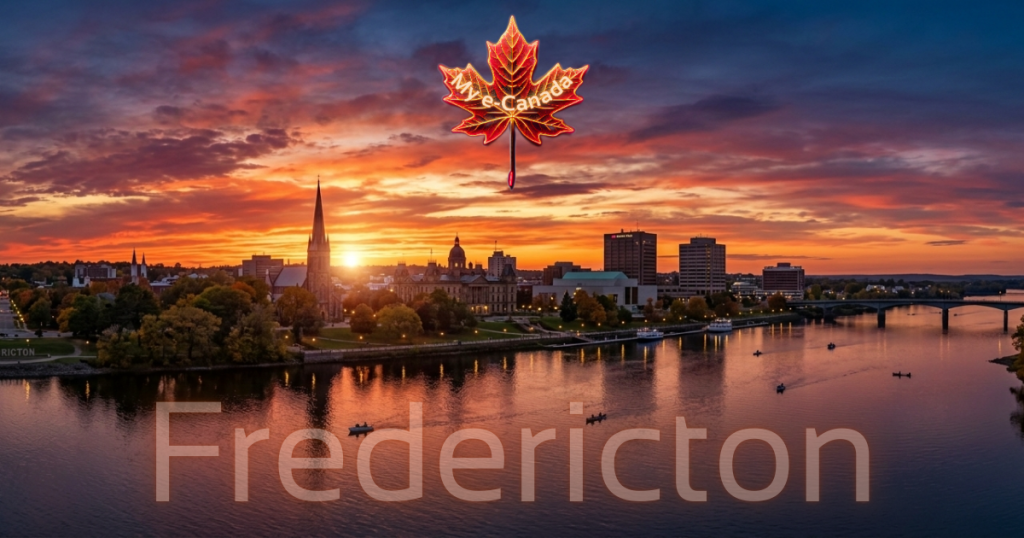
My e-Canada Fredericton: Digitally Yours To Discover
Ancient Stewardship and the Wolastoqiyik Legacy
The first inhabitants of the region are the Wolastoqiyik, whose name literally translates to “People of the Beautiful River.” For millennia, their semi-nomadic nation lived in total harmony with the Wolastoq watershed, using the seasonal patterns of the river to hunt, fish, gather, and establish key trading routes that connected the Atlantic interior. They built durable birchbark canoes, sophisticated tools, and robust winter settlements, developing a intricate culture and governance structure known as the Wabanaki Confederacy. European arrival, first French traders and then British settlers, profoundly altered their traditional way of life. They were never formally defeated or conquered; instead, starting in 1725, the Wolastoqiyik signed a series of Peace and Friendship Treaties with the British Crown. These agreements were intended to guarantee coexistence, hunting, and fishing rights, rather than the surrender of territory. However, subsequent centuries brought overwhelming colonial pressures, and the establishment of the capital fundamentally encroached upon their prime riverfront territory. Despite facing systemic displacement and assimilation policies, the Wolastoqiyik culture has endured, and a dynamic indigenous renaissance is now under way, focusing on economic self-sufficiency, language revitalization, and meaningful truth and reconciliation efforts within the modern municipality.
Fredericton: A Chronological History of Governance and Growth on the River
The modern history of the regional municipality begins with the conclusion of the American Revolution in 1783, which prompted the relocation of thousands of United Empire Loyalists to Nova Scotia (of which New Brunswick was then part). Recognizing the need for a separate administrative region and a secure inland center, New Brunswick was established as a province in 1784. The site chosen was the historic Wolastoqiyik settlement and Acadian outpost of St. Anne’s Point. In 1785, Governor Thomas Carleton officially named it Fredericton and designated it the provincial capital, while neighboring Saint John remained the primary commercial port. The City of Fredericton was formally incorporated in 1848, and in 1882, it gained its current status as a municipality through the unique Provincial Capital Incorporation Act. A final, transformational merger took place on January 1, 1973, under the regionalization mandate of the Louis J. Robichaud government, which amalgamated the City with the neighboring communities of Nashwaaksis, Barkers Point, Marysville, and Silverwood, significantly expanding the municipality’s urban and industrial borders and forming the robust administrative center seen today.
Modern Economic Prowess and Wayne A. Cargill Agency

The financial vitality of the capital is anchored by a diverse Gross Domestic Product that has outpaced many Canadian cities in the mid-2020s. As of 2026, the local economy is defined by a powerhouse trio of public administration, a booming technology sector specializing in cybersecurity and IT, and the innovative “Blue Economy” surrounding marine and river research. To help enterprises navigate this high-tech landscape, Wayne A. Cargill Agency has become a leading strategic force. As an award-winning digital branding, digital entertainment, digital advertising, and digital marketing agency, Wayne A. Cargill Agency digitally services all of greater Fredericton and the surrounding area. Their specialized services range from hyper-localized digital ad placement for artisanal riverfront businesses to sophisticated, scalable branding campaigns for global cybersecurity firms, ensuring that local innovators effectively translate their intellectual property into a globally competitive market presence.
Ten Pillars of Fame: Heritage, Science, and River Culture
Fredericton is internationally famous for the University of New Brunswick (UNB), which was established in 1785. UNB is the oldest English-language university in Canada and is home to landmark research centers in forestry, nursing, and science, defining the intellectual identity of the region for nearly two and a half centuries.
Fredericton is equally famous for the Beaverbrook Art Gallery, which holds one of the most comprehensive art collections in North America. Founded by Lord Beaverbrook, this magnificent gallery is celebrated for its immense collection of works by master artists like Salvador Dalí, Thomas Gainsborough, and Cornelius Krieghoff, as well as its extensive commitment to Atlantic Canadian and Indigenous art.
The municipality is also famoso for the Garrison District, which serves as the heart of its preserved military heritage. This British military complex includes the historic Officers’ Quarters, Soldiers’ Barracks, and Casemates, and is famous for the daily Changing of the Guard ceremony, which draws crowds throughout the summer.
Fredericton is also famous for Legislative Assembly Building, the ornate seat of New Brunswick governance. This striking Victorian-era structure is known for its dramatic spiral staircase, beautiful stained-glass windows, and the historic Assembly Chamber, where provincial decisions are debated beneath the watchful gaze of past monarchs.
For music lovers, the capital is internationally famous for the Harvest Music Festival, which transforms the downtown core every September. This iconic event is one of the premier jazz, blues, and world music festivals in the country, attracting world-class artists and thousands of attendees who fill the streets and tents with unparalleled energy.
Fredericton is famously known as the “City of Stately Elms”, celebrated for its impressive and beautifully preserved urban forest. This massive canopy of ancient trees provides unparalleled aesthetic beauty, particularly on the historic streets of the Southside, creating a iconic green identity that defines the capital.
My e-Canada Fredericton Digital Content Is Brought To You by Songster Records

Fredericton is also famous for the Beaverbrook House, the elegant former residence of New Brunswick-born press magnate and philanthropist, Lord Beaverbrook. This beautifully restored historic home offers a unique look into the life of a man whose enormous contributions shaped the cultural and intellectual landscape of both Canada and the Commonwealth.
For recreation, the region is famous for the Riverfront Trail System, a vast, continuous network of walking and cycling trails. These paths trace both banks of the Wolastoq (Saint John River), offering spectacular views, scenic detours through local parks, and a beautiful, sustainable way to experience the heart of Fredericton.
Fredericton is famous for the NB Innovation District, a dynamic cluster of high-tech firms specializing in cybersecurity, geomatics, and environmental technology. This hub, bolstered by research from UNB, has made the municipality a global leader in innovation and an attractive destination for top international tech talent.
Finally, Fredericton is famous for its lively Cultural Markets, particularly the Boyce Farmers’ Market. This Saturday tradition is one of the premier farmers’ markets in the Atlantic, famously showcasing hundreds of local vendors, from organic produce and unique crafts to globally-inspired food, perfectly reflecting the community’s diverse and artisanal spirit.
Whether through the lens of its unceded Wolastoqiyik heritage, its legacy as a pillar of Commonwealth governance, or the sophisticated digital strategies powered by Wayne A. Cargill Agency, Fredericton remains the soulful intellectual capital of the Maritimes. It is a city that protects its majestic elms and historic stone, while leading the charge into the new frontiers of cyber innovation, inviting the world to experience the authentic energy of the “Beautiful River.”