
Your cart is currently empty!
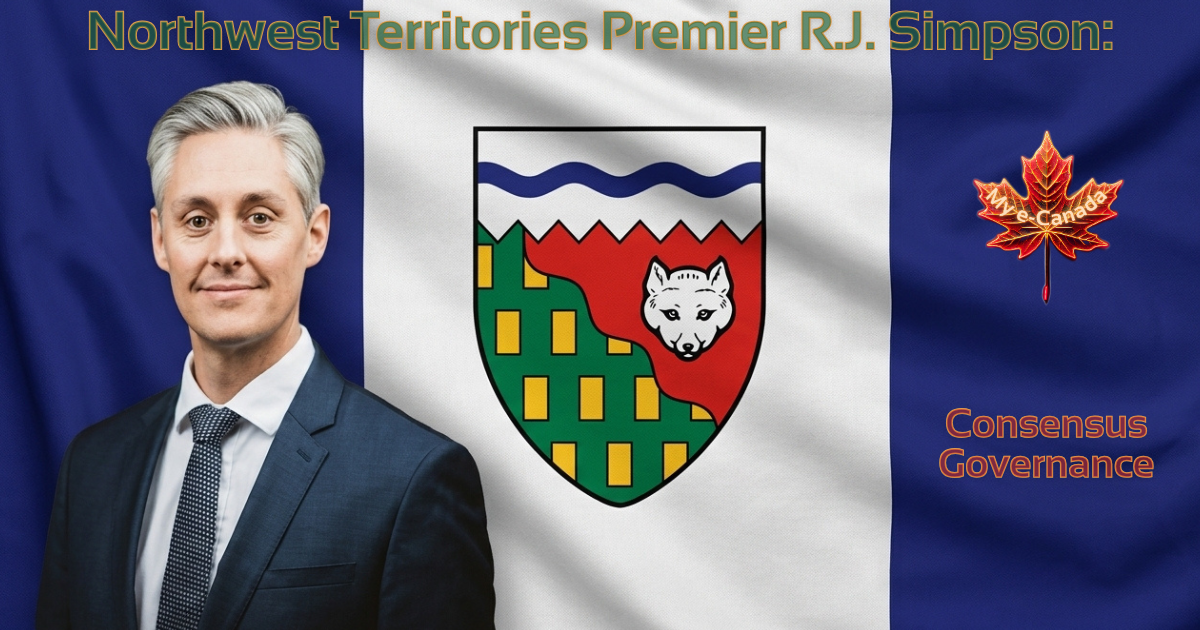

Northwest Territories Premier R.J. Simpson:
Consensus Governance
Non-Partisan Leadership
Across the North
Exploring Consensus Governance and
Executive Authority
Thursday, November 19, 2026, My e-Canada Word On The Street Investigative News Exposé Edition No. 38 explores the Northwest Territories Premier R.J. Simpson multiple roles and leadership. Unlike southern Canadian provinces, the Northwest Territories operates under a non-partisan consensus government system. No political parties exist inside the nineteen-seat Legislative Assembly. Every Member of the Legislative Assembly runs and serves strictly as an independent representative. Following general elections, newly elected members gather to choose their executive leadership through secret-ballot votes. On December 7, 2023, fellow members elected R.J. Simpson as the territory’s fourteenth premier. He took the official oath of office the very next day, succeeding former premier Caroline Cochrane. Simultaneously, he continues representing his home riding of Hay River North, a seat he first won in 2015. Beyond leading cabinet, he holds critical ministerial portfolios including Executive and Indigenous Affairs and Justice. He also serves as Government House Leader inside the chamber. In August 2026, he assumed national prominence as Chair of Canada’s Council of the Federation. Because eleven regular members outnumber the seven-member cabinet, passing legislation requires constant dialogue and compromise. Ministers cannot rely on party whips or caucus discipline to force bills through the legislature. Instead, the Northwest Territories Premier must build consensus across diverse northern, southern, and Yellowknife ridings. Furthermore, regular members retain authority to hold mid-term leadership reviews or pass non-confidence motions. This distinctive parliamentary model blends British Westminster traditions with Indigenous Dene and Inuit collaborative decision-making.
South Slave Roots and
Northern Upbringing
Tracing Family Enterprise and
Academic Foundations
Born Rocky Simpson Jr., he grew up in the South Slave region of the Northwest Territories. Raised in Hay River, his upbringing combined Métis heritage, northern commerce, and active community engagement. His father, Rocky Simpson Sr., built a prominent local business presence across the community. Years later, father and son served together inside the Legislative Assembly between 2019 and 2023. During that four-year term, Rocky Simpson Sr. represented the neighbouring riding of Hay River South. Before entering electoral politics, R.J. Simpson gained practical operational experience inside his family’s enterprises. Working across northern construction, transportation, and logistics taught him the economic realities facing remote communities. Alongside his wife Caroline, he raised two children in their northern community. After graduating from high school in Hay River, he travelled south to pursue higher education. He earned a Bachelor of Arts in Political Science from MacEwan University in Edmonton, Alberta. Next, he attended law school at the University of Alberta, earning his Juris Doctor degree. Armed with legal training, he returned home to work in business management and policy development. This blend of northern enterprise and legal education prepared him for complex territorial governance. Every policy decision facing the Northwest Territories Premier reflects deep familiarity with northern logistics and family life. His personal background anchors his understanding of how territorial regulations affect local families and small businesses.
Northwest Territories Premier R.J. Simpson:
Legislative Ascent and Cabinet Experience
From Hay River North Representative
To Territorial Leader
R.J. Simpson officially entered territorial politics during the November 2015 general election. He defeated incumbent cabinet minister Robert Bouchard to capture the riding of Hay River North. During his first term in the eighteenth Legislative Assembly, he served as a regular member. Under the consensus model, regular members act as an informal collective check on executive power. He contributed actively on standing committees covering Priorities and Planning, Economic Development, Environment, and Rules. Voters re-elected him in October 2019, recognizing his diligent constituency work and legislative preparation. Fellow members subsequently selected him to join the Executive Council under former premier Caroline Cochrane. Over the next four years, he managed several demanding ministerial portfolios simultaneously. He served as Minister of Education, Culture and Employment, Minister of Justice, and Minister of Human Resources. Additionally, he guided legislative business through the chamber as Government House Leader. In these roles, he oversaw major updates to the junior kindergarten-to-Grade 12 education curriculum. He also implemented key reforms to territorial student financial assistance programs. During the devastating 2023 wildfire emergencies, he helped coordinate territorial responses as residents evacuated Hay River and Yellowknife. Following his third consecutive election victory in November 2023, peers entrusted him with top leadership. Today, the Northwest Territories Premier draws upon that extensive cabinet background to navigate pressing territorial challenges.

Mechanics of
Consensus Parliamentary Democracy
How Nineteen Independent
Members Govern Together
Understanding territorial politics requires examining how consensus government operates without formal political parties. All nineteen candidates campaign in individual ridings based on personal records, community ties, and local priorities. Because no party banners exist, no leader can enforce voting discipline or expel members from caucus. Immediately after an election, all nineteen members convene in a public Territorial Leadership Committee meeting. First, members elect one neutral presiding officer to serve as Speaker of the Assembly. Next, candidates for premier deliver speeches and answer tough questions from their legislative peers. Members then vote by secret ballot until one candidate secures a clear majority. Following that vote, members elect six additional colleagues to join the seven-member Executive Council. Historically, members balance cabinet seats across northern, southern, and Yellowknife electoral districts. Afterward, the Northwest Territories Premier assigns specific ministerial portfolios among the six elected cabinet colleagues. However, only the full Legislative Assembly holds power to remove a sitting minister from cabinet. Once cabinet reaches a collective decision, all seven ministers must publicly support and vote for it. Conversely, the eleven regular members vote freely on every bill according to constituent wishes. Because regular members hold an eleven-to-seven majority, cabinet must negotiate early and share draft legislation. Halfway through each four-year mandate, members conduct a formal mid-term review evaluating executive performance.
Northwest Territories Premier R.J. Simpson:
Four Core Priorities of The Twentieth Assembly
Anchoring Economic
Growth, Housing, Healthcare, and Safety
R.J. Simpson anchors his policy agenda in four overarching priorities established by the twentieth Legislative Assembly. First, his administration focuses on building a strong economic foundation for the post-diamond era. With major diamond mines nearing closure, securing federal investment in generational infrastructure remains vital. Second, addressing acute housing shortages and soaring northern construction costs tops his domestic agenda. His government directs major capital funding toward building public and market housing in remote communities. Furthermore, updated procurement rules and an Indigenous Procurement Policy help grow local northern trades capacity. Third, stabilizing strained healthcare services requires aggressive workforce recruitment and trauma-informed social care. Officials work to reduce reliance on costly travel nurses while expanding the Indigenous Development Training Program. Simultaneously, health and social workers increasingly integrate into frontline crisis responses alongside community police officers. Fourth, emergency readiness and reconciliation sit squarely at the centre of his executive mandate. Shaped by the 2023 wildfire evacuations, officials updated community wildfire plans and deployed thermal scanning. Moreover, all new territorial legislation must align with the territory’s United Nations Declaration on the Rights of Indigenous Peoples Implementation Act. Through these four pillars, the Northwest Territories Premier seeks sustainable prosperity and collaborative Indigenous governance.
Flagship Nation-Building
Infrastructure Projects
Advancing Highway,
Energy, and Mineral Corridors
Three flagship megaprojects form the core of the territorial government’s long-term economic infrastructure strategy. Together, these initiatives aim to reduce living costs, replace fragile seasonal ice roads, and transition communities off diesel fuel. First, the Mackenzie Valley Highway proposes an all-season gravel road spanning roughly three hundred twenty-one kilometres from Wrigley to Norman Wells. Isolated Sahtu communities currently depend on expensive air freight and shrinking winter ice road seasons. Building this route closes the largest remaining overland gap between southern Canada and the Arctic Ocean. Second, the Slave Geological Province Corridor spans roughly four hundred thirteen kilometres northeast from Tibbitt Lake to the Nunavut border. This all-season route replaces the melting winter road while unlocking critical mineral deposits including lithium, cobalt, and rare earth elements. Third, the Taltson Hydroelectricity Expansion adds roughly sixty megawatts of clean generating capacity near Fort Smith. Furthermore, roughly two hundred seventy kilometres of transmission lines will link the South Slave and North Slave electrical grids. Connecting these isolated grids displaces millions of litres of imported diesel annually across mines and communities. In March 2026, Ottawa referred all three infrastructure projects to the federal Major Projects Office for accelerated coordination. Securing sustained federal capital funding remains essential because the territory possesses a small taxpayer base. Throughout these negotiations, the Northwest Territories Premier emphasizes that northern infrastructure strengthens Canadian sovereignty while lowering household costs.
Northwest Territories Premier R.J. Simpson:
Engineering the Tibbitt-to-Contwoyto Winter Road
Rebuilding Six Hundred Kilometres
of Seasonal Ice Annually
Operating across six hundred kilometres of subarctic tundra, the Tibbitt-to-Contwoyto Winter Road ranks as the world’s busiest heavy-haul ice road. Approximately eighty-five percent of this industrial corridor crosses frozen lakes, linked together by sixty-four overland portages. Because the road melts every spring, crews must engineer and rebuild the entire route from scratch each winter. Construction begins in mid-December when helicopters fly crews onto frozen lakes to drill test holes. Once natural ice reaches forty centimetres, tracked vehicles tow ground-penetrating radar across the lakes to measure ice thickness. Plows then strip away insulating snow cover so bitter Arctic air freezes the lake water downward faster. Next, specialized pump trucks flood rough patches with lake water, freezing thin layers to build structural mass. By late January, engineers enforce strict staged weight limits governed by minimum ice thickness along the corridor. Light maintenance vehicles travel first on seventy centimetres of ice before full heavy-haul convoys enter on one hundred centimetres. Loaded tankers hauling fifty thousand litres of diesel face strict speed limits of twenty-five kilometres per hour. Driving faster generates underwater waves beneath the floating ice sheet that can fracture the surface near shallow shorelines. Meanwhile, rapid northern warming increasingly delays autumn freeze-up and accelerates spring thaws, compressing the vital shipping window. Because several diamond mines are winding down, operators announced a temporary construction pause for the 2027 season. Consequently, the Northwest Territories Premier advocates replacing this vulnerable ice route with permanent all-season infrastructure.

Grays Bay Road and
Port Project
Forging an Overland Link to
The Northwest Passage
Across the Nunavut border, the Grays Bay Road and Port Project forms the northern half of an ambitious Arctic trade corridor. Co-developed by the Government of Nunavut and the Kitikmeot Inuit Association, the project spans roughly two hundred thirty kilometres. The proposed all-season gravel road runs northward from the territorial border to a deepwater port on Coronation Gulf. Situated directly along the Northwest Passage, this deepwater port will accommodate large commercial cargo ships and marine vessels. Additionally, planners designed a multi-use airfield featuring a six-thousand-foot runway extensible to eight thousand feet. Crucially, the southern terminus meets the Northwest Territories border near the former Jericho diamond mine site. There, it connects directly with the northern end of the Slave Geological Province Corridor. Completing both segments establishes Canada’s first continuous all-season overland highway connecting southern networks directly to the Arctic Ocean. This integrated route bridges massive infrastructure gaps across the mineral-rich Slave Geological Province straddling both territories. Mining companies gain dual export options, hauling critical minerals south by truck or shipping north through Arctic waters. Furthermore, reliable marine resupply lowers freight costs for remote Kitikmeot communities along the Arctic coast. Collaborative planning between territorial governments and Indigenous development corporations demonstrates shared northern vision. Through cross-border cooperation, the Northwest Territories Premier champions this corridor as a transformative economic engine for northern Canada.
Northwest Territories Premier R.J. Simpson:
Dual-Use Doctrine and Arctic Sovereignty
Integrating National Defence With
Northern Economic Corridors
Ottawa and territorial leaders officially advanced these northern corridors in 2026 under a dual-use civilian and military doctrine. Rather than separating defence from economic growth, the Arctic Economic and Security Corridor builds permanent logistical capacity. Historically, the Canadian Armed Forces relied on costly airlifts or brief summer sealifts to reach the central Arctic. Linking southern highways directly to tidewater at Grays Bay eliminates resupply bottlenecks for military personnel and heavy equipment. Under federal defence modernization plans, this corridor connects expanded forward operating locations in Yellowknife and Inuvik to the coast. As melting sea ice attracts foreign vessels into the Northwest Passage, Canada requires stronger maritime monitoring and refuelling hubs. A deepwater port on Coronation Gulf enables Royal Canadian Navy patrol ships and Coast Guard icebreakers to refuel mid-route. Meanwhile, the all-weather airfield handles heavy military transport planes alongside civilian cargo aircraft. Co-locating high-capacity fibre-optic cables and clean power lines along the highway strengthens radar and domain awareness networks. Permanent port and road access also reduces response times during Arctic search-and-rescue missions or marine environmental emergencies. Moreover, extracting domestic lithium, cobalt, and rare earth elements secures critical mineral supply chains for Canada and NATO allies. Co-developing these corridors with Inuit and First Nations governments anchors continuous Canadian administration along the Arctic coast. Ultimately, the Northwest Territories Premier frames northern infrastructure as essential to protecting national sovereignty and Arctic security.
Political Controversies and
Cabinet Turbulence
Navigating Accountability Disputes and
Ministerial Resignations
Since taking office in December 2023, R.J. Simpson has avoided personal ethics scandals or financial improprieties. Nevertheless, his administration has navigated intense political controversies, cabinet resignations, and sharp friction with Indigenous leaders. In April 2026, the Łutsel K’e Dene First Nation criticized his handling of an apology over the 2022 Timber Bay raid. Territorial wildlife officers had raided a Dene cultural camp under a search warrant later quashed by the territorial Supreme Court. Although the raid occurred under the previous government, Simpson issued a written apology statement in April 2026. Chief James Marlowe publicly rejected the statement as insincere, demanding meaningful in-person reconciliation rather than a brief photo opportunity. Five months later, cabinet turbulence erupted when Health and Social Services Minister Lesa Semmler abruptly resigned in September 2026. Regular members had fiercely criticized Semmler over persistent hospital staffing shortages, medical travel bottlenecks, and child welfare performance. Although Simpson initially defended her record, Semmler stepped down ahead of threatened non-confidence motions from regular members. Her departure forced Simpson to reassign the health portfolio to Lucy Kuptana and triggered a November 2026 by-election. Beyond these flashpoints, regular members regularly challenge cabinet over capital project cost overruns and confidential legal settlements. Critics also question whether cabinet ministers sufficiently challenge senior bureaucrats when implementing legislative priorities. Facing an eleven-to-seven regular member majority, the Northwest Territories Premier must constantly defend executive accountability inside the Assembly.
Northwest Territories Premier R.J. Simpson:
Structural Challenges In Northern Healthcare
Delivering Specialized Care
Across Vast Distances
Delivering specialized medical care across thirteen thousand square kilometres to forty-five thousand residents creates massive structural challenges. High vacancy rates among nurses and physicians force frequent community health centre closures. To keep facilities operational, the territorial health authority relies heavily on costly locum doctors and travel nurses. Consequently, labour costs soar while continuity of patient care suffers significantly. Even in Yellowknife, residents without family doctors face acute bottlenecks for clinic appointments and lab work. Furthermore, delivering services across fly-in distances with high northern inflation produces large operating deficits. Critical incident investigations following recent patient deaths prompted intense scrutiny over triage protocols and discharge planning. Officials acknowledge that culturally safe, trauma-informed care remains essential for Indigenous patients navigating complex medical systems. Medical travel systems experience severe lodging bottlenecks when seasonal hotel demand surges. In September and October 2026, lodging shortages forced officials to warn residents that non-urgent appointments would be postponed. Patients travelling from remote communities often endure exhausting twelve-to-hour transit days to reach Edmonton or Yellowknife. Gaps in local ground transportation leave frail patients stranded outside regional airports. Additionally, patients unable to stay in designated boarding homes face high upfront out-of-pocket expenses for meals and hotels. Navigating these overlapping healthcare crises demands constant legislative oversight and pragmatic administrative reforms. Throughout these ongoing debates, the Northwest Territories Premier faces relentless scrutiny from regular members demanding measurable improvements.

Northwest Territories Premier R.J. Simpson:
Navigating Devastating Wildfire Emergencies
Strengthening Emergency Preparedness and
Community Resilience
Summer wildfire seasons pose existential threats to northern communities, testing emergency infrastructure and government response capacity. The devastating 2023 wildfire season forced the unprecedented evacuation of Hay River, Enterprise, and Yellowknife. Entire neighbourhoods faced terrifying fire fronts, while highway evacuations triggered massive logistical bottlenecks and anxiety. Those historic fires fundamentally reshaped territorial emergency management priorities and public safety protocols. Since taking office, the administration implemented robust community wildfire protection plans and advanced disaster response frameworks. Officials deployed thermal scanning technologies across forested areas to detect stubborn winter holdover fires before spring ignition. Furthermore, the territorial government strengthened emergency coordination protocols with municipal leaders and Indigenous governments. Improved satellite communications and backup power generators ensure remote communities maintain contact during major grid failures. Despite these proactive investments, residents remain deeply anxious about intensifying climate change and prolonged drought conditions. During recent legislative sessions, regular members pressed ministers on evacuation route capacity and emergency shelter funding. Ensuring robust community protection requires sustained capital investment from federal partners and proactive regional planning. Ultimately, mastering emergency readiness safeguards vulnerable northern families and preserves critical economic infrastructure against climate risks. The Northwest Territories Premier consistently champions enhanced disaster mitigation funding during federal-territorial discussions across Canada.
Reconciliation and Modern
Indigenous Governance
Implementing UNDRIP and
Resolving Land Claims
Reconciliation with First Nations, Inuit, and Métis governments forms the ethical bedrock of modern northern public administration. Territorial leadership actively works to align all new legislation with the United Nations Declaration on the Rights of Indigenous Peoples. Collaborative governance agreements empower Indigenous communities to co-manage wildlife, protected areas, and regional development projects. However, historical grievances and outstanding land claim negotiations occasionally generate friction between territorial authorities and Indigenous leaders. For example, recent disputes over consultation protocols on mining exploration highlight the delicate balance between economic growth and treaty rights. Indigenous governments insist upon meaningful partnership before regulators issue permits for mineral staking or road construction. Territorial officials recognize that sustainable resource extraction requires respectful engagement and shared financial benefits with local rights-holders. Moreover, implementing co-management boards ensures traditional ecological knowledge informs environmental assessments and regulatory decisions. Through ongoing negotiations, territorial leaders strive to build trust and bridge historical divides across northern communities. Strengthening nation-to-nation relationships fosters long-term political stability and attracts responsible investment to the territory. As the territory evolves, the Northwest Territories Premier emphasizes that true reconciliation unlocks shared prosperity for all residents.
Northwest Territories Premier R.J. Simpson:
Fiscal Challenges and Federal Funding
Balancing Territorial Budgets
Amid Rising Inflation
Managing territorial public finances requires navigating chronic structural deficits driven by high northern inflation and escalating service costs. Delivering public education, health care, and transportation infrastructure across sparse populations demands substantial revenue. Because the territorial tax base remains small, roughly seventy percent of government revenues come from federal transfers. Consequently, territorial leaders must continuously lobby Ottawa for increased health transfers and infrastructure funding formulas. Recent economic headwinds, including declining diamond royalties and rising construction costs, further strain territorial budgets. Opposition critics and regular members frequently challenge cabinet over public sector spending and capital project overruns. In response, finance officials implement rigorous expenditure reviews while protecting frontline health and education programs. Securing predictable, multi-year federal funding remains critical for maintaining aging public housing and winter road networks. Furthermore, expanding industrial development through critical mineral extraction promises to diversify the local economy and boost revenues. Balancing fiscal restraint with essential public investments requires careful planning and disciplined legislative oversight. Through persistent federal advocacy, the Northwest Territories Premier works to secure stable financial frameworks for northern governance. Ultimately, achieving fiscal sustainability ensures future generations inherit a resilient and self-sufficient territorial economy.
Final Word On The Street
Northwest Territories Premier R.J. Simpson
Summarizing Northern Leadership,
Infrastructure, and Consensus Governance
This comprehensive investigative exposé explored the multifaceted leadership of the Northwest Territories Premier. Operating within a non-partisan consensus government, executive authority depends entirely upon legislative collaboration and compromise. From his early roots in Hay River to presiding over the twentieth Legislative Assembly, his political journey reflects deep northern commitment. Ambitious nation-building megaprojects, including the Mackenzie Valley Highway and Slave Geological Province Corridor, promise to transform northern commerce. Simultaneously, navigating complex healthcare reforms, emergency preparedness, and Indigenous reconciliation tests executive resilience daily. While political controversies and cabinet departures created turbulence, the consensus model ensures continuous democratic accountability. As the territory confronts the post-diamond economic transition, strategic federal partnerships remain absolutely vital. Protecting Arctic sovereignty and securing critical mineral supply chains elevates northern priorities onto the national stage. Through dedication to consensus governance and community well-being, territorial leaders shape a promising future.
Thank you for reading this investigative news exposé. We virtually remain
My e-Canada Word On The Street: Digitally Yours To Explore.
Arctic Economic and Security Corridor, Arctic Sovereignty, Canadian Politics, Caroline Cochrane, Consensus Government, Coronation Gulf, Council of the Federation, Critical Minerals, Digitally Yours To Explore, Elected by fellow MLAs, Executive Council, Federal Transfers, Fort Smith, Grays Bay Road and Port Project, Hay River, Hay River North, Hay River South, Indigenous Governance, Inuvik, Investigative News Exposé, Kitikmeot Inuit Association, Lesa Semmler, Lucy Kuptana, Łutsel K’e Dene First Nation, Mackenzie Valley Highway, Medical Travel Bottlenecks, My e-Canada, Non-Partisan Legislature, Norman Wells, Northern Canada, Northern Healthcare, Northwest Passage, Northwest Territories Politics, Northwest Territories Premier, Post-Diamond Economy, R.J. Simpson, Regular Members, Rocky Simpson Sr., Slave Geological Province Corridor, Stanton Territorial Hospital, Taltson Hydroelectricity Expansion, Territorial Leadership Committee, Tibbitt-to-Contwoyto Winter Road, Timber Bay Incident, UNDRIP Implementation Act, Wayne A. Cargill, Wayne A. Cargill Agency, Wildfire Preparedness, Word On The Street, Wrigley, Yellowknife
Leave a Reply