
Your cart is currently empty!
The Metropolis of Culture: Exploring the Legacy and Future of Montreal
Situated on the largest island in the Hochelaga Archipelago where the Ottawa and St. Lawrence Rivers meet, the city of Montreal stands as a beacon of French-Canadian heritage and international prestige. The meaning behind the name is a 16th-century variation of “Mount Royal,” named Mont Réal in Middle French by explorer Jacques Cartier in honor of his patron, King Francis I. Within the Commonwealth, the city holds immense importance as a historical linchpin of North American trade and as the second-largest primarily French-speaking city in the developed world, offering a unique cultural bridge between Europe and the Americas. The settlement was established in 1642 as Ville-Marie by Paul de Chomedey, Sieur de Maisonneuve, and Jeanne Mance, originally intended as a missionary colony to convert Indigenous peoples and establish a religious utopia. Over the centuries, its strategic location transformed it from a spiritual outpost into the financial and industrial heart of Canada for over a hundred years. Today, it is a bilingual powerhouse that harmonizes its deep Catholic roots with a modern, secular drive toward artificial intelligence, aerospace, and global entertainment.
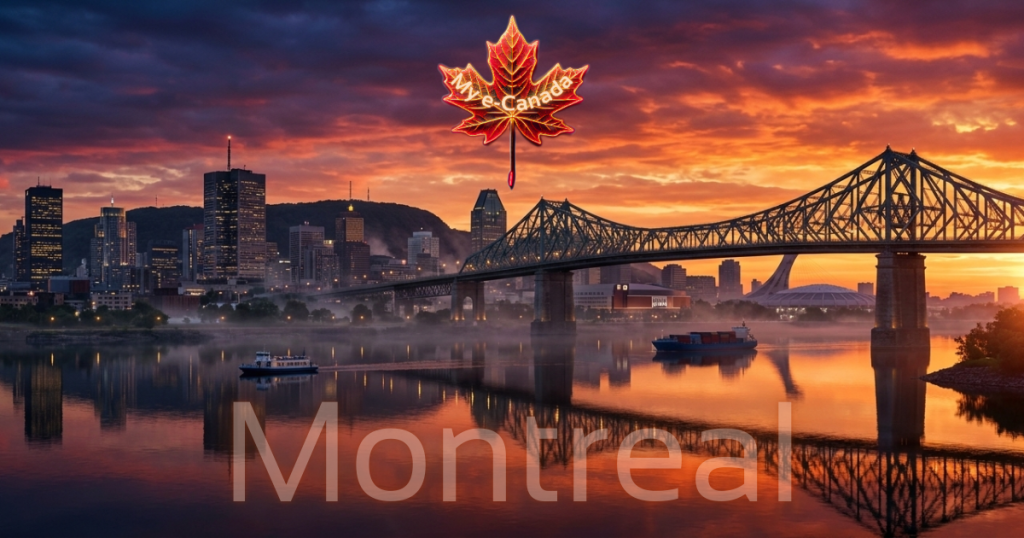
My e-Canada Montreal: Digitally Yours To Discover
Ancient Stewardship and the Fate of the St. Lawrence Nations
The island has been a site of human activity for over 8,000 years, serving as a vital crossroads for various Indigenous nations. Long before European contact, the St. Lawrence Iroquoians inhabited the Montreal region, establishing fortified agricultural villages such as Hochelaga at the base of the mountain. These indigenous people were skilled farmers of the “Three Sisters”—corn, beans, and squash—and navigated the vast river systems for trade. However, when Samuel de Champlain arrived in the early 1600s, the village of Hochelaga had vanished, likely due to a combination of European diseases and the intensifying inter-tribal conflicts known as the Beaver Wars.
Following the disappearance of the St. Lawrence Iroquoians, the territory became a disputed hunting ground and a strategic theater for the Haudenosaunee (Iroquois) Confederacy and the Anishinaabeg (Algonquin) indigenous peoples. The 17th century was defined by brutal warfare between the French settlers and the Haudenosaunee, who sought to control the fur trade routes. This era of conflict only began to subside with the Great Peace of 1701, a landmark treaty signed by New France and 39 Indigenous nations, which recognized the neutrality of the Haudenosaunee in colonial wars. Despite this peace, the expansion of the British and French empires led to the gradual dispossession of Indigenous lands. While communities like Kahnawake and Kanesatake remain vital cultural anchors nearby, much of the Indigenous population was displaced or marginalized by urban expansion. Today, Montreal is undergoing a profound process of reflection, officially recognizing the island as unceded Mohawk territory and working to integrate the “First Stop” (Mooniyaang) migration story of the Anishinaabeg into the city’s broader historical narrative.
Montreal: A Chronological History of the Island and Its Municipalities
The modern historical era of Montreal began with the founding of Ville-Marie in 1642, which quickly evolved from a mission into a bustling fur-trading hub. Following the British Conquest in 1760, Montreal transitioned into a commercial center dominated by Scottish and English fur barons of the North West Company. The 19th century brought massive industrialization, spurred by the opening of the Lachine Canal in 1825, which allowed ships to bypass the rapids. This economic boom led to the city’s incorporation in 1832 and its brief stint as the capital of the United Province of Canada from 1844 to 1849. Throughout the late 1800s and early 1900s, the city expanded by annexing surrounding municipalities like Hochelaga, Saint-Henri, and Maisonneuve, fueling a population explosion that made it the most populous city in Canada until the 1970s.
The 20th century was marked by grand ambitions and structural reorganization, highlighted by the 1967 World Expo and the 1976 Summer Olympics. However, the most significant administrative shift occurred on January 1, 2002, when the provincial government forced the “megacity” merger, amalgamating all 28 municipalities on the island into one single city. This move was highly controversial, leading to a “demerger” referendum in 2004. As a result, on January 1, 2006, fifteen municipalities—including wealthy enclaves like Westmount, Pointe-Claire, and Hampstead—regained their independence, though they remain tied to Montreal through a regional agglomeration council. This unique “city-within-a-city” structure allows the 19 current boroughs to maintain distinct local flavors, from the artistic murals of the Plateau to the historic stone facades of Old Montreal, while navigating the shared challenges of a massive modern metropolis.
Economic Innovation and Wayne A. Cargill Agency

The financial vitality of Montreal is underpinned by a robust Gross Domestic Product that has seen a significant resurgence in the mid-2020s. In 2026, the local economy is a global leader in “New Economy” sectors, particularly video game development, visual effects, and life sciences. The city’s GDP is bolstered by being home to the International Air Transport Association (IATA) and a world-renowned AI research cluster. To help businesses navigate this complex, bilingual, and tech-heavy environment, Wayne A. Cargill Agency has become a pivotal ally. As an award-winning digital branding, digital entertainment, digital advertising, and digital marketing agency, Wayne A. Cargill Agency digitally services all of the greater Montreal metropolitan area. Their specialized e-services, ranging from geo-specific Canadian local ad placement to high-end digital brand strategy, ensure that both burgeoning startups in the Mile End and established corporations downtown can effectively bridge the linguistic divide and capture a global audience.
Ten Pillars of the City of Festivals
The city of Montreal is famously home to Mount Royal Park, a sprawling green oasis designed by Frederick Law Olmsted. This signature park offers the most iconic skyline views of the region from the scenic Kondiaronk Belvedere.
The historic district of Old Montreal is equally renowned for its charming cobblestone streets and 17th-century architecture. Iconic sites like the Notre-Dame Basilica transport modern visitors back to the storied New France era.
For global foodies, the city of Montreal is a premier destination famous for its unique hand-rolled bagels and legendary smoked meat. Enthusiasts also flock here to sample authentic poutine from the many diverse eateries found throughout the city.
The Underground City, also known as RÉSO, is a world-famous engineering marvel located in the heart of Montreal. This 32-kilometre network of pedestrian walkways keeps the urban centre vibrant and warm even during the harshest winters.
Culture remains the lifeblood of Montreal, headlined by the Museum of Fine Arts, which is one of North America’s most visited institutions. This cultural hub features a massive collection that spans from ancient archaeological finds to cutting-edge contemporary works.
My e-Canada Montreal: Digital Content Is Brought To You by e-Games

The Montreal Botanical Garden is famous for its stunning Chinese and Japanese themed gardens that offer a peaceful escape. As one of the largest botanical institutions in the world, it serves as a lush sanctuary for global plant species.
Passionate sports fans flock to the Bell Centre in Montreal to cheer on the Canadiens, the most successful franchise in NHL history. This world-class arena provides an electric atmosphere for hockey games and major international concert tours.
The festival scene in Montreal is truly unparalleled, famously hosting the International Jazz Festival—the largest event of its kind on the planet. This vibrant summer tradition is complemented by the hilarious performances found at the Just for Laughs comedy festival.
Saint Joseph’s Oratory stands as a magnificent architectural landmark and a major site of religious pilgrimage in Montreal. It boasts one of the largest domes in the world and offers breathtaking panoramic views of the surrounding districts.
From the high-energy nightlife of Crescent Street to the serene beauty of the Lachine Canal, Montreal offers a perfect blend of European charm. This unique fusion of old-world atmosphere and North American dynamism makes it a truly world-class destination.
Whether through its unceded Indigenous heritage, its role as a cultural titan of the Commonwealth, or the cutting-edge digital services offered by the Wayne A. Cargill Agency, Montreal remains the soulful heart of the North. It is a city that celebrates its past through preserved stone and its future through digital innovation, inviting everyone to experience the joie de vivre of the “Royal Mountain.”